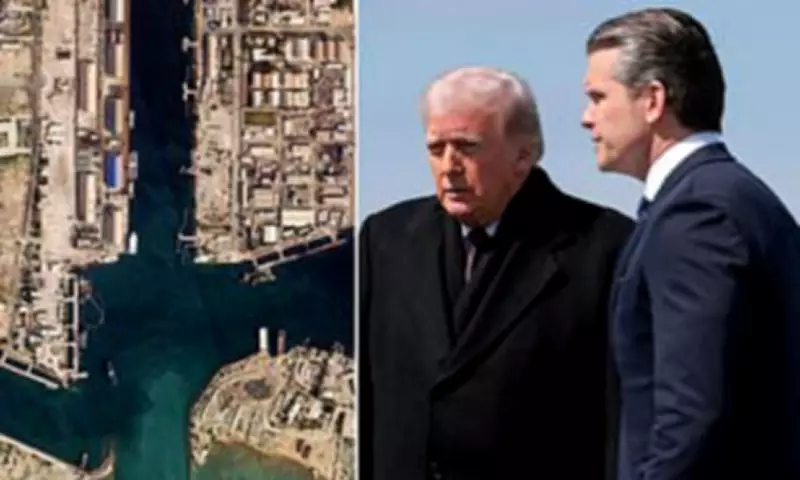
Pentagon Requests Massive $200 Billion War Funding as Trump Considers Major Troop Deployment
The Pentagon has formally requested a staggering $200 billion in supplemental funding for the ongoing war in Iran, according to multiple sources. This development coincides with President Donald Trump actively considering the deployment of thousands of additional US troops to the Middle East region, signaling a potential escalation into a new phase of the conflict.
Staggering Costs and Congressional Hurdles
The colossal funding request follows a study revealing the immense financial burden of the war's initial stages. During the first 100 hours of Operation Epic Fury, the United States spent approximately $3.7 billion, equating to a daily expenditure of $891.4 million. This figure ballooned to $11 billion by the end of the first week alone.
Sources indicate the Pentagon has asked the White House to seek this funding from Congress. However, its approval is far from certain. The Trump administration anticipates significant resistance on Capitol Hill. Democrats remain largely opposed to the war efforts, and key figures like Kentucky libertarian Senator Rand Paul typically vote against military funding. This political landscape suggests the necessary 60 votes to avoid a Senate filibuster may not be attainable. A Pentagon spokesperson declined to comment on the matter when contacted.

Strategic Objectives and Risky Ground Operations
The primary strategic objective under consideration is securing safe passage for oil tankers through the critical Strait of Hormuz, a mission that would rely heavily on US air and naval forces. However, securing the strait could also necessitate deploying American troops directly to Iran's shoreline, a move described by sources as highly risky.
Further discussions within the administration have involved options to send ground forces to Iran's Kharg Island, which handles 90 percent of the nation's oil exports. Military experts warn such an operation would be perilous, as Iran possesses the missile and drone capability to target the island. While the US carried out strikes on Kharg Island in March, controlling it is viewed by some analysts as a preferable, though dangerous, alternative to destroying this vital economic hub.
Another complex objective under discussion is deploying US forces to secure Iran's stocks of highly enriched uranium. Experts caution this task would be extraordinarily difficult and hazardous, even for elite special operations units.
Political Risks and Presidential Posture
Any deployment of US ground troops into Iran carries profound political risks for President Trump. American public support for the Iran campaign is low, and it conflicts with Trump's longstanding campaign promises to avoid new military entanglements in the Middle East.
A White House official, speaking anonymously, stated, 'There has been no decision to send ground troops at this time, but President Trump wisely keeps all options at his disposal.' The official reiterated the president's focus on the defined objectives of Operation Epic Fury: destroying Iran's ballistic missile capacity, annihilating its navy, neutralizing its terrorist proxies, and ensuring Iran can never obtain a nuclear weapon.
Current Conflict Status and Military Calculus
The US military continues its offensive, targeting Iran's navy, missile stockpiles, drone capabilities, and defense industry. Since the war began on February 28, the US has conducted over 7,800 strikes, damaging or destroying more than 120 Iranian vessels, according to US Central Command.
The human cost includes 13 US troops killed and approximately 200 wounded, though most injuries are reported as minor. The discussions on reinforcements extend beyond the scheduled arrival of a Marine Expeditionary Unit next week. However, the US military is also contending with the loss of significant force projection, as the USS Gerald R. Ford aircraft carrier is diverted to Greece for maintenance following an onboard fire.

President Trump's position on securing the Strait of Hormuz has appeared inconsistent. After initially suggesting the US Navy could escort vessels, he later called for allied nations to assist. With little international interest, Trump recently mused on social media about potentially concluding operations and leaving the responsibility for the strait to other countries that depend on it.
In related intelligence testimony, it was revealed that US strikes in June had obliterated Iran's nuclear enrichment program, with the entrances to its underground facilities sealed with cement. A senior White House official confirmed that Trump has various options for dealing with Iran's nuclear material but has not yet decided on a definitive course of action.