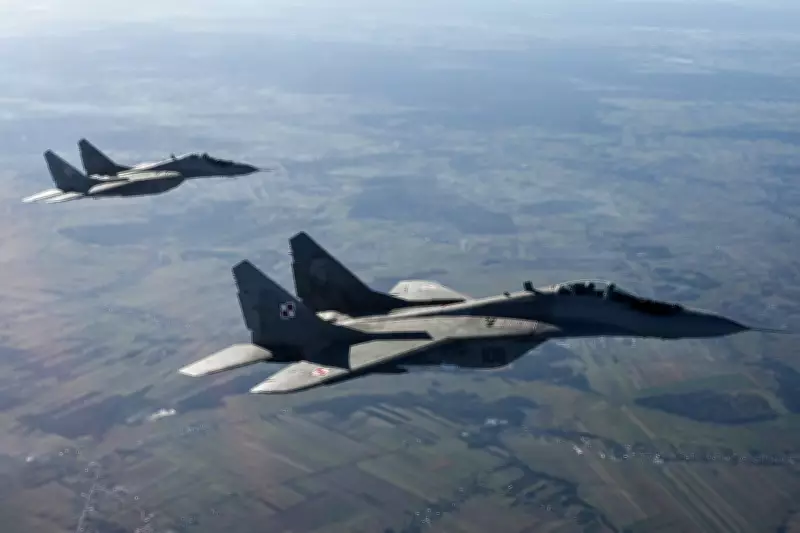
Poland has scrambled fighter jets and placed its air defence systems on high alert following a substantial Russian missile and drone assault on Ukraine overnight. The NATO member nation's Armed Forces Operational Command confirmed the deployment of a pair of fighter jets alongside an early warning aircraft after detecting long-range Russian missiles striking Ukrainian territory in close proximity to Polish borders.
Maximum State of Readiness Activated
Ground-based air defence systems and radar reconnaissance units were elevated to a maximum state of readiness as a precautionary measure. In an official statement released on social media platform X, the Polish army emphasised that these actions were preventive in nature, specifically designed to secure and protect Polish airspace, particularly in regions adjacent to the threatened areas of Ukraine.
The statement further clarified that the Operational Command of the Armed Forces is continuously monitoring the evolving situation, with all subordinate forces and resources maintained in a state of immediate readiness for any potential response required.

Ukrainian Casualties and Attack Details
Ukrainian President Volodymyr Zelensky reported that the overnight Russian offensive resulted in the deaths of four individuals across eleven different regions of Ukraine, with dozens more sustaining injuries. President Zelensky detailed the assault in a post on X, noting that nearly forty drones were launched against Shostka in the Sumy region.
In Slatyne, located in the Kharkiv region, a drone strike targeted an electric train. Overall, President Zelensky stated that the attack comprised more than three hundred and ninety strike drones and thirty-four missiles of various types, including ballistic, cruise, and guided air-launched missiles.
He underscored the urgent need for enhanced protection to save lives from such Russian strikes and stressed the critical importance of continuing international support for Ukraine.
Historical Context of Airspace Incursions
This incident is not an isolated event for Poland, which has previously been compelled to prepare for potential attacks. There have been multiple incursions into Polish airspace in recent times, prompting the nation's leadership to advocate for a no-fly zone over its territory as recently as September of the previous year.
In December, Polish fighter jets intercepted a Russian reconnaissance aircraft operating near Polish airspace over the Baltic Sea, according to military reports. Nations situated on NATO's eastern flank have remained on heightened alert due to a series of airspace violations in recent months.
Regional Security Concerns
These disruptions have included incidents affecting airports in Lithuania during December and a violation of Estonian airspace by three Russian military jets for approximately twelve minutes in September. Other NATO members, including Romania and Denmark, have also experienced similar security challenges.
Several states have accused Russian President Vladimir Putin of engaging in hybrid warfare tactics, which involve causing significant disruptions to civilian travel and military systems without launching a direct, conventional attack. The Kremlin has consistently denied these allegations.
While NATO has not yet enacted a collective military response to these intrusions, defensive measures have been significantly bolstered along the alliance's eastern flank, where the majority of these disruptive incidents have been concentrated. The ongoing situation highlights the persistent volatility and security risks in the region stemming from the conflict in Ukraine.