Vladimir Putin is assembling a terrifying set of superweapons that may bring nations to their knees at the simple push of a button. Deep inside Russia's military machine, the tyrant is quietly building an arsenal designed not to win a war in Europe, but to decimate entire nations. His scientists are racing ahead with a terrifying array of nuclear systems that sound closer to doomsday fiction than modern military reality.
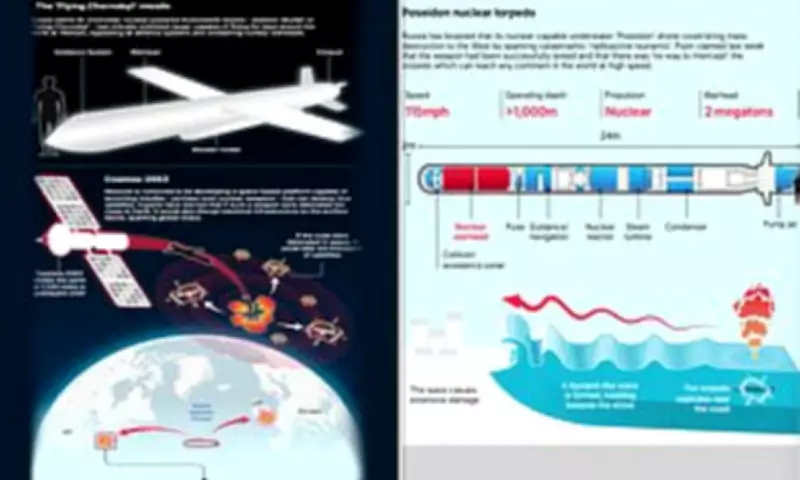
They are building a suite of super weapons intended to frighten the world into submission, but these are not just bombs and missiles. Putin's arsenal includes nuclear-powered underwater drones, reactor-driven cruise missiles, hypersonic attack vehicles, and even suspected space-based capabilities that American officials warn could blind satellites and plunge societies into darkness. If Kremlin commanders are to be believed about their 'Poseidon' doomsday torpedo, a detonation would hurl a gigantic wall of irradiated seawater across coastal cities and naval bases in the West.
For decades, Washington and Moscow relied on mutual deterrence and arms control treaties to prevent escalation. Many treaties have been abandoned or are dead, and military communication channels are strained. Russia is at war in Europe and has repeatedly rattled the nuclear sabre. Each time the Kremlin announces progress on its so-called invincible weapons, Western officials exchange looks that say plainly: the world is closer to nuclear peril than at any point since 1962.

The Poseidon Underwater Drone
Perhaps the most alarming weapon is Poseidon, a nuclear-powered, nuclear-capable underwater drone the size of a small submarine. Russian state media claims it can travel thousands of miles underwater, guided by artificial intelligence, before detonating near enemy coastlines. In theory, such a blast could drive a massive radioactive surge inland, sending huge tsunami waves that could devastate cities. Putin confirmed a Poseidon test late last month, saying Russia launched it from a submarine and activated its reactor.
Former Russian president Dmitry Medvedev declared Poseidon a true 'doomsday weapon,' and Russian media suggested it could 'drown Britain.' Western analysts say such scenarios are exaggerated but agree the concept is designed to terrify. The weapon is said to be 20-24 metres long and about 2 metres in diameter. In November, Putin unveiled the Khabarovsk submarine, built to carry Poseidon, costing an estimated £1 billion.
The Burevestnik Nuclear-Powered Cruise Missile
Above the waves, Russia has developed the Burevestnik, known as the 'Flying Chernobyl,' a weapon of 'unlimited range' powered by a miniature nuclear reactor. In October, Putin said Russia achieved key objectives in a test, with the missile flying for several hours covering nearly 87,000 miles. Western governments have not verified these claims. In 2019, a suspected Burevestnik-related accident killed multiple Russian nuclear specialists and caused a detectable radiation spike. Critics call the concept reckless, risking radioactive wreckage.
Space-Based Capabilities
In February 2022, Russia launched Cosmos-2553 into a high orbit, which US officials linked to experiments for a future nuclear anti-satellite device. Russia vetoed a UN resolution reaffirming the ban on nuclear weapons in orbit. Kremlin-aligned analysts describe an orbital capability that could detonate over enemy lines, fry satellites, shut down GPS, and plunge regions into darkness.
The Sarmat and Avangard Missiles
The RS-28 Sarmat, known to NATO as Satan II, is a super-heavy intercontinental ballistic missile weighing over 200 tonnes, capable of carrying multiple warheads and decoys. Putin claims it has a range over 35,000 km and can penetrate all missile defence systems. The Avangard hypersonic glide vehicle can plunge through the atmosphere at speeds above 15,350 mph, changing course mid-descent to avoid interception. It is estimated to have a mass of 1,500-2,000 kg.
Kinzhal and Zircon Missiles
The Kinzhal missile is air-launched from MiG-31K interceptors, advertised as a hypersonic dagger with a range of 932-1,243 miles. Ukraine claims to have shot down several using Patriot batteries. The Zircon is a sea-skimming hypersonic cruise missile with speeds up to 7,000 mph, launched from warships or submarines. Each missile likely costs several million pounds.

Peresvet Laser and S-500 Defence
Peresvet is a laser system that can blind satellites and protect mobile missile convoys. The S-500 Prometheus air and missile defence network is marketed as capable of shooting down stealth aircraft and ballistic missiles. Independent experts argue it remains unproven.
On November 6, 2025, Putin told his Security Council that if the US resumed nuclear testing, Russia would take reciprocal measures. The Kremlin announced a successful Poseidon test on October 29. Analysts say Russia could resume underground detonations within months. The meaning for the West is stark: a nation at war in Europe is boasting of weapons that can cross oceans, fly for days, strike from orbit, and blind satellites, preparing to restart nuclear explosions. The Kremlin's messaging has shifted from deterrence to escalation.