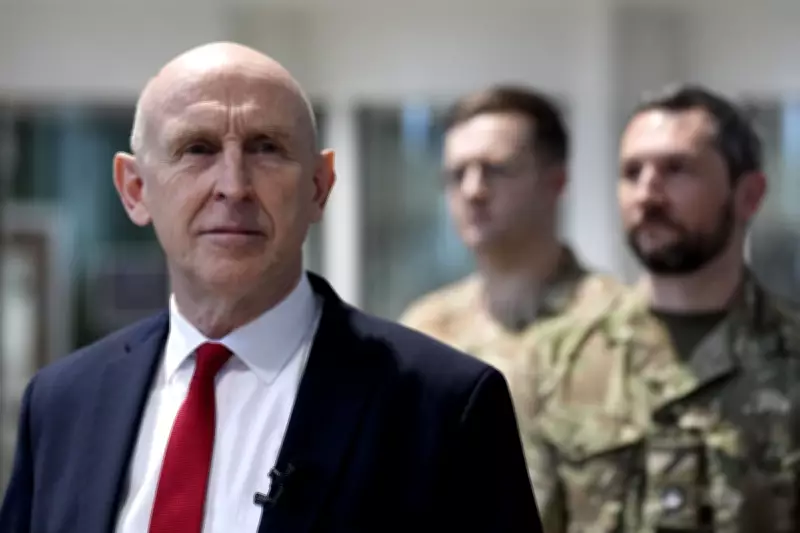
Defence Secretary John Healey has raised serious concerns about potential Russian influence behind Iran's military tactics in the ongoing Middle East conflict, suggesting Vladimir Putin's "hidden hands" may be guiding some operations.
Military Briefing Reveals Strategic Links
During a visit to the Permanent Joint Headquarters at Northwood in Hertfordshire on Thursday, Mr Healey received detailed operational updates about British military activities across the volatile region. The defence secretary was briefed by senior military commanders including Lieutenant General Nick Perry, the UK's chief of joint operations.
General Perry presented what he described as "definitively" observable connections between Russia and Iran, specifically highlighting Iran's deployment of drone technology that appears to have been "learned from the Russians." This technological transfer suggests deeper cooperation than previously acknowledged between Moscow and Tehran.

Evidence Gathering and Analysis
When questioned by journalists about specific evidence of these links, Mr Healey pointed to ongoing forensic examination of a drone that struck a hangar at the Akrotiri base. "We're taking part in analysing the drone that struck the hangar at Akrotiri for any evidence of Russian or any other foreign components and parts," he explained.
The defence secretary promised transparency regarding findings, stating: "We will update you and appropriately publish any findings from that when we've got them." He emphasized that many observers would not be surprised by Russian involvement, noting: "I think no one will be surprised to believe that Putin's hidden hand is behind some of the Iranian tactics, potentially some of their capabilities as well."
Strategic Motivations and Regional Impact
Mr Healey highlighted the economic dimension of this cooperation, observing that "one world leader that is benefiting from the sky high oil prices at the moment is Putin." He added pointedly: "It helps him with a fresh supply of funds for his brutal war in Ukraine."
The defence secretary's comments came amid escalating regional tensions following US-Israeli strikes, with Iran reportedly warning vessels against passing through the strategically vital Strait of Hormuz. This development has already caused heating oil prices to double within the past week, creating global economic repercussions.
Military Operations and Regional Defence
Brigadier Guy Foden provided additional context about British military activities, revealing that UK forces had conducted air combat patrols over Jordan and the United Arab Emirates, along with "a number of sorties" over Qatar. Royal Air Force jets continue to participate in defensive operations around Cyprus alongside European allies.
In Iraq, bases at Erbil and Baghdad faced multiple attacks on Wednesday night, with British personnel actively assisting in the defence of the Erbil facility. "Last night they shot down two UAVs (unmanned aerial vehicles) coming out of the camp but a number of UAVs did impact on the camp," Brigadier Foden reported.
Lieutenant General Perry confirmed there had been "no British casualties" from these incidents, though American forces sustained "some" casualties that were described as "nothing too serious."
Navigating the Strait of Hormuz Challenge
Addressing the critical situation developing around the Strait of Hormuz, Mr Healey acknowledged the complexity of potential responses. "The reports of Iran mining the Straits is becoming established," he stated. "The evidence and number of commercial ships being attacked is becoming established."
The defence secretary highlighted two significant considerations: "First, that recognising the huge impact that this potentially has on oil prices and on people's cost of living around the world. There is an international imperative and incentive to try and see this resolved."
He continued: "Big steps like the record release of reserve oil helps, but doesn't solve the problem. And the second is a realism that in circumstances of conflict, demining any waters is extremely difficult."

Mr Healey revealed that he had already deployed "some demining autonomous systems in the region since before the conflict" and was discussing additional options with military planners. However, he emphasized that lasting resolution would likely require diplomatic rather than purely military solutions: "In the end, this is likely to be most quickly sorted and the Straits are most likely to be quickly opened by a de-escalation of the conflict, by a greater stabilisation and confidence in the region and by all those nations that want to see the straits reopened being willing to work together."
Operational Statistics and Personnel Recognition
The defence secretary provided operational metrics, noting that UK forces had accumulated "more than 300 pilot flying hours over the last 13 days" and confirming that HMS Dragon remained en route to the Mediterranean as of Thursday noon.
During his Northwood visit, Mr Healey personally addressed service personnel, expressing gratitude for their dedication and professionalism in challenging circumstances. His remarks underscored the UK's continued military engagement in the region while highlighting growing concerns about external influences exacerbating an already volatile situation.