Queen Máxima Commences Dutch Army Reserve Training
Queen Máxima of the Netherlands has officially started training to become a reserve member of the Dutch army, a significant development announced by the Ministry of Defense. The 54-year-old Argentinean-born queen, wife of King Willem-Alexander, began her military instruction this week as part of broader efforts to enhance enlistment across the Netherlands.
Royal Commitment to National Security
The Ministry of Defense released a statement explaining Queen Máxima's decision, noting that "because the security of the Netherlands can no longer be taken for granted, Máxima has decided to become a reservist." The Royal House echoed this sentiment, stating that the queen, "like many others, wants to make a contribution to that security." This move follows her daughter Crown Princess Amalia, the heir to the Dutch throne, who completed basic military training last month as a volunteer reservist.
Defense Ministry spokesperson Klaas Meijer emphasized that enlisting was entirely Queen Máxima's choice, adding, "we are of course very proud that she is doing this and hope that other people will think, 'hey, this is something I could do.'" The incoming Dutch coalition government, expected to be sworn in later this month, has plans to expand the nation's military to 122,000 staff, up from the current 80,000 including military personnel, civilians, and reservists.

Training Details and Future Deployment
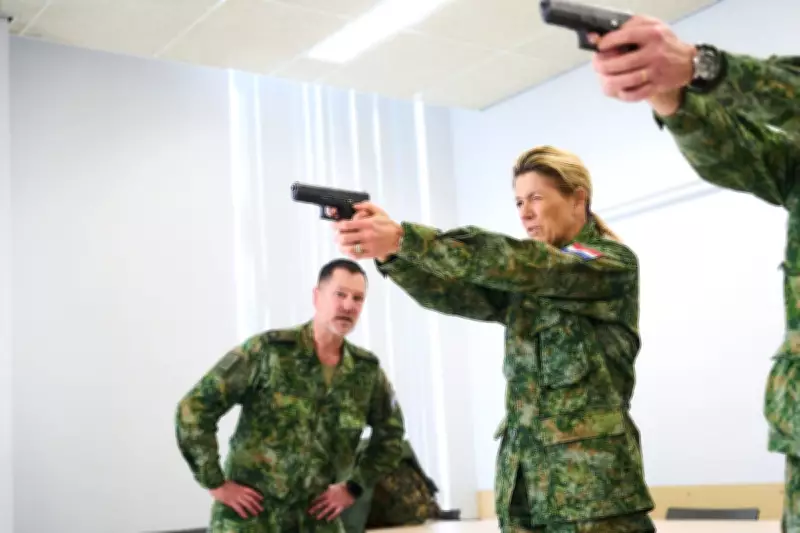
Queen Máxima's training is taking place at a military academy in the city of Breda, with the House of Orange releasing photographs showing her engaging in various exercises. Images depict her gripping a pistol with both hands, hanging from a rope on a rock climbing wall, and jumping into a swimming pool while wearing green overalls and blacked-out ski goggles.
The defense ministry outlined that her training will encompass "all the practical and theoretical military components necessary to become a reservist. These include physical resilience, self-defense, marksmanship, map reading, and military law." Upon completion, Queen Máxima will be awarded the rank of lieutenant-colonel and will "deploy wherever needed," according to the Royal House. Ministry spokesperson Meijer noted that reservists are typically deployed for tasks within the Netherlands but have occasionally been sent overseas on a voluntary basis.
European Context of Military Recruitment
The Netherlands is not alone in its efforts to strengthen military forces amid geopolitical tensions, particularly Russia's war in Ukraine and concerns about NATO alliance stability. The incoming Dutch government plans to introduce a "freedom contribution" for citizens and businesses to help fund increased military expenditures.
Across Europe, similar initiatives are underway. Germany has approved government plans to attract more military recruits as it seeks to bolster its armed forces against perceived Russian threats. France launched a new program in November aimed at training thousands of volunteers aged 18 and 19, with ambitions to reach up to 50,000 volunteers annually by 2035.
At a recent Paris naval conference, Dutch navy chief Vice Admiral Harold Liebregs highlighted successes in recruitment and retention, attributing improvements partly to growing security concerns. "Something happened in Europe. We have been struggling with shortages of personnel for a couple of years but now for the first time in years we see that the retention rate is pretty OK," Liebregs stated. "Recruitment and influx is also picking up … People are really willing to join the navy."
Other European nations are also taking action. Denmark extended compulsory enlistment to women for the first time last year, while Belgium has reactivated two military brigades as part of a broader defense enhancement drive. These recruitment efforts are expected to strain existing defense budgets but align with NATO spending commitments made at last year's summit.
Retired Gen. Jean-Paul Paloméros, former head of the French Air Force, commented on the challenges, noting, "It's good, it's a difficult path," especially regarding financing and resources. He added, "I think it was needed somewhere to make sure that the young generations understand that freedom and peace are not taken for granted and it doesn't come as a free lunch."

Queen Máxima's training underscores a royal tradition in Europe, with other royals like Princess Elisabeth of Belgium and King Philippe also having military backgrounds. Her involvement is poised to inspire further public engagement in military service across the continent.