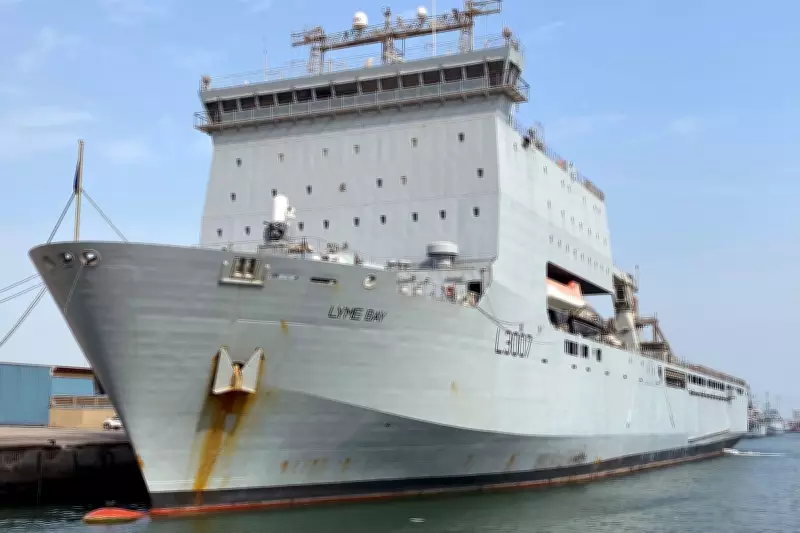
Royal Navy Prepares Advanced Minehunting Drone Ship for Potential Hormuz Deployment
The Royal Navy is advancing plans to transform one of its landing ships into a sophisticated minehunting "mothership" equipped with cutting-edge autonomous drones. This strategic upgrade is specifically designed to provide options for reopening the vital Strait of Hormuz, should such a military operation become necessary.
Strategic Upgrade for Critical Shipping Lane
RFA Lyme Bay, a Royal Fleet Auxiliary landing and transport vessel, is scheduled for a comprehensive refit that will integrate advanced technological equipment. The conversion will enable the ship to deploy both underwater drones and crewless minehunting boats, creating a hybrid platform capable of clearing mines from contested waters.
This development comes as the United Kingdom collaborates with international allies to formulate military strategies for re-establishing access through the Strait of Hormuz. The strait serves as a crucial global artery for oil and gas shipments, currently facing effective blockade by Tehran.

Political Context and Deployment Considerations
Former US President Donald Trump had previously urged Western allies to dispatch warships to the region to assist in reopening the strategic waterway. However, Western nations have thus far declined to commit naval assets to such an operation.
Any potential deployment of RFA Lyme Bay to the Strait of Hormuz is not expected until the volatile regional situation stabilises. Military planners currently assess the threat posed by Iranian drones and missiles as too significant for immediate operations.
A defence source explained: "Whilst no decisions have yet been taken on whether these capabilities will be sent to the Strait of Hormuz, this preventative step gives ministers options should they be needed to help resume the normal flow of merchant shipping."
Ship's Background and Recent Activities
RFA Lyme Bay has traditionally served as a landing and transport vessel, previously delivering humanitarian aid to both the Caribbean and Middle Eastern regions. The ship had been undergoing routine maintenance in Gibraltar before being brought to a heightened state of readiness following the outbreak of conflict with Iran.
In recent days, the vessel has been conducting training drills in the Mediterranean, preparing for potential deployment scenarios. The decision to equip the ship with anti-mine capabilities followed a comprehensive reassessment of regional risks, including potential civilian evacuations from Lebanon should Israeli ground operations expand.
Broader Naval Context and Strategic Vision
This development follows the deployment of the destroyer HMS Dragon to the eastern Mediterranean, where it assists in defending Cyprus from potential missile and drone attacks. Until early 2026, the Royal Navy maintained a permanent minehunting presence in the Middle East based in Bahrain, but the last of those vessels, HMS Middleton, was withdrawn for maintenance shortly before the outbreak of hostilities.
General Sir Gwyn Jenkins, the First Sea Lord, emphasised the strategic importance of this conversion, stating it represents "a perfect example of how we are building a hybrid navy – one where crewed ships and cutting-edge uncrewed systems work together seamlessly to keep our people safe and our seas secure."
Captain Mark Colley, the ship's commanding officer, expressed confidence in his crew's preparedness: "I am proud of the work my ship's company has done to prepare RFA Lyme Bay, and be ready to embark this kit. Having recently returned to high readiness, we have been put through our paces but I know we are ready to support this autonomous uncrewed kit so as to play an important role in its use."
The Royal Navy's investment in autonomous minehunting technology represents a significant evolution in naval warfare capabilities, particularly for operations in high-risk environments where traditional crewed vessels face substantial threats from advanced weaponry.