

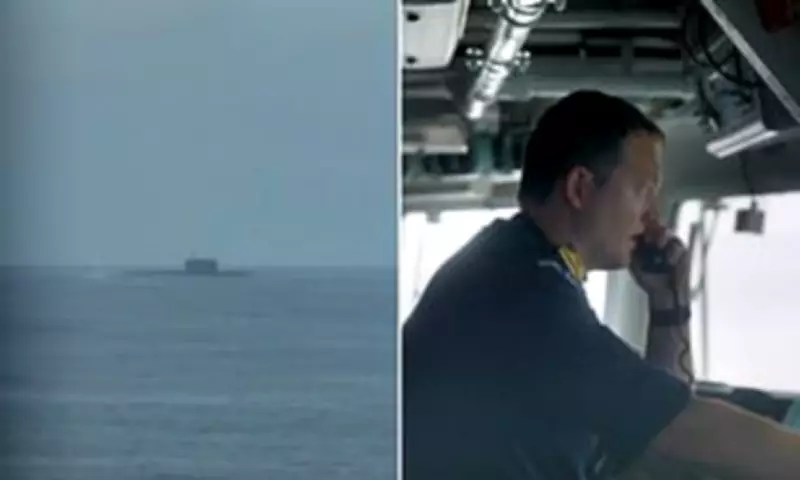
In a dramatic display of maritime vigilance, the crew of a British warship scrambled to intercept a Russian submarine at risk of exploding, before tracking it through the English Channel. Exclusive footage from Channel 5's new season of 'Warship: Life in the Royal Navy' captures the tense moments aboard HMS Iron Duke as it spotted the diesel-powered Novorossiysk heading towards British waters last October.
High-Stakes Interception
The 230-foot-long Novorossiysk, manned by a crew of 50, was being towed in the North Sea after reportedly suffering a fuel leak in the Strait of Gibraltar, raising serious concerns about a potential explosion. Dramatic scenes filmed inside the control centre of the Plymouth-based frigate show the crew identifying the submarine, swiftly informing the captain, and then heading to the bridge to scour the horizon for its presence.
One crew member spotted the submarine with binoculars, triggering a mission to stalk the vessel and gather intelligence on its capabilities. While the Novorossiysk, which entered service in 2014, did not have a nuclear reactor on board, it was part of a group of submarines equipped with Kalibr cruise missiles, adding to the strategic significance of the operation.

Tracking Amidst Storm Amy
As the submarine returned from its deployment in the Mediterranean, the Royal Navy tracked it over three days, from 7 to 9 October, using HMS Iron Duke alongside a Wildcat helicopter from 825 Naval Air Squadron. However, as the ship headed towards its target, Storm Amy began to batter the UK coast, threatening to interfere with the mission and heightening the operational challenges.
The Dutch navy eventually took over duties to escort the submarine and an accompanying towing vessel, the Yakov Grebelsky, in the North Sea until they returned home to St Petersburg. At the time, NATO chief Mark Rutte mocked Moscow over the 'limping' condition of the submarines, while the Kremlin denied it had been forced to surface due to technical problems.
Geopolitical Tensions and Denials
Russia's Black Sea Fleet insisted that the Novorossiysk had surfaced off France to comply with navigation rules in the English Channel, rejecting reports of a serious malfunction. They described it as a 'scheduled inter-fleet transit' after completing tasks in the Mediterranean. Rutte's comments highlighted the shift in Russian naval presence, noting, 'Now, in effect, there is hardly any Russian naval presence in the Mediterranean left. There's a lone and broken Russian submarine limping home from patrol.'
Adding to the intrigue, VChK-OGPU, a shadowy Telegram channel that publishes purported Russian security leaks, reported on September 27 that fuel was leaking into the hold of the Novorossiysk, raising the risk of an explosion. NATO's Maritime Command later published photographs on October 9 of a French navy frigate observing a Russian submarine operating on the surface off the coast of Brittany, underscoring the alliance's vigilance.
Broader Context and Series Details
This incident was not an isolated event. The month before, the Royal Navy had to send HMS Iron Duke to shadow a Russian frigate and freighter off the UK coast, amid warnings from defence minister Luke Pollard about increasing Russian warship transits through the English Channel. Shadowing the Novorossiysk was reportedly the 26th or 27th time that Iron Duke had been activated to track Russian vessels in British waters.
The dramatic incident can be watched in full in the first episode of the new series of Channel 5's 'Warship: Life in the Royal Navy', airing on Wednesday at 8pm. Presented by former Royal Marine JJ Chalmers and Kate Humble, the series offers an inside look at life on board HMS Iron Duke alongside a 200-person crew. Elsewhere in the show, Chalmers gains exclusive access to the Royal Navy’s flagship, HMS Prince of Wales, revealing how its crew of 1,600 operates on the biggest and most powerful British warship ever built.
In a related development, Prime Minister Keir Starmer recently authorised the military to board and detain Russian ships in British waters to disrupt a network of vessels enabling Moscow to export oil despite Western sanctions. This move, part of broader European efforts, has been met with a hostile response from Russia, which warned of political, legal, and asymmetric measures in retaliation.

The Russian Novorossiysk can operate at a depth of nearly 1,000 feet and has a range of 7,500 nautical miles, showcasing the advanced capabilities involved in these maritime confrontations. As tensions persist, the Royal Navy continues to monitor Russian movements, ensuring the security of UK waters and undersea cables in alignment with NATO commitments.





