

Royal Navy's Delayed Warship Deployment Highlights UK's Military Challenges
The Royal Navy's Type 45 air defense destroyer HMS Dragon finally departed Portsmouth for Cyprus last night, a full week after receiving orders to prepare for sea. The delayed deployment means the warship may arrive in the eastern Mediterranean next week, potentially finding that the immediate crisis has passed while French naval forces have already established a dominant presence near the island nation.
French Naval Display Overshadows British Efforts
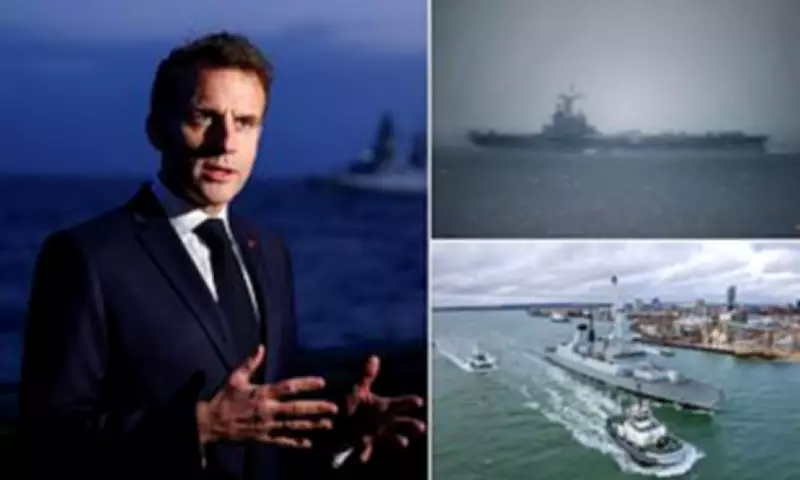
What HMS Dragon will certainly encounter is a formidable French-led carrier strike group positioned near Cyprus, ready to protect the island from potential Iranian missile attacks. The aircraft carrier Charles de Gaulle, accompanied by an allied armada of French, Italian, Spanish, and Greek vessels, has been stationed in the region for days, allowing French President Emmanuel Macron to demonstrate France's military capabilities while highlighting Britain's struggles.
During his visit to Cyprus earlier this week, Macron insisted the island could "count on France," directly commenting on Britain's difficulties defending the crucial RAF Akrotiri base from Iranian reprisals. The French president further announced plans to deploy additional warships to the Red Sea and Straits of Hormuz to support American efforts protecting oil tanker routes.

Public Confidence in Defense Plummets
A new YouGov poll reveals growing public concern about Britain's defense capabilities, with 56 percent of voters believing the government is handling defense matters poorly. This represents an 11-point increase in negative sentiment over just one week, reflecting mounting anxiety about military readiness.
Macron's administration has capitalized on the situation with a glossy social media video showcasing the French president alongside military personnel and impressive hardware including the Charles de Gaulle carrier. The carefully produced footage features patriotic elements including La Marseillaise and dramatic classical music, with Macron declaring: "Your presence demonstrates the power of France."
Naval Capacity Comparison Reveals Operational Challenges
On paper, the Royal Navy's 63 vessels appear significantly outnumbered by the French Marine Nationale's 133 ships, though the reality involves important distinctions. The French total includes over 50 support vessels and incorporates coastguard resources, while their major warship inventory comprises one aircraft carrier, two helicopter carriers, 17 destroyers and frigates, and nine submarines.
The Royal Navy maintains two aircraft carriers, two assault ships, 13 destroyers and frigates, and nine submarines, plus various smaller vessels. However, serious questions persist about how much of the British fleet can deploy with immediacy. Only three of the six Type 45 destroyers are currently operational, with HMS Daring non-operational since 2017 and cannibalized for spare parts.
Most aging Type 23 frigates remain unavailable, with replacement Type 26 and 31 frigates not expected until later this decade or beyond. Britain's five Astute-class attack submarines currently have only one deployed overseas, stationed in Australia rather than the Middle East.
Parliamentary Committee Raises Alarm
Parliament's Defence Committee has expressed significant concerns about the Royal Navy's capacity to respond effectively to the Iran crisis. Following a secret briefing from Ministry of Defence officials, committee members acknowledged satisfaction with decision-making processes but noted "the considerable gap between some of the political rhetoric circulating internationally, and the reality of the UK's support to the United States and regional partners."

The committee's statement continued: "The situation has also underlined longstanding and grave concerns – which we share – about whether the Royal Navy has sufficient capacity and resilience to respond effectively to a crisis at a time of worsening global security." They called upon the government to urgently release the Defence Investment Plan and increase defense spending to 3 percent of GDP during this Parliament.
Defence Leadership Praises Rapid Preparation
Defence Secretary John Healey praised what he called the "remarkable effort" to prepare HMS Dragon for deployment within just six days, work that normally requires six weeks. "I have only praise for our Royal Navy personnel and civilian teams who have worked flat out," Healey stated. "They are the very best of Britain in action."
HMS Dragon's commanding officer, Commander Iain Griffin, echoed this sentiment: "My ship's company have worked tirelessly to ensure we are ready for our mission to the eastern Mediterranean. I am proud of the professional manner in which they have responded. We are trained for this, we are ready for this, we have the equipment and people, we have the support of the British people and, most importantly, our families and friends."
The delayed deployment and contrasting naval displays highlight broader questions about Britain's military capabilities amid growing international tensions, with France's assertive positioning serving as a stark reminder of shifting European defense dynamics.





