East Anglian RAF Bases Face Escalating Drone Espionage Threat
Communities surrounding three critical Royal Air Force installations in East Anglia are experiencing heightened anxiety as reports confirm a dramatic surge in illegal drone activity over the past year. The incidents, concentrated at RAF Mildenhall and RAF Lakenheath in Suffolk, alongside RAF Feltwell in Norfolk, have more than doubled, prompting grave national security concerns and legislative action.
New Military Powers to Counter Aerial Intrusions
In direct response to this escalating threat, new legislation has been enacted, authorising military personnel to intercept and shoot down drones flying over or near these sensitive defence sites. Previously, only police forces held such interception authority. This significant shift in protocol underscores the severity of the perceived risk, particularly from state actors like Russia.
Local residents, many of whom have lived alongside these bases for decades, express a mixture of shock and support for the strengthened measures. Christine Brown, 71, a lifelong resident near RAF Mildenhall, voiced a common sentiment: "I'm very concerned to hear drones are flying over us. You don't know what they're spying on and taking photographs of. It's all a bit 'James Bond' and Cold War-like." Her husband, Malcolm, 75, welcomed the enhanced defensive powers, stating, "You can't be too careful."

Resident Testimonies Highlight Widespread Fear
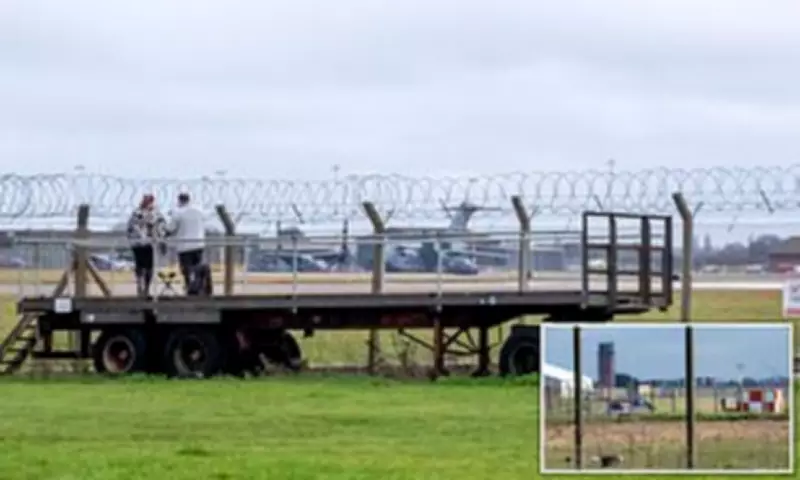
The fear of foreign espionage is palpable. Tanya Marrington, 58, whose home backs onto RAF Mildenhall, shared her apprehension: "The thought of Russians using drones to spy on us frightens me. I'm really glad they can be shot down now." This concern extends beyond permanent residents. Plane spotters visiting the area, like Lewis Shinton, 33, and Sophie Key, 24, witnessed firsthand the breach of airspace when a control tower announced an unauthorised drone at 3,000 feet—far exceeding the legal 400-foot limit. "That has freaked me out," said Sophie.
Lewis added a sobering perspective on the intelligence risk: "There is so much information you can get using a drone, and it concerns me that any sensitive data could potentially fall into Russian hands." This view is echoed by Rosalind Hamill, a retiree involved in the West Row community garden, who believes Russian spies have been monitoring UK airspace for years and supports the new vigilance.
Strategic Importance and Community Impact
The targeted bases hold distinct strategic roles. While Mildenhall serves as a crucial supply hub for aircraft fuel and parts, Lakenheath hosts fighter jets, making both high-value intelligence targets. The increased security has tangibly altered local life. A Feltwell-area business owner, who requested anonymity, noted tightened security has restricted previously accessible areas, lamenting, "It's a real shame it has to be this way." They also observed that recent drone activity appears sophisticated, unlike amateur operations.
Retired cleaner Anita Meadows, 70, whose home overlooks RAF Feltwell, directly implicated Russian leadership: "I believe Putin could be behind all this." She recalled former Russian colleagues from her time at Addenbrooke's Hospital fearing his capabilities, a memory that fuels her current worries.
Military and Expert Endorsement of Defensive Measures
The policy change has received endorsement from within the defence community. An American serviceman, recently stationed at one of the bases and speaking anonymously, emphasised the priority: "I am very worried for the protection of British airbases... the shooting down of unauthorised drones is essential." Local enthusiasts like amateur videographer Maxine McMillan, 56, who films aircraft at Lakenheath, also support the powers despite her passion for aviation, acknowledging the necessity for control.

This collective local and professional endorsement highlights a unified front against what is perceived as a clear and present danger. The combination of doubled illegal drone incursions, specific fears of Russian state-sponsored espionage, and the strategic value of the RAF installations has created a potent scenario, leading many to question if East Anglia has indeed become a new frontline in a modern, technology-driven cold war.