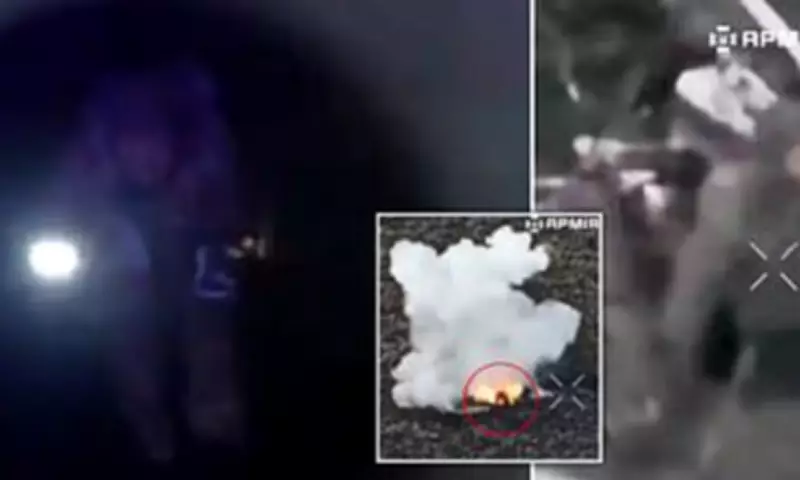
Russian soldiers attempting to infiltrate Ukrainian positions through abandoned underground pipelines are surviving for often just minutes, according to Ukrainian commanders on the front lines.
Deadly Emergence
At a command post in northeastern Kharkiv Oblast, Ukrainian sergeant 'Tovsty' of the Khartiia Brigade described the emerging tactic in stark terms. Drone feeds have repeatedly captured Russian troops surfacing from disused pipes to slip behind Ukrainian lines. A Russian soldier can hope to survive for a single hour after emerging, 'but it's usually 10 minutes, and that's it,' he told the Kyiv Independent.
The battlefield has shifted decisively underground in parts of the front. With drones saturating the skies, exposed movement has become near-suicidal, pushing Russian forces to exploit remnants of Soviet-era gas infrastructure as cover passageways. 'You can't really walk on the ground now in the war of drones, so everything is done underground,' Tovsty said. But what appears to be a hidden route is in reality a brutal funnel of attrition.

Grim 'Whack-a-Mole' Struggle
For months, Ukrainian units have been locked in a grim 'whack-a-mole' struggle: identifying exit points, eliminating troops as they emerge, sealing the holes, only for new openings to appear elsewhere. Despite heavy losses and appalling conditions inside the pipes, the Russian army continues to feed men into the system.
The objective is Kupiansk, a strategically important town in Kharkiv Oblast near the Russian border, once occupied in early 2022 before being retaken by Ukraine later that year. Moscow has been attempting to reclaim it ever since. At the centre of the fighting are four abandoned Soviet-era gas pipelines that cross beneath the Oskil River, connecting occupied territory with Ukrainian rear positions.
Conditions Inside the Pipes
The pipes are barely passable. Soldiers must crawl roughly 15km through narrow, 1.2-metre-wide tunnels before reaching Ukrainian lines. Some wait underground for extended periods while groups accumulate. 'People die in there,' said the brigade's deputy commander, callsign 'Abat.' 'They are just thrown out there, their weapons stuck to their backs with duct tape so they don't lose them.'
Reports of the tactic first surfaced last year, with Ukrainian monitoring groups describing improvised methods including wheeled benches and electric scooters. Russian media outlet Astra published a video in which a soldier said 'dozens of soldiers suffocated, committed suicide, or died in panic and delirium.' 'People were going crazy there. One shot himself. One pointed a machine gun at himself. The second one smashed his head in,' he said.
Occasional Successes
Despite the risks, the tactic has produced occasional results. In September 2025, Russian troops reportedly infiltrated the northern outskirts of Kupiansk via the pipeline network, briefly threatening the town before Ukrainian forces counterattacked. President Volodymyr Zelensky visited the area in December 2025, rejecting Russian claims of full control.
Since then, Ukrainian forces say they have significantly improved their ability to counter the tactic, sealing sections of pipeline and better mapping likely exit points. 'The threat from Russian infiltration through pipelines in the Kupiansk sector was, in fact, uncontrollable,' but Ukraine has since sealed off certain sections and better understands the routes, said 'Druid,' commander of an unmanned systems unit.
Limited but Disruptive
Analysts say the tactic is locally disruptive but limited in scale. 'The pipelines can be an effective strategy locally to cause confusion,' said Pasi Paroinen of Finland's Black Bird Group. However, Russia continues to rely heavily on manpower-driven assaults, attempting to grind down Ukrainian defences through repeated infiltration and river crossings.
Ukrainian commanders estimate that around 95 per cent of such attempts end in casualties. 'No matter how many troops they lose, they will keep hitting head-on to the end for Kupiansk,' Abat said, calling the fighting 'a bone in my throat.'

Challenges in Countering
One of Ukraine's biggest challenges is that the pipelines are extremely difficult to destroy. Even targeted strikes often fail to fully block them, as Russian troops dig around damaged sections. Artillery is limited by proximity to Ukrainian positions, leaving drones as the primary tool, though their firepower is insufficient to collapse the network permanently.
'There is a hole - it is closed, filled in with earth, and blown up. A hundred meters from it, another hole may appear, and after that, another one ten meters away,' said 'Druid.' 'So we don't have the possibility to close holes in the pipelines permanently.'
Russian troops emerging from the pipes are often disoriented. 'They just move randomly,' Tovsty said, adding that drone operators occasionally attempt to guide them from above. Personnel can spend weeks to months underground, with so-called 'Veteran' units believed to include men with mining experience used for infiltration.
Ukrainian Adaptation
After months of countering the tactic, Ukrainian troops say they now know precisely where to position themselves. 'After more than half a year of countering Russia's tactic, Tovsty says he and his men now know 100 per cent where to wait for the Russian soldiers to crawl out of the pipelines.'
Yet the attacks continue. Across the Oskil, Russian forces also maintain pressure through repeated crossings on foot and by improvised means, with a roughly equal split between river and pipeline infiltration. Military analyst Mick Ryan says the approach reflects a broader Russian strategy that has changed little since the start of the war. 'Ukraine has developed more effective solutions to Russia's key advantages, which are greater manpower and greater industrial production, and that is starting to hurt Russia.'
But others are more cautious. Austria-based analyst Tom Cooper argues Ukraine should have taken stronger measures earlier, including installing sensors inside pipeline routes. 'Ukrainian troops have to watch over all the possible pipelines despite the manpower shortage, also behind the front line, they need additional troops which they don't have to cover at depth as well. I mean, it's a nightmare from their point of view.'