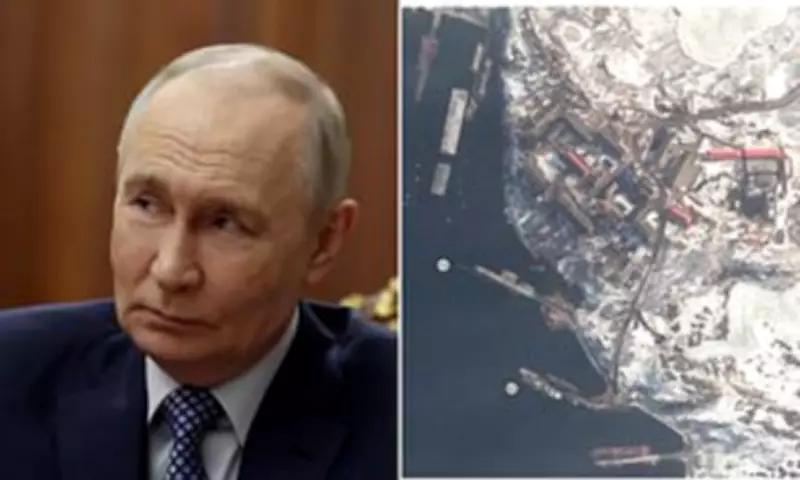
A covert Russian submarine mission into British territorial waters has starkly revealed the precarious state of the United Kingdom's Armed Forces, according to warnings issued by Labour last night. The operation, which involved sophisticated underwater surveillance, has intensified demands for immediate increases in defence expenditure and the publication of a long-delayed strategic investment plan.
Russian Submarine Activity in the North Sea
It was disclosed yesterday that the Kremlin deployed one attack submarine alongside two specialised spy submarines into the North Sea. These vessels were able to monitor vital undersea infrastructure, including critical cables and pipelines that serve the United Kingdom. The Russian submarines were tracked continuously for an entire month by a Royal Navy warship, support vessels, and helicopters before eventually retreating from the area.
During the surveillance operation, sonar devices were deployed by British forces to deter any potential damage to the essential undersea assets. However, security experts have emphasised that this incident represents yet another alarming demonstration of how stretched and under-resourced the UK's military capabilities have become. This concern follows previous embarrassments, such as the shortage of available warships during recent Mediterranean crises.

Escalating Tensions and Diplomatic Challenges
In a separate development that further compounds the situation, Vladimir Putin dispatched a Russian warship this week to escort sanctioned oil tankers through the strategically important English Channel. This provocative action has amplified calls for the Chancellor to urgently elevate defence spending to three percent of Gross Domestic Product. Additionally, there is mounting pressure to release the overdue Defence Investment Plan, which outlines future military funding and strategic priorities.
Former First Sea Lord and Labour security minister Lord West stated unequivocally: 'We need to put the Russians under pressure and not take any nonsense, whatever it takes. And if they want to start a shooting match we should shoot back.' He further argued that Putin's deployment of submarines into UK waters constitutes a clear breach of international law, describing Russia as already engaged in a 'grey zone' conflict involving cyber warfare and boundary-pushing tactics.
Political Responses and Defence Criticisms
Conservative defence spokesman James Cartlidge highlighted the broader implications, stating: 'This situation underlines the failure to rebuild the Royal Navy. It also remains a failure of government for the Ministry of Defence not to have published the Defence Investment Plan.' The covert Russian submarine operation was formally revealed by Defence Secretary John Healey during a Downing Street press conference, where he emphasised the need to expose ongoing Russian activities that threaten national security.
According to Ministry of Defence reports, a Russian Akula class attack submarine was detected entering international waters in the North Sea several weeks ago. This vessel was monitored around the clock by the Type 23 frigate HMS St Albans, supported by the RFA Tidespring, Merlin helicopters, and RAF P8 aircraft. However, this attack submarine served primarily as a decoy, while smaller, specialised submarines from Russia's Main Directorate of Deep Sea Research conducted covert operations near critical underwater infrastructure elsewhere.
Specialised Russian Capabilities and British Countermeasures
The Russian GUGI units specialise in underwater surveillance, sabotage, and reconnaissance missions. Their mini-submarines are believed to be equipped with retractable arms capable of cutting cables or intercepting data transmissions. In response, the Royal Air Force and Royal Navy deployed floating sonobuoy devices to track the Russian vessels throughout the month-long operation, during which British forces covered thousands of miles and accumulated over 450 flight hours.

Defence Secretary Healey confirmed that the attack submarine eventually 'retreated home' after being identified, while the two remaining GUGI vessels were left with no doubt that their secret mission had been exposed. Both have since departed UK waters. He stressed that there is no evidence of damage to undersea cables or pipelines, and noted that the activity occurred in the UK's 'wider waters' rather than close to shore.
Broader Strategic Implications and Future Commitments
Addressing President Putin directly, Healey declared: 'We see you. We see your activity over our cables and our pipelines, and you should know that any attempt to damage them will not be tolerated and will have serious consequences.' He reiterated that Russia remains the 'primary threat to the UK and to NATO,' despite ongoing conflicts elsewhere, such as the war in Iran.
When questioned about the need for accelerated military spending and the delayed investment plan, Healey insisted that both Rachel Reeves and Sir Keir Starmer remain firmly committed to national security. He emphasised that the government is taking concrete steps to rebuild military strength, reinforce security, and support economic growth. Furthermore, he assured that despite global attention being focused on the Middle East, the UK military continues to defend the homeland vigilantly.
In remarks interpreted as a subtle critique of certain international stances, Healey added: 'By what we're doing, rather than by what we're saying, we recognise that while we've got responsibilities that we're discharging in the Middle East, we won't take our eye off NATO, we won't take our eye off defending and deterring on the northern flank, and we won't take our eye off the Putin threat.'
The Ministry of Defence also released additional imagery yesterday showing Royal Navy ships monitoring other Russian vessels near the British coast, including HMS Somerset and HMS St Albans tracking a Russian tanker accompanied by what appeared to be a Kremlin warship. This visual evidence underscores the persistent and multifaceted nature of the Russian challenge in UK waters.