

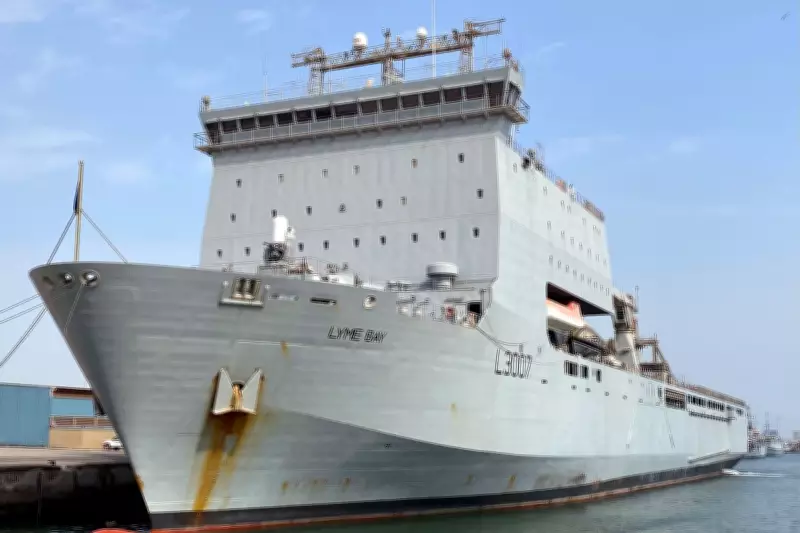
Britain is accelerating military preparations in response to the escalating Middle East crisis, with a second naval vessel now being readied for potential deployment to the volatile region. The landing ship RFA Lyme Bay is being brought to heightened readiness as tensions continue to mount following recent military exchanges between the United States, Israel, and Iran.
Naval Deployment Strategy
The Ministry of Defence has confirmed that RFA Lyme Bay, equipped with comprehensive aviation and medical facilities, could provide crucial support for evacuation operations and maritime tasks in the eastern Mediterranean. This development follows earlier plans to deploy the Type 45 destroyer HMS Dragon to safeguard British military personnel and RAF bases in Cyprus from potential drone or missile attacks originating from Iran and its proxy forces.
A Ministry of Defence spokesman stated: "As part of prudent planning, we have taken the decision to bring RFA Lyme Bay to heightened readiness as a precaution, should she be needed to assist in maritime tasks in the eastern Mediterranean." Defence Secretary John Healey informed Parliament that HMS Dragon would sail from Portsmouth "in the next couple of days" to fulfill its protective mission.

Economic Implications and Market Reactions
The geopolitical tensions have triggered significant economic concerns, particularly regarding energy markets and inflation. Following Monday's spike that saw oil prices approach four-year highs above $100 per barrel, markets experienced some relief on Tuesday with Brent crude falling more than 8% to just under $91 per barrel. This retreat came after US President Donald Trump characterized the military action as a "short-term excursion" rather than prolonged conflict, though he simultaneously threatened "death, fire and fury" against Iran unless vessels were guaranteed safe passage through the strategically vital Strait of Hormuz.
The FTSE 100 Index recovered some ground, rising 1.6% to 10,414.8 points in early Tuesday trading. However, economic uncertainty persists, with the British Chambers of Commerce warning that inflation would remain "firmly above" the Bank of England's 2% target due to the "highly uncertain" global situation.
Political Responses and Fuel Duty Debate
Both Prime Minister Sir Keir Starmer and Chancellor Rachel Reeves have acknowledged the conflict's potential to cause economic damage in the United Kingdom. Following discussions with G7 counterparts, Ms. Reeves indicated readiness to support "a co-ordinated release" of international oil reserves to mitigate economic shocks. She also emphasized the need for action to "guarantee the security of vessels passing through the Strait of Hormuz."
The Chancellor has resisted calls to cancel a planned increase in fuel duty despite requesting the competition watchdog to prevent wartime profiteering. Fuel duty has remained frozen since 2011, with a temporary 5p reduction implemented in 2022 following Russia's invasion of Ukraine. Ms. Reeves previously announced this reduction would be gradually unwound between September 2026 and March 2027, drawing criticism from opposition parties.
Shadow Chancellor Sir Mel Stride argued: "The latest developments in the Middle East make it even more important for Rachel Reeves to reverse course and scrap the rise in fuel duty she announced at the budget." Reform UK's Nigel Farage and Robert Jenrick staged a publicity stunt at a Derbyshire petrol station, symbolically cutting 25p per litre to support their proposal to reinstate the fuel duty reduction.
Ongoing Conflict and Diplomatic Measures
The duration of hostilities remains uncertain, with further strikes reported in Tehran as President Trump declared the US operation "very complete" while the Pentagon simultaneously stated America had "only just begun to fight." Iran has continued launching strikes against Israel and Gulf states, prompting additional security measures.
The United States has withdrawn non-essential diplomatic staff from Saudi Arabia, while Britain has evacuated dependants of embassy personnel from the United Arab Emirates "as a precautionary measure." A government-chartered flight returned British citizens from Dubai in the early hours of Tuesday morning.

Political Criticism and Military Readiness
Conservative leader Kemi Badenoch has defended her criticism of the government's military response, rejecting suggestions she should apologize for claiming British forces were "just hanging around" in the Middle East. She clarified: "I was criticizing the Government, that they're not doing enough, and they are the ones hanging around. HMS Dragon is still in Portsmouth well over a week after it should have left."
Mrs. Badenoch contrasted Britain's response with France's deployment of approximately ten ships to the Mediterranean and the French president's visit to Cyprus, questioning: "We are the ones who have a base in Cyprus. What is our Prime Minister doing?"
The dual naval preparations underscore Britain's increasing military engagement in the region as diplomatic efforts continue alongside economic stabilization measures. The situation remains fluid, with potential for further escalation requiring continued vigilance from both military and economic policymakers.





