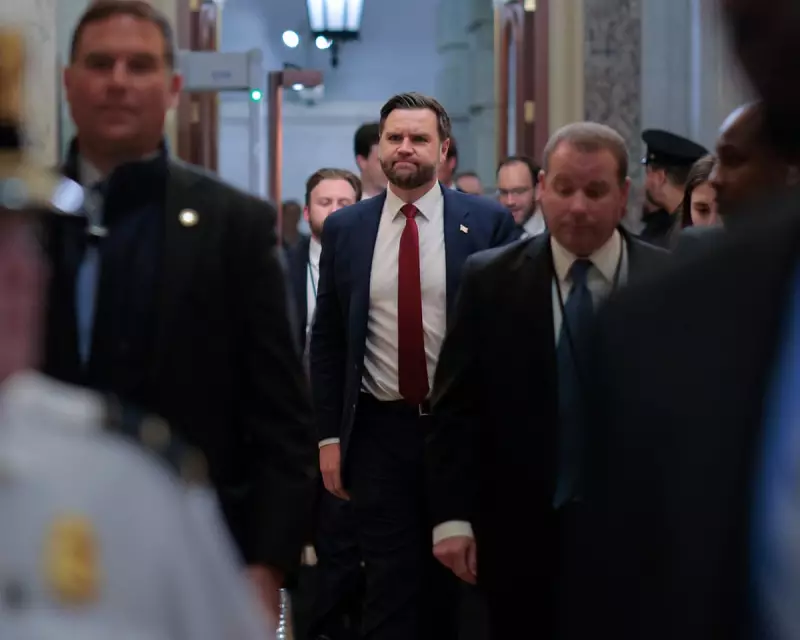
The United States Senate has narrowly defeated a significant war powers resolution that would have curtailed President Donald Trump's ability to initiate further military action in Venezuela without first notifying Congress. The pivotal vote, held on 14 January in Washington DC, saw Vice President JD Vance cast a decisive tie-breaking ballot to kill the measure.
Republican Senators Flip Votes After White House Assurances
The outcome hinged on a dramatic last-minute shift by two Republican senators. Josh Hawley of Missouri and Todd Young of Indiana, who had previously joined Democrats to advance the resolution just one week earlier, changed their positions. Both stated they reversed their votes after receiving direct assurances from the Trump administration regarding its intentions in Venezuela.
Young declared he had been persuaded after discussions with Secretary of State Marco Rubio, receiving guarantees that there were currently no American troops in Venezuela. He added that the administration committed to seeking congressional authorisation in advance for any "major military operations." Hawley similarly told reporters he was convinced the resolution was no longer necessary following talks with both Rubio and President Trump himself.

A Rare Bipartisan Rebuke Turns to Administration Victory
The final vote split the Senate 50-50, forcing Vice President Vance to step in. The resolution's defeat marks a sharp reversal from the previous week, when it had passed with bipartisan support in a move widely seen as a rare congressional check on the president's foreign policy. That earlier vote had followed a surprise US military raid which captured the deposed Venezuelan leader, Nicolás Maduro, an operation conducted without prior congressional notification.
President Trump had reacted furiously to the initial passage, pressuring his party to reject the measure and stating that the Republican senators who supported it "should never be elected to office again." Despite the administration's ultimate victory, the episode revealed growing unease on Capitol Hill regarding the executive's expanding military ambitions, which have also included threats concerning Greenland, Iran, and Mexico.
Democratic Condemnation and Warnings of 'Forever Wars'
Democratic leaders condemned the result in forceful terms. Senate Minority Leader Chuck Schumer warned that the vote "makes things more dangerous, not less" and "emboldens Donald Trump to push further down this reckless path." Senator Tim Kaine of Virginia, a champion of war powers measures, vowed to file "a whole lot more" resolutions to block unauthorised military operations, stating to Republicans: "They can run but they can't hide."
Libertarian-leaning Republican Senator Rand Paul, who voted for the resolution alongside colleagues Lisa Murkowski and Susan Collins, criticised the procedural arguments used to defeat it. He called it an "absurdity" to claim Trump hadn't already taken acts of war in Venezuela, questioning, "If we don't know it's a war until after all the people die ... wouldn't it then be a little late?"
On social media, Oregon Democrat Jeff Merkley accused Republicans of voting in favour of "forever wars, and against the best interests of the American people." The debate underscores the ongoing tension between presidential authority and congressional oversight in matters of military engagement.