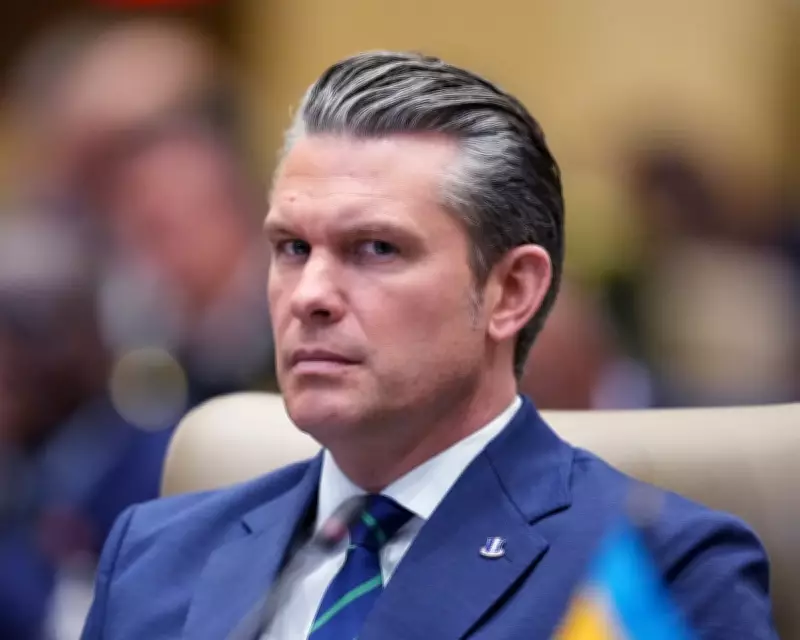
Democratic Lawmaker Condemns Hegseth's Call for 'No Quarter' Against US Enemies
Defense Secretary Pete Hegseth's recent remarks during a Pentagon press briefing have sparked significant controversy and legal scrutiny. A top Democratic senator with military experience has strongly criticized Hegseth's call for "no quarter" against US enemies, warning that such language could constitute a violation of international humanitarian law.
Senator Kelly's Strong Rebuttal
US Senator Mark Kelly of Arizona, a retired Navy captain and former astronaut, responded forcefully to Hegseth's comments on social media platform X. Kelly emphasized that "'No quarter' isn't some wanna be tough guy line – it means something. An order to give no quarter would mean to take no prisoners and kill them instead."
The senator elaborated further, stating: "That would violate the law of armed conflict. It would be an illegal order. It would also put American service members at greater risk. Pete Hegseth should know better than to throw around terms like this."

The Controversial Statement
During Friday's press briefing at the Pentagon, Defense Secretary Hegseth declared: "We will keep pressing, keep pushing, keep advancing – no quarter, no mercy for our enemy." According to official transcripts, this statement came amid a wide-ranging discussion about US military strategy and recent conflicts.
Legal experts and critics have noted that the phrase "no quarter" carries specific legal implications under international law. Rather than being merely belligerent rhetoric, the term historically means that enemy combatants will not be taken prisoner but instead executed on the battlefield.
International Legal Framework
The prohibition against declaring "no quarter" has deep roots in international humanitarian law. The Hague Convention of 1899 specifically forbids such declarations, with subsequent amendments in 1907 reinforcing this prohibition. According to these conventions, declaring that no quarter will be given constitutes a war crime.
The International Committee of the Red Cross (ICRC) provides clear guidance on this matter. Their International Humanitarian Law Databases state that "humanitarian law prohibits the use of this procedure, that is, ordering that there shall be no survivors, threatening the adversary therewith, or conducting hostilities on this basis."
Furthermore, under the statute of the International Criminal Court, "declaring that no quarter will be given" is explicitly classified as a war crime in international armed conflicts. This legal framework has been established to protect combatants and civilians during warfare.
Broader Context of Military Communication
This controversy emerges as the White House and Department of Defense face increasing scrutiny for their communication strategies regarding military conflicts. Recent social media posts from official government accounts have featured simplistic pop culture memes that some critics argue trivialize the realities of war.
Last week, the White House posted a video combining clips from the animated Wii Sports game with footage of US-Israeli strikes on Iran. In one segment, an animated baseball player declares "out of the park," while another shows a bowling player throwing a "strike" at pins labeled "Iranian regime officials" to accompanying cheers.
Peter Loge, a political scientist at George Washington University, commented to The Hill about this trend: "It takes a really complicated and important situation – armed conflict – and boils it down to a little cartoon image. By making war like a game or cartoon, that removes the reality of war from people's minds."
Additional Remarks from the Briefing
Hegseth's "no quarter" statement came during a broader discussion about Iran's leadership. The defense secretary claimed that Iran's new supreme leader, Mojtaba Khamenei, is wounded and likely disfigured, questioning his ability to govern effectively.
"We know the new so-called not-so-supreme leader is wounded and likely disfigured," Hegseth stated. "He put out a statement yesterday. A weak one, actually, but there was no voice and there was no video. It was a written statement."

Iranian officials have disputed these claims. A representative told Reuters on Wednesday that Khamenei's injuries were minor, while Iran's ambassador to Japan, Peyman Saadat, stated on Friday that Khamenei had not been "impaired" by any injuries.
Ongoing Political Conflict
The exchange between Kelly and Hegseth represents the latest chapter in an ongoing political conflict between the two veterans. This dispute has previously extended into legal proceedings and military disciplinary matters.
In November, Senator Kelly joined five other Democratic lawmakers in a video urging troops to disobey unlawful military directives from the administration. This prompted strong reactions from political opponents, with accusations of sedition and calls for disciplinary action against the retired captain.
The Pentagon subsequently initiated an investigation into Kelly, citing federal laws that allow retired service members to be recalled to active duty for potential court-martial proceedings. However, in February, a judge expressed skepticism about these proceedings, questioning whether the government's arguments represented "a bit of a stretch" and noting the lack of precedent for censuring a sitting US senator through military channels.
The controversy surrounding Hegseth's remarks highlights ongoing tensions between military communication strategies, international legal obligations, and political accountability. As debates continue about appropriate language and conduct in armed conflicts, this incident underscores the complex intersection of military operations, legal frameworks, and political discourse in contemporary warfare.