The conspicuous omission of Taiwan from the United States' newly released defence strategy document has triggered significant alarm in Taipei, occurring against a backdrop of heightened Chinese military activity near the self-governed island. The 2026 National Defense Strategy, unveiled by the Trump administration, represents a dramatic recalibration of American defence priorities and perceived limitations.
A Notable Absence in Strategic Planning
Analysts have highlighted the stark contrast between this document and its 2022 predecessor. While the earlier edition explicitly mentioned Taiwan multiple times, condemning Beijing's "increasingly provocative rhetoric and coercive actions" that "threatened stability" across the Taiwan Strait, the 2026 version contains no direct references to the island. This silence is particularly striking given the longstanding US commitment, bound by treaty, to help arm Taiwan for its self-defence against potential aggression.
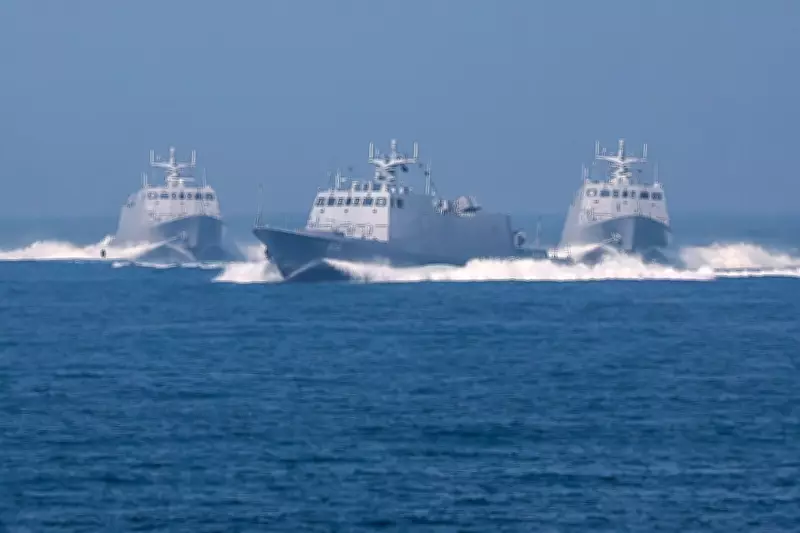
The timing of this strategic shift is especially sensitive. On the very Sunday the concerns emerged, Taiwan's defence ministry reported detecting a People's Liberation Army helicopter and six naval vessels conducting sorties that crossed the median line separating the island from mainland China. In response, Taipei deployed aircraft, naval ships, and coastal missile systems, stating it had "monitored the situation and responded" in a social media post.

Expert Analysis and Political Reactions
Several experts interpret Taiwan's exclusion as part of a broader strategic manoeuvre by the Trump administration to maintain diplomatic flexibility with Beijing. Taiwanese political scientist Dennis Weng, founding director of the Asia Pacific Peace Research Institute, noted that the document "adopted a more restrained, pragmatic and even reconciliatory language for Beijing." This analysis gains weight with the revelation that Trump is scheduled to meet Chinese President Xi Jinping in April.
The political reaction within Taiwan has been sharply divided. Legislators from the main opposition party, the Kuomintang (KMT), expressed profound concern about the message this omission sends ahead of Trump's planned meeting with Xi. KMT legislator Lai Shyh-bao told media: "Even though we have spent so much buying US arms, there is no mention of Taiwan's security in this strategy. That shows where Trump's priorities lie." Another KMT lawmaker, Wang Hung-wei, added: "Taiwan has met what the US demanded, but cannot even get a single mention in return. That leaves people with a bitter feeling."
In contrast, officials from the ruling Democratic Progressive Party (DPP) urged caution against overinterpreting the document, emphasising that America's "actions and institutions" carry more substantive weight than any strategic paper.
A Shift Towards Homeland Defence and Limited Support
The 2026 strategy outlines a significant reorientation of US military focus. The document explicitly states that as American forces concentrate on homeland defence and the Indo-Pacific region, "our allies and partners elsewhere will take primary responsibility for their own defence with critical, but more limited support, from American forces." This indicates a planned reduction in the US military footprint across various global theatres, marking a departure from previous defence postures.
Despite the absence of direct references to Taiwan, the document does address security in the Asia-Pacific region, albeit with limited detail. It commits the US military to "erect a strong denial defence along the First Island Chain" – a strategic archipelago that includes Taiwan, Japan, and the Philippines. Furthermore, it asserts that the US military presence in East Asia will persist "to ensure that neither China nor anyone else can dominate us and our allies."
This strategic ambiguity leaves Taiwan in a precarious position, balancing between visible Chinese military pressure and an evolving, less explicitly supportive American defence framework. The coming months, particularly surrounding the planned Trump-Xi meeting, will be crucial in determining the practical implications of this doctrinal shift for cross-strait stability and regional security dynamics.