Trump Hails 'Most Daring' US Rescue Mission in Iran as Historic
President Donald Trump has hailed a special forces mission to rescue an airman trapped in Iran as "one of the most daring Search and Rescue Operations in U.S. History". The dramatic operation unfolded after an F-15 fighter jet was shot down over a remote area of Iran on Friday, carrying both the airman and a pilot.
The pilot was rescued the same day by two military helicopters, but the airman—identified by Mr Trump as a highly-respected colonel—evaded would-be captors for almost two days. Protected overhead by Reaper drones, the colonel was armed only with a handgun while hiding from danger as a complex rescue plan was developed.
Complex Operation with High Stakes
The mission involved several dozen warplanes and helicopters, alongside hundreds of special forces officers. However, two of the five rescue planes became stuck in a remote Iranian airfield and were deliberately blown up to prevent them from falling into enemy hands. Earlier, the CIA had deceived Iranian forces by falsely claiming the colonel had already been found.

Mr Trump noted this was the first time in military memory that two US pilots had been recovered separately deep inside enemy territory. This raises the question: what are the most daring rescue missions in history?
Scott O'Grady, Bosnia (1995)
US pilot Scott O'Grady was flying a routine combat air patrol over Bosnia on June 2, 1995, when his plane was hit by a Serbian missile from an unexpected mobile site. An SA-6 missile struck about 10ft behind his seat, engulfing him in flames as he ejected. Fearing his parachute would burn, he released it early and fell for over 25 minutes to a clearing near a highway.
Suffering burns to his face and neck, O'Grady raced into the woods to evade paramilitary soldiers. For six days, he endured wet conditions, thirst, and hunger—eating ants and plants after his emergency water ran out. He developed trench foot and often moved at night to avoid chasing Serbs.
On the sixth night, he contacted a squadron mate in the sky. Soon, four Marine helicopters raced 80 miles into enemy territory to rescue him, with around 40 other aircraft providing cover. O'Grady sprinted from the woods carrying a 9mm pistol. President Bill Clinton later praised his courage, and his story inspired the 2001 film Behind Enemy Lines.
Bat 21, Vietnam (1972)
Described as "one of the most difficult rescues of the war" by the National Museum of the United States Air Force, the mission to recover Lieutenant Colonel Iceal 'Gene' Hambleton was the largest in the force's history. Hambleton ejected safely after his EB-66 aircraft was hit by a surface-to-air missile on April 2, 1972.
Releasing his parachute at 28,000ft, he took 16 minutes to land in the middle of the North Vietnamese Easter Offensive. He later credited the early parachute release with saving his life by allowing fog to conceal him. Hiding in the jungle, he found corn and collected rainwater.
A Sikorsky HH-3E helicopter sent to rescue him was shot down, severely impacting his morale. US forces flattened a village believed to be the source of the attack, but Hambleton was stabbed in the back while walking through it. After fracturing his arm in a fall, he was finally rescued by a Navy SEAL team after more than 11 days on the run. The mission cost 15 lives and inspired the 1988 film Bat*21.
Bravo Two Zero, Iraq (1991)
Bravo Two Zero was an eight-man Special Air Service (SAS) patrol deployed to Iraq during the First Gulf War. Tasked with gathering intelligence or destroying Scud missile launchers, they were inserted by an RAF Chinook helicopter on January 22, 1991. After communication failures, they were discovered by a shepherd on January 24 and decided to withdraw.
Despite standard procedure to return to an infiltration point for helicopter pickup, no aircraft arrived due to pilot illness. The patrol split into two groups while trying to contact a Coalition aircraft. Over the following days:

- Vince Phillips died from hypothermia.
- Stan MacGowan was captured.
- Colin Armstrong escaped alone, walking 200 miles across the desert to Syria in what was called the "longest escape and evasion in SAS history".
- Bob Consiglio was shot and killed, and Steven 'Legs' Lane died of hypothermia.
- Three others were captured, tortured, and held at Abu Ghraib Prison before release on March 5.
The mission was later detailed in books by patrol members, including Bravo Two Zero by Andy McNab (Steven Mitchell).
Operation Barras, Sierra Leone (2000)
In August 2000, 11 members of the Royal Irish Regiment and one Sierra Leonean soldier were taken hostage by the West Side Boys, an armed gang in Sierra Leone. The soldiers were held deep in the jungle, beaten, and subjected to mock executions.
After negotiations, half the prisoners were released in exchange for a satellite telephone. Special forces hid in the jungle for days to gather intelligence. As the West Side Boys' demands became "outlandish", Operation Barras was launched on September 10.
Special forces were flown in on heavily-armed helicopters, using ropes to drop into Gberi Bana and rescue the hostages. All hostages were freed, but Bombardier Bradley Tinnion, 28, died from machine gun fire. All participants received the Operational Service Medal for Sierra Leone.
Jugroom Fort Rescue, Afghanistan (2007)
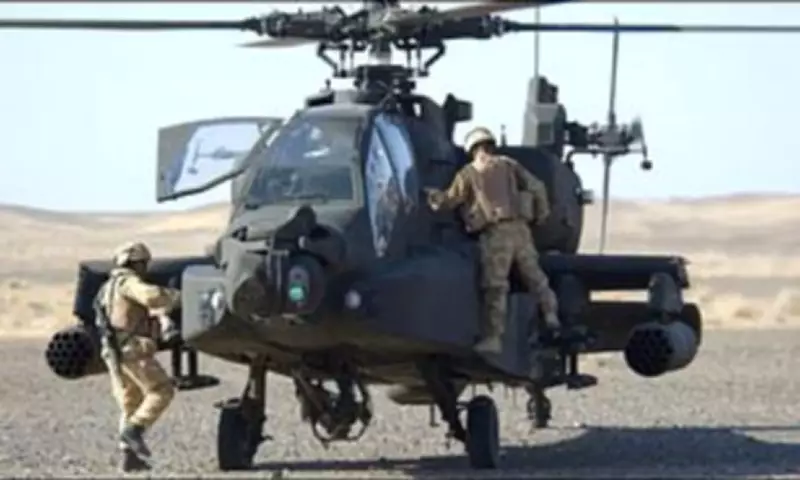
In an "audacious" operation during the war in Afghanistan, Royal Marines strapped themselves to the sides of Apache gunships to recover the body of Lance Corporal Mathew Ford. Ford went missing after an assault on Jugroom Fort, a Taliban-held position in Helmand Province.
After a Taliban counter-attack forced a withdrawal, Ford was unaccounted for. With no passenger space in Apaches, four marines volunteered to strap themselves to the helicopters—an "unprecedented operation". A bomb was dropped as a distraction, and the men found Ford dead amid Taliban gunfire.
They secured his body to an Apache and carried him to safety. An official report later found Ford was killed by friendly fire. A road in his hometown of Immingham, Lincolnshire, now bears his name.