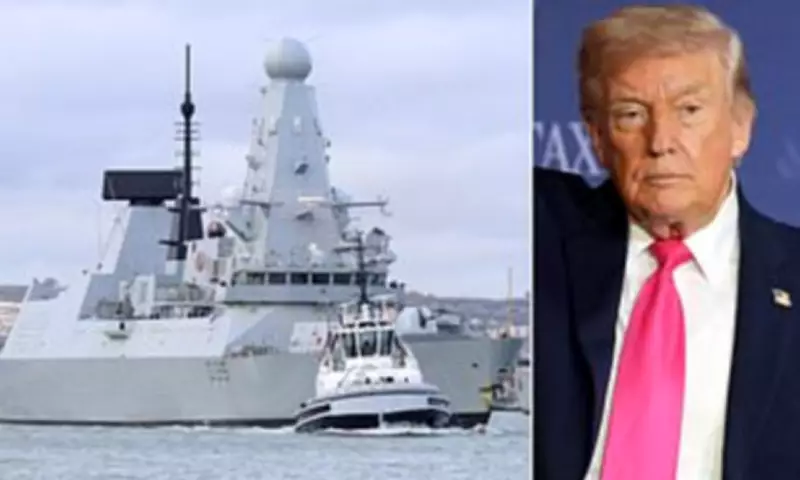
Trump Derides British-Led Hormuz Naval Mission as 'Useless' and a 'Paper Tiger'
Former US President Donald Trump has launched a scathing attack on a planned British-led multinational military taskforce intended to patrol the strategically vital Strait of Hormuz, branding the initiative "useless" and a "Paper Tiger". The verbal assault came just as Iran declared the crucial shipping channel "completely open", triggering an immediate 10 per cent drop in global oil prices and a surge in stock markets.
Iran's Surprise Announcement and Global Economic Impact
In a dramatic development on Friday, Iran's foreign minister announced that "the passage for all commercial vessels through Strait of Hormuz is declared completely open". This waterway, through which approximately one-fifth of the world's oil flows, had been effectively closed for several weeks, exacerbating the ongoing cost-of-living crisis worldwide. The sudden reopening caused Brent crude oil to plummet to its lowest price in over a month, providing temporary relief to consumers and businesses grappling with energy costs.
Tehran suggested its decision to reopen the strait was connected to a recently announced ceasefire in Lebanon, where Israel had been conducting bombing campaigns against Iran's proxy militant group Hezbollah. However, the announcement created immediate uncertainty about security arrangements in the region.

Trump's Mockery of NATO Allies and British Leadership
While welcoming Iran's announcement, Trump directed his ire toward NATO countries offering military support for the strait's security. In a characteristically blunt social media post, he wrote: "Now that the Hormuz Strait situation is over, I received a call from NATO asking if we would need some help. I TOLD THEM TO STAY AWAY, UNLESS THEY JUST WANT TO LOAD UP THEIR SHIPS WITH OIL. They were useless when needed, a Paper Tiger!"
The former president claimed Iran "has agreed to never close the Strait of Hormuz again", but insisted the United States would maintain its own naval blockade "until such time as our transaction with Iran is 100 per cent complete." He added this would happen "pretty soon" as "the war in Iran is going along swimmingly."
British and French Response to the Crisis
Despite Trump's criticism, British Prime Minister Sir Keir Starmer and French President Emmanuel Macron announced on Friday that their nations would send warships to help secure the strait. Following a Paris summit attended by 49 world leaders discussing how to reopen the critical waterway, Sir Keir stated that Britain and France would lead a mission to protect commercial vessels navigating the strait "as soon as conditions allow."
"The world needs the Strait of Hormuz fully opened, because that is how we keep prices down and stop the economic damage," Sir Keir emphasized. "The UK will lead a multinational mission to protect freedom of navigation. It will be strictly peaceful and defensive."
Military planners are scheduled to meet in London next week, with more than a dozen countries expected to contribute naval assets to the operation. However, the mission faces significant practical challenges and skepticism from regional experts.
Operational Concerns and Regional Skepticism
Serious questions have emerged about the feasibility of the proposed taskforce. Concerns were highlighted by the recent experience of HMS Dragon, which took weeks to reach Cyprus to defend an RAF base before being embarrassingly pulled in for repairs. This incident has raised doubts about the Royal Navy's capacity to respond swiftly to emerging crises.
Richard Meade, editor of the influential shipping journal Lloyd's List, captured the prevailing uncertainty: "There are a few question marks. Everybody is currently looking at each other and asking the same question, 'What does this mean?'"
One tanker operator speaking to the BBC was even more direct, stating that Iran's announcement "doesn't change anything" regarding the practical realities of shipping through the region. Furthermore, Tehran has given no indication whether it would accept the presence of a multinational taskforce in what it considers its territorial waters.

Security Threats and Diplomatic Negotiations
Significant security concerns persist despite Iran's announcement. Intelligence reports suggest Tehran has laid underwater mines across the waterway, though Trump has claimed these are being "removed." The safety of commercial shipping remains uncertain, with no clear timeline for when normal maritime traffic might resume.
As the US-Iran ceasefire continues to hold, Washington officials revealed they are negotiating a three-page plan to formally end hostilities. Reports suggest this could involve Iran surrendering its enriched uranium stockpiles in exchange for approximately $20 billion of frozen funds being released. However, Trump has contradicted this, asserting that "no money will exchange hands in any way."
Sources in Tehran have warned that continued US naval blockades would constitute a dealbreaker, creating a potential diplomatic impasse even as military planners prepare their response to the evolving situation in one of the world's most strategically important waterways.