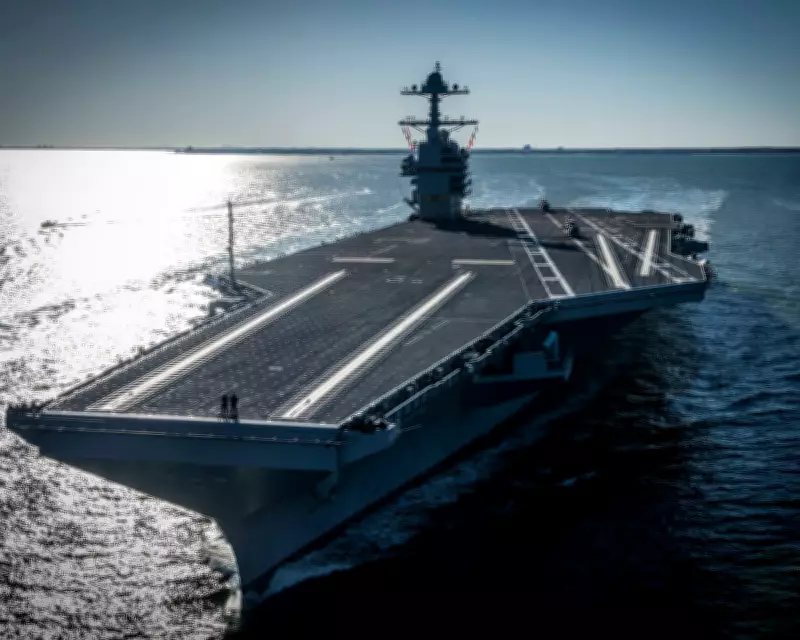
In a decisive move to escalate pressure on Tehran, former President Donald Trump has ordered the deployment of a second aircraft carrier strike group to the Middle East. The USS Gerald R. Ford, renowned as the world's largest aircraft carrier, will join the USS Abraham Lincoln in the region, substantially enhancing American firepower as negotiations over Iran's nuclear and ballistic missile programmes continue.
Strategic Deployment Amid Ongoing Diplomacy
The USS Gerald R. Ford and its accompanying warships are expected to take approximately three weeks to sail from the Caribbean Sea to the Middle East. This deployment follows Trump's recent comments, where he indicated he was "thinking" about sending a second carrier, though he initially expressed optimism that Iran might be willing to strike a nuclear agreement.
Background of the Carrier's Movements
Previously, the Ford carrier strike group had been operating in the Caribbean Sea since mid-November, after departing from the eastern Mediterranean in late October. During this period, it played a pivotal role in US operations, including the seizure of Venezuela's former president Nicolás Maduro in early January. The return to the Middle East marks an unusually extended deployment, as the carrier left the United States in June 2025 with no clear return date scheduled.

Iran's Stance and Regional Dynamics
Iran has shown willingness to curb its nuclear enrichment programme in exchange for sanctions relief but has resisted additional demands. These include limits on its ballistic missile programme and reductions in support for proxy groups such as Hezbollah, a key concern for Israel. Last week, indirect negotiations between the US and Iran took place in Oman, with further discussions anticipated, though no specific dates have been set.
Shifts in Trump's Rhetoric and Military Strategy
Trump's approach to Iran has evolved significantly over the past month. Initially, he hinted at intervention during protests against the Iranian regime, but with limited military assets available at the time. The arrival of the USS Abraham Lincoln carrier strike group changed this dynamic, though by then, Iranian authorities had suppressed protests through a severe crackdown, resulting in thousands of casualties.
Recently, Trump's focus has shifted towards curbing Iran's nuclear programme, which was already impacted by a summer bombing campaign involving Israeli and US air forces. On Thursday, Trump warned that failure to reach a deal would be "very traumatic" and expressed hope for a swift resolution, suggesting a timeline of about a month for concluding talks.
Implications for US Military Presence
The addition of the USS Gerald R. Ford to the Middle East dramatically expands the US military's capabilities in the region. This move underscores the ongoing strategic efforts to influence Iran's actions through a combination of diplomatic engagement and military deterrence, as global attention remains fixed on the outcome of these high-stakes negotiations.