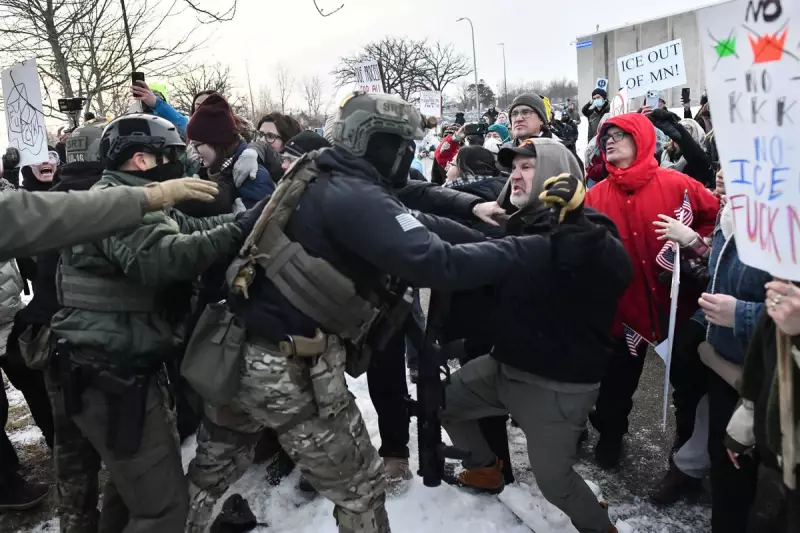
President Donald Trump has issued a stark warning to state officials in Minnesota, threatening to invoke the rare and powerful Insurrection Act to deploy military forces if ongoing protests against Immigration and Customs Enforcement (ICE) are not quelled.
Trump's Ultimatum to Minnesota
The president made the threat in a post on his Truth Social platform on the morning of Thursday, 15 January 2026. He demanded that Minnesota lawmakers act to stop what he called "professional agitators and insurrectionists" from attacking ICE officers. Trump stated that if "corrupt politicians" in the state failed to obey the law, he would personally institute the Insurrection Act.
This 19th-century law grants the president authority to use federal military troops, or to federalise state National Guard units, to suppress civil unrest, insurrection, or rebellion. Its use is exceptionally rare in modern times.

Protests Sparked by Fatal Shooting
The president's incendiary remarks come directly in response to a week of nationwide demonstrations triggered by a fatal shooting in Minneapolis. An ICE officer shot and killed 37-year-old Renee Good just seven days prior, igniting fierce public outcry.
The tensions were further inflamed less than 24 hours before Trump's post, when another ICE officer shot an immigrant in the leg. These incidents have fuelled sustained and vocal protests targeting ICE operations and calling for greater accountability, with Minnesota becoming a central flashpoint.
Trump framed the conflict as an attack on ICE "Patriots" who are "only trying to do their job," positioning any state inaction as lawlessness justifying extreme federal intervention.
A Rare and Historic Power
The Insurrection Act is not a single law but a series of statutes consolidated from legislation passed between 1792 and 1871. While President Trump claimed "many Presidents have done before," its deployment is a historical anomaly.
The last confirmed use was in 1992, when President George H. W. Bush sent active-duty army and marine units into Los Angeles following the citywide riots after the acquittal of four police officers in the beating of Rodney King. The prospect of its use in 2026 represents a significant escalation in the federal response to domestic protest.
Diplomatic Meeting Amid Domestic Crisis
Also on Thursday, President Trump's schedule highlighted a significant diplomatic engagement alongside the domestic turmoil. He was expected to meet at the White House with Venezuela’s opposition leader, María Corina Machado.
This marks their first face-to-face meeting since the United States captured the country's now-deposed leader, Nicolás Maduro. The juxtaposition of a major domestic crisis with high-stakes foreign policy underscores a tumultuous day for the administration.
White House Press Secretary Karoline Leavitt was scheduled to brief the press in the mid-afternoon, likely facing intense questioning on both the Insurrection Act threat and the Venezuela talks.
The situation leaves Minnesota officials in a precarious position, balancing the right to protest with the president's demand for order and his unprecedented threat of military force on US soil.