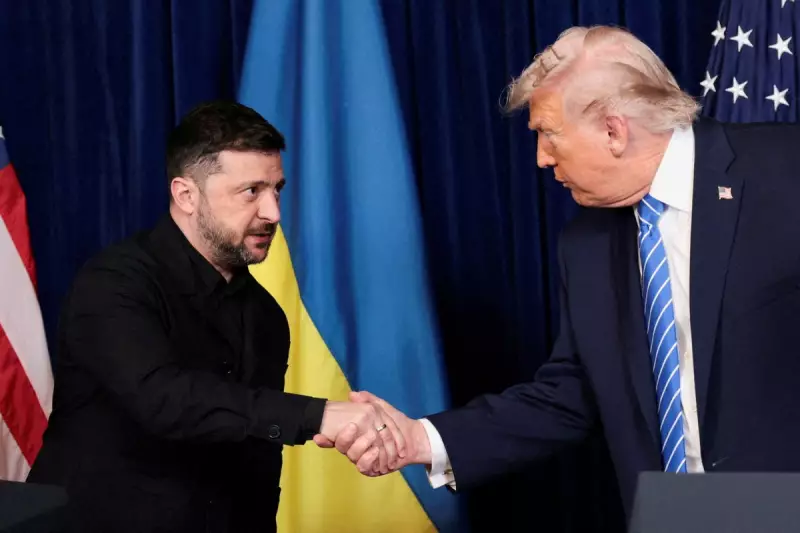
Senior US officials are reportedly weighing a significant expansion of the Donald Trump-led Gaza "Board of Peace" to encompass other global conflicts, including the war in Ukraine, according to a Financial Times report. This development coincides with a Ukrainian diplomatic mission en route to Washington for crucial talks on security guarantees.
Parallel to the UN? The Proposed Expansion of Trump's Peace Board
The concept, first announced by President Trump on 15 January 2026 via Truth Social, initially focused on the post-war administration and reconstruction of Gaza. The board is to be chaired by Trump himself and includes figures such as World Bank president Ajay Banga and Canadian prime minister Mark Carney.
However, the Financial Times reveals that the administration is now mulling using this model as a template for Ukraine and other conflict zones like Venezuela. A person briefed on the proposal described it to the FT as a "potential substitute for the UN... a kind of parallel unofficial body" to handle protracted conflicts.

The full membership list, expected to be unveiled at the World Economic Forum in Davos next week, is said to include key figures involved in Ukraine-Russia diplomacy. These reportedly include US special envoys Steve Witkoff and Jared Kushner, as well as Secretary of State Marco Rubio.
Kyiv's Diplomatic Push Amidst Warnings of Escalation
As these high-level discussions take shape, a Ukrainian delegation is travelling to the United States to negotiate a bilateral agreement on security guarantees and a post-ceasefire "prosperity package". President Volodymyr Zelensky stated that finalised documents could be signed on the sidelines of the Davos forum, contingent on agreed terms.
Zelensky emphasised that his team seeks clarity from Washington on Russia's stance towards US-backed diplomatic efforts, accusing Moscow of stalling with "maximalist demands." This follows Trump's recent comment that Vladimir Putin "is ready to make a deal" while "Ukraine is less ready." Zelensky has forcefully rebutted this characterisation, asserting Ukraine will never be a stumbling block to peace.
The diplomatic urgency is underscored by severe military and humanitarian pressures. Zelensky warned on Friday 17 January that allied supplies of air defence missiles were "insufficient" and that Russia is preparing "new massive attacks." This aligns with a dire assessment from Kyiv Mayor Vitali Klitschko, who revealed the capital has only half the electricity it needs for its 3.6 million residents following relentless Russian strikes on energy infrastructure.
International Support and a Fragile Nuclear Truce
Amid the crisis, international allies are stepping up support. The UK's Deputy Prime Minister, David Lammy, visited Kyiv to mark a partnership anniversary and announced an additional £20 million to bolster Ukraine's energy infrastructure. He reaffirmed the UK stands "shoulder to shoulder" with Ukraine.
In a significant tactical development, the Czech Republic's President, Petr Pavel, promised during talks in Kyiv to provide Ukraine with combat aircraft capable of shooting down drones "in a relatively short time." These are believed to be Czech-made L-159 jets.
In a rare positive note, the UN's nuclear watchdog, the International Atomic Energy Agency (IAEA), secured a localised ceasefire agreement between Russian and Ukrainian forces. This temporary truce will allow engineers to repair the last remaining backup power line to the occupied Zaporizhzhia nuclear power plant, averting a potential nuclear safety crisis.
The coming week, with high-stakes talks in Washington and potential announcements at Davos, appears pivotal for shaping the next phase of the nearly four-year conflict.