

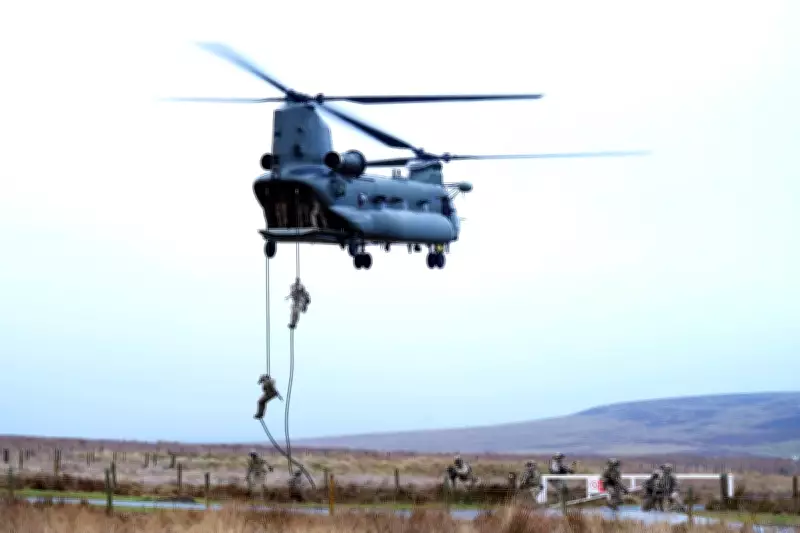
The British military has successfully concluded a rigorous, multi-service training exercise in preparation for assuming a pivotal leadership role within NATO's special operations framework. Exercise Hyperion Storm, conducted at the Otterburn training area in Northumberland, represented the culmination of an intensive 18-month evaluation period mandated by the alliance.
Demonstrating Joint Capability
During the complex manoeuvres, Royal Marine Commandos and Army Rangers executed a coordinated assault on a simulated enemy position. Deployed via RAF Chinook helicopters, personnel fast-roped from altitudes of approximately twenty feet onto the rain-swept moorland to join ground forces. The exercise showcased seamless integration between maritime, land, and air components, a critical requirement for the forthcoming NATO responsibility.
Scrutiny and Validation
Colonel Phil O'Callaghan, the exercise's deputy commander and a Royal Marine, emphasised the exacting nature of the NATO validation process. "The evaluation is demanding, with every detail scrutinised," he stated. "Our headquarters had to meet over 850 distinct performance measures to achieve complete validation from NATO."

This marks the first instance where the United Kingdom's Joint Special Operations Forces have been assembled for such a significant NATO leadership capacity. Colonel O'Callaghan highlighted the achievement as a demonstration of the versatility inherent within the UK Commando Force, Ranger Regiment, and Royal Air Force.
Operational Readiness and Future Deployment
From July this year, UK forces will assume command of NATO's Special Operations Forces component for a twelve-month period. This role, distinct from command of special forces units, places the UK at the helm of alliance reaction capabilities. Flight Lieutenant Jamie Johnson, a Chinook pilot involved in the exercise, noted the global scope of potential deployments, stating, "During that period, we could be deployed anywhere that NATO deems necessary."
Safety and Context
The training at Otterburn occurred shortly after a separate live-fire incident resulted in the death of Captain Philip Gilbert Muldowney. Addressing safety protocols, Colonel O'Callaghan affirmed the military's acute awareness of operational risks. "We are very cognisant of the risk both within training and on operations," he explained. "It is the quality and rigour of this training that ensures those risks remain manageable."
Following the successful mock assault and securing of objectives, the participating Chinooks landed at the remote site to extract the special operations personnel, who subsequently returned to their base at RAF Leeming in North Yorkshire. The exercise underscores the UK's ongoing commitment to high-readiness, interoperable forces capable of supporting NATO allies and partners worldwide.






