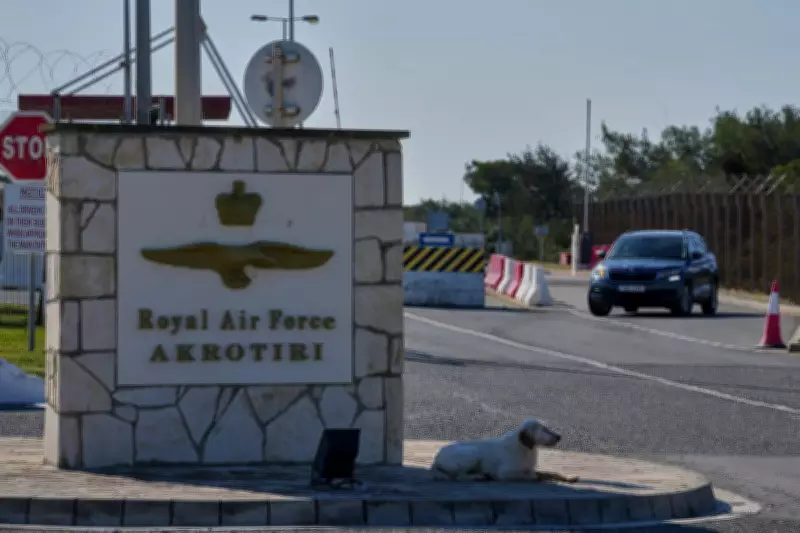
The British government has firmly stated that the United Kingdom is not at war, despite a significant escalation involving an Iranian-made drone strike on a key Royal Air Force base in Cyprus and a consequential decision to allow American forces to utilise British military installations during ongoing hostilities with Iran.
Akrotiri Base Targeted by Iranian Drone
UK officials confirmed that an attack drone struck the runway at RAF Akrotiri, a vital British air force base located in Cyprus, late on Sunday. The incident resulted in no injuries and was described as causing only "minimal" damage, yet it marked a serious development by bringing the regional conflict directly onto European soil for the first time.
It remains unclear whether the drone was launched directly from Iranian territory or by a militant group backed by Tehran, such as Hezbollah in Lebanon. Approximately twelve hours after the initial strike, sirens sounded again at the base as British Typhoon fighter jets and F-35 warplanes were scrambled into the air in response to a new perceived threat.

Heightened Security and Historical Context
Local residents received text messages from base authorities warning of an "ongoing security threat" and advising people to stay indoors away from windows. The Cypriot government separately reported that two drones heading towards Cyprus were successfully intercepted on Monday.
RAF Akrotiri serves as the UK's primary air base for operations across the Middle East, having been used extensively in recent years for missions against Islamic State targets in Syria and Iraq, as well as strikes against Houthi positions in Yemen. The base, retained by Britain after Cyprus gained independence in 1960, was previously attacked in 1986 by Libyan militants.
In response to mounting tensions between the US and Iran, Britain deployed additional F-35 fighter jets to Akrotiri last month, alongside enhanced radar systems, counter-drone technology, and air defences as part of comprehensive "defensive measures." The UK defence ministry announced on Monday that families of British personnel living on the base were being relocated to nearby accommodation as a precautionary step.
British Policy and Diplomatic Positioning
British officials have maintained a careful diplomatic stance, refusing to explicitly state whether the UK supports the US-Israeli military campaign against Iran. They have consistently emphasised that Iran should not be allowed to obtain nuclear weapons and have called for an end to Iranian strikes, advocating for a diplomatic resolution to the crisis.
Britain did not participate in the initial strikes on Iran that commenced on Saturday, and initially declined American requests to use UK bases in England or on Diego Garcia in the Indian Ocean. However, in a significant policy shift on Sunday, Prime Minister Keir Starmer announced he had agreed to permit US forces to utilise British bases specifically for attacks targeting Iran's missiles and their launch sites.
Legal Justifications and Political Reactions
Starmer justified this decision as a response to Iranian attacks on British interests and allies in the Gulf region, asserting it was legal under international law. He stressed that British bases could not be used for attacks on political or economic targets within Iran, and repeatedly clarified, "We are not joining these strikes, but we will continue with our defensive actions in the region."
US President Donald Trump expressed strong criticism in comments to the Daily Telegraph on Monday, stating he was "very disappointed in Keir" and that the prime minister "took far too long" to change his position regarding the use of British military installations.
Historical Parallels and Contemporary Concerns
Middle East Minister Hamish Falconer reiterated the government's position on Monday, telling the BBC, "The UK is not at war," while explaining that Iran possesses ballistic missiles "pointed at the Gulf and it is vital that those missile launchers are taken out in the face of these completely reckless attacks."

The memory of Britain's involvement in the Iraq War remains profoundly influential in contemporary political calculations. Former Prime Minister Tony Blair's decision to join the US-led invasion in 2003 resulted in the deaths of 179 British troops, approximately 4,500 American personnel, and countless Iraqi civilians, creating lasting political controversy.
The current government is determined to avoid repeating that history, yet critics warn that attempts to establish firm limitations on British involvement could be overwhelmed by the rapidly evolving dynamics of the conflict. Labour Party lawmaker John McDonnell voiced these concerns starkly, stating, "We are being drawn in, just as we were in Iraq, following the US into an incredibly dangerous situation."
More than two decades after Britain followed the United States into the devastating war in Iraq, the government is now navigating complex diplomatic and military challenges to avoid being pulled into another Middle Eastern conflict with unpredictable and potentially far-reaching consequences.