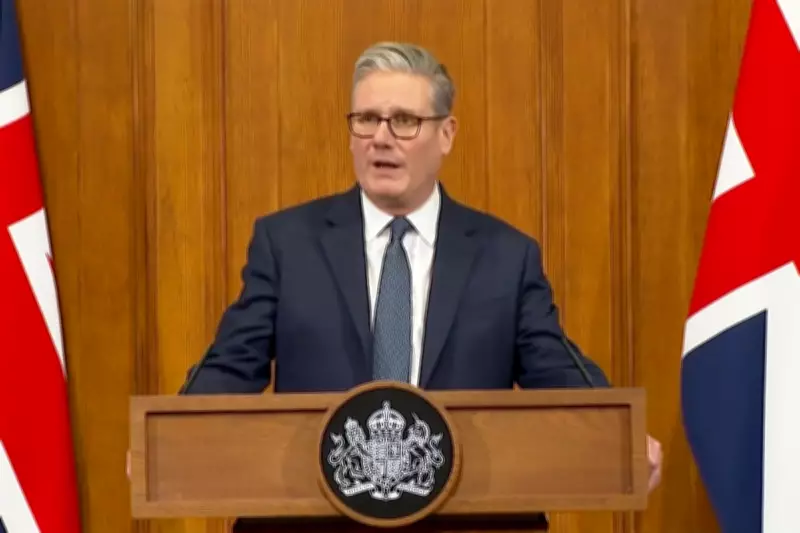
Starmer Bolsters UK Military Presence in Middle East, Defends Stance on Iran War
Prime Minister Sir Keir Starmer has confirmed a significant reinforcement of British military assets in the Middle East as regional tensions escalate, while firmly rejecting calls for the United Kingdom to join the United States in direct combat operations against Iran.
Enhanced Defence Deployment Announced
During a press conference addressing the ongoing crisis, Sir Keir announced the immediate deployment of four additional Typhoon fighter jets to join the existing Royal Air Force squadron stationed in Qatar. This move is designed to strengthen defensive operations both within Qatar and across the wider region. Simultaneously, Wildcat helicopters equipped with advanced anti-drone capabilities are scheduled to arrive in Cyprus imminently.
The Prime Minister emphasised that these deployments are part of a broader defensive strategy, developed in coordination with allies over recent months. "We started pre-deploying to the region in January and February, particularly to Cyprus and Qatar," Sir Keir stated, highlighting preparatory measures that included fighter jets, air defence missiles, and anti-drone systems.

Resisting Pressure for Direct Combat Role
Despite mounting criticism from former US President Donald Trump, who derided Sir Keir as "no Churchill," the British leader has resisted pressure to commit UK forces to join American military actions directly. Sir Keir articulated a clear distinction between defensive support for allies and active participation in the conflict, asserting his responsibility to make decisions based on British national interest.
"It's for me as the British prime minister to take decisions that I consider to be in the best interest of the United Kingdom," Sir Keir declared, while acknowledging President Trump's prerogative to act in what he perceives as America's national interest.
US-UK 'Special Relationship' Under Scrutiny
The Prime Minister revealed that his last communication with President Trump occurred on Saturday evening, prior to the US leader's public criticisms. Nevertheless, Sir Keir insisted that the foundational "special relationship" between the two nations remains fully operational. He pointed to ongoing cooperation, including shared use of military bases, joint protection efforts for personnel in the region, and continuous intelligence sharing on a twenty-four-seven basis.
"The special relationship is in operation right now," Sir Keir affirmed, detailing collaborative defence measures undertaken with American counterparts. He also provided a timeline clarifying that a formal US request to utilise British bases was not received until Saturday afternoon, with a subsequent decision being announced on Sunday evening following ministerial consultation.
Mass Evacuation Efforts Underway
As the conflict disrupts regional stability, the UK government has initiated a substantial evacuation operation for British nationals. The first government-chartered flight from Muscat, Oman, experienced delays but has now departed, with additional charter flights promised in the coming days. British Airways has augmented its schedule, adding a fourth daily flight from Muscat to London Heathrow—a route not typically served by the airline.
Sir Keir described the evacuation as "one of the biggest operations of its kind," significantly larger than the withdrawal from Afghanistan. Over 140,000 Britons have registered their presence in the Middle East with the Foreign, Commonwealth & Development Office, underscoring the scale of the logistical challenge.
Personal Stories of Escape Emerge
Among those returning to safety are consultants Sarah and Ed Short from Kent, who endured a harrowing journey to escape the conflict zone. The couple, originally on holiday in Dubai, paid £1,500 to travel hundreds of miles across the Middle East in a privately hired vehicle—described humorously as a "disco bus"—to reach an evacuation flight from Oman after their scheduled departure from the United Arab Emirates was grounded due to airspace closures.

Energy Security and Cabinet Unity
Concurrently, Energy Secretary Ed Miliband expressed confidence in the UK's energy supply resilience despite disruptions to oil and gas shipping lanes through the Strait of Hormuz—a critical chokepoint where approximately one-fifth of global oil and liquefied natural gas transits. Mr Miliband advocated for accelerated green energy adoption to reduce dependency on volatile international markets.
Sir Keir also dismissed reports of cabinet dissent regarding the UK's response to initial US strikes, reiterating that no concrete decision was required until the formal American request was received on Saturday.
The Prime Minister concluded by reaffirming Britain's commitment to its core values despite external pressures, stating his satisfaction that robust measures are in place to ensure the safety of British citizens both abroad and at home.