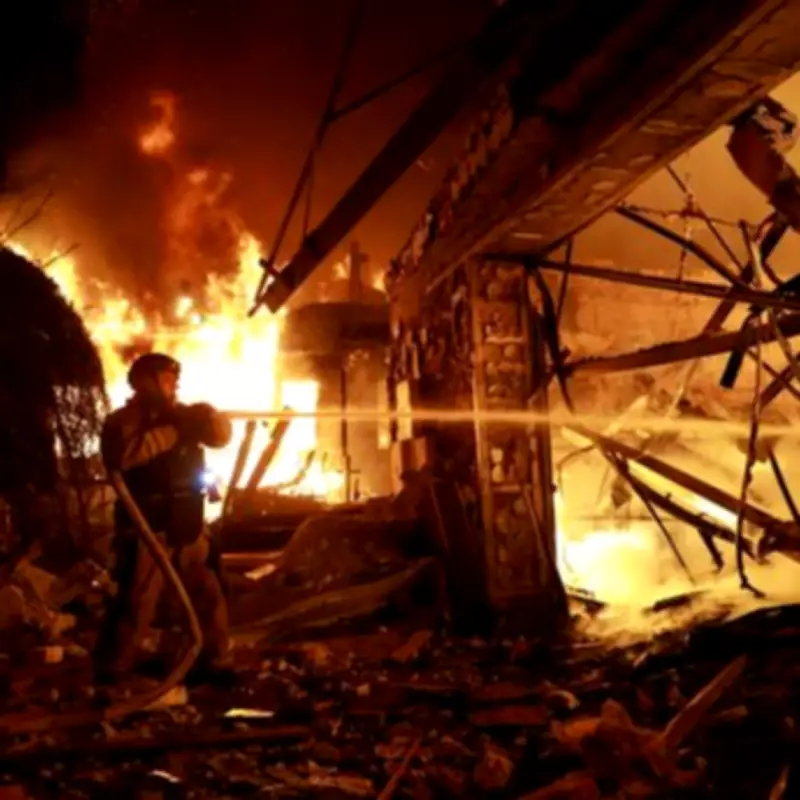
Zelensky Warns Ukraine Faces Critical Missile Shortage Amid Trump's Iran Conflict
Ukrainian President Volodymyr Zelensky has issued a stark warning that his country will begin running out of essential missiles due to Donald Trump's escalating war with Iran. In an interview with the BBC, Zelensky explained that the conflict in the Middle East is diverting crucial US military resources away from Ukraine, directly impacting Kyiv's ability to defend itself against ongoing Russian attacks.
Diverted Resources and Depleted Reserves
The Ukrainian leader stated that the Kremlin actively desires the US-Israeli offensive against Iran to become a "long war", as this would systematically redirect American military assets from Eastern Europe to the Gulf region. Zelensky emphasised that President Trump has not taken a definitive side in the four-year-long Ukraine conflict and appears unwilling to "irritate" Russian President Vladimir Putin.
"In addition to energy prices, it means the depletion of US reserves, and the depletion of air defence manufacturers. So we have a depletion of resources," Zelensky declared. He specifically highlighted that there will "definitely" be a shortage of Patriot missiles, which are vital for intercepting incoming Russian missiles targeting Ukrainian cities.

The Stark Production Versus Consumption Reality
Zelensky provided sobering statistics to illustrate the imbalance between missile production and wartime consumption. "America produces 60-65 missiles per month. Imagine, 65 missiles per month is about 700-800 missiles per year, produced each year. And on the first day in the Middle East war, 803 missiles were used," he argued. This dramatic disparity reveals how quickly stockpiles can be exhausted during intense conflicts.
Diplomatic Tensions and Strategic Flashpoints
The situation has created significant diplomatic friction between the US and UK. President Trump has repeatedly criticised UK Prime Minister Keir Starmer for refusing to deploy British warships to the Gulf to assist American forces in securing the Strait of Hormuz. Zelensky expressed hope for improved coordination, stating, "I would really like President Trump to meet with Starmer... so that they have a common position." He added that while he wouldn't dictate policy to Trump, the two leaders should meet to "re-load the relationship."
Critical Gulf Geography and Military Movements
The Strait of Hormuz has emerged as a critical flashpoint in the conflict. This narrow sea passage connects the Persian Gulf to open waters and handles approximately 20% of global liquefied natural gas and 25% of seaborne oil trade annually. Its strategic importance cannot be overstated, particularly for European energy security.
Meanwhile, significant US military assets are being repositioned toward the region. At least 5,000 US marines are currently relocating to the Middle East, many aboard the amphibious assault ship USS Tripoli. This vessel, designed for sea-to-land operations, was recently observed near Singapore and is now heading toward the Gulf. Military analysts speculate it could be used to deploy marines to secure Kharg Island, Iran's primary oil export terminal, which has already sustained substantial US strikes.
President Trump has claimed that "military targets" on Kharg Island were destroyed while initially sparing oil infrastructure. The US has hinted at potentially taking control of the island to disrupt Iran's funding streams, with explicit threats to target the infrastructure directly if Iran attempts to close the Strait of Hormuz.
The Broader Implications for European Security
This diversion of military resources creates a dangerous vulnerability for Ukraine at a critical juncture in its defense against Russian aggression. As US attention and arsenal shift toward the Gulf, European nations face heightened energy security concerns and must reconsider their strategic dependencies. The interconnected nature of global conflicts has never been more apparent, with battlefield decisions in the Middle East directly impacting defensive capabilities in Eastern Europe.