

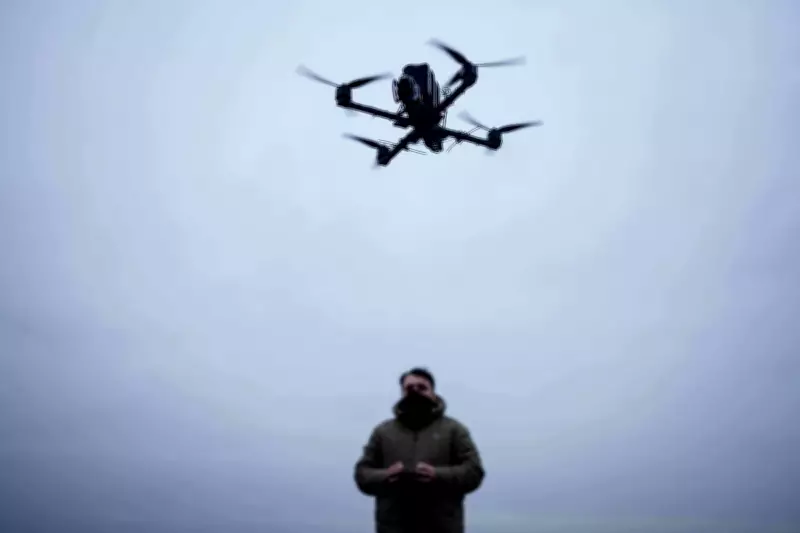
Ukraine's Battle-Tested Drone Defenses Attract US and Gulf Interest Amid Wartime Ban
As the conflict in the Middle East depletes US missile stockpiles, Ukraine is strategically leveraging its wartime innovations in low-cost drone interception to gain geopolitical influence. The nation, now a leading producer of interceptor drones, is proposing a swap: offering its expertise to the United States and Gulf partners in exchange for high-end Patriot missiles, which it critically lacks for defense against ballistic threats.
Innovation Under Fire
When Russia launched its full-scale invasion four years ago, Ukraine's domestic arms industry was underdeveloped. Forced to innovate for survival, it has rapidly built a defense sector focused on affordable drones, including models specifically designed to counter Iranian-style Shahed drones, which Russia deploys in large numbers. The US recently sought "specific support" against these Shaheds in the Middle East, prompting President Zelenskyy to order the deployment of Ukrainian equipment and experts, though operational details remain classified.
While other countries can produce interceptor drones, Ukraine boasts the only mass-produced system rigorously tested in actual combat. Oleh Katkov, editor-in-chief of Defense Express, emphasized this advantage, stating, "There is a huge difference between a mass-produced system proven to work in real combat and something others only promise to develop. It's like selling the house, not just the bricks." If successful, this cooperation could position Ukraine as a new player in modern warfare, though scaling production for global markets without compromising its own defense remains uncertain.

The Patriot Problem and Proposed Swap
Interest from the Middle East has surged as Gulf states exhaust their stocks of expensive Patriot missiles, used to intercept far cheaper Shahed drones from Iran. An Iranian-designed Shahed costs around $30,000, while a single Patriot interceptor missile runs into millions. Lockheed Martin reported producing a record 600 PAC-3 MSE interceptors in 2025, but Zelenskyy claimed Middle Eastern nations used over 800 such missiles in just three days—more than Ukraine's reserve throughout its four-year war.
In response, Kyiv developed low-cost interceptor drones priced between $1,000 and $2,000, moving from prototype to mass production within months in 2025. However, Ukraine lacks defenses against ballistic missiles, making Patriot acquisitions a life-or-death priority. Zelenskyy has pitched a straightforward "swap" to partners: "We'd like to quietly receive the Patriot missiles we have a deficit of, and give them a corresponding number of interceptors."
Obstacles to Exporting Ukrainian Expertise
Despite Zelenskyy's optimism, analysts warn that entering the global arms market involves complex diplomatic challenges. Yevhen Mahda, executive director of the Kyiv-based Institute of World Policy, noted, "Weapon trading is an incredibly subtle and sensitive issue," dominated by the US. He cautioned that expecting markets to open simply due to Ukraine's compelling story is "naive," emphasizing the need for a "tough, calculated diplomatic game."
Ukrainian officials have recently begun discussing a shift from a wartime export freeze to a state-regulated market, but implementation details are unclear. Mahda stressed, "We need more than just presidential statements. We need action. How can we talk about exports if we officially aren't selling anything yet?" The US and Gulf countries, including the UAE, Bahrain, Saudi Arabia, and Qatar, have repeatedly requested Ukrainian interceptor drones, according to three Ukrainian weapons producers, though none responded immediately to requests for comment.
Production Capacity and Human Expertise
Ukrainian manufacturers express readiness to share their technology. Marco Kushnir, a spokesperson for General Cherry, which produces the effective "Bullet" interceptor, said, "We are ready to share them, and we want to share them," noting the company could act within days and produce "tens of thousands" of interceptors monthly. Ukraine currently has a surplus of these drones, with production capacity not compromising national defense. For instance, Skyfall's 3D-printed P1-Sun model costs about $1,000, reaches speeds over 300 km/h, and can produce up to 50,000 drones per month.

The bigger challenges involve training crews and integrating drones with radar systems for long-range detection. Andrii Taganskyi, director of the Camera Business at Odd Systems, highlighted that interceptor drones are not standalone products and require integration into broader radar networks. While some models are partially automated, effective use demands trained personnel. Zelenskyy has reiterated Ukraine's willingness to send instructors abroad, a significant strategic sacrifice given the constant drone barrage from Russia and the vital role of every trained soldier.
Oleh Katkov summarized, "This is a tool that requires training. And the real, proven expertise—not just on paper—exists only in Ukraine." Despite risks, there is a clear understanding that the benefits of such cooperation might far outweigh the costs, potentially reshaping Ukraine's role in global defense markets.





