

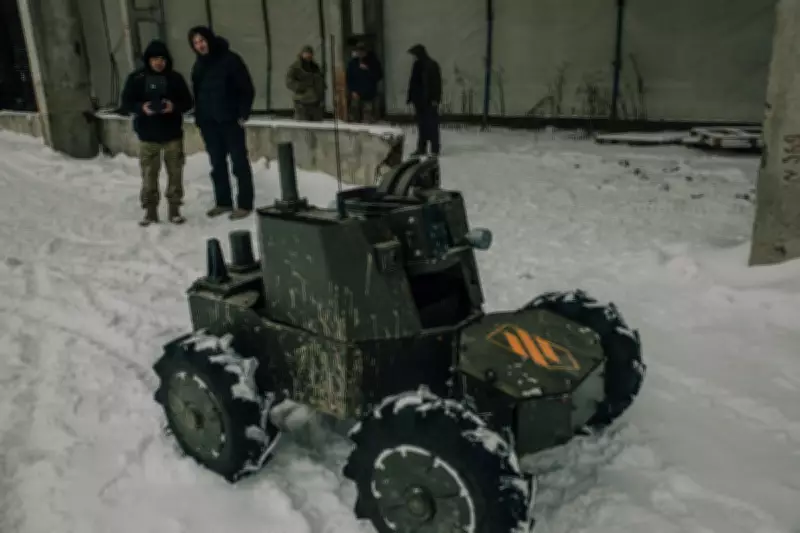
Ukraine's Robot Army Transforms Warfare in Conflict with Russia
The frontline of Europe's largest conflict since 1945 has undergone a dramatic technological transformation, with Ukraine deploying an expanding fleet of unmanned ground vehicles that are fundamentally changing how modern warfare is conducted. Lieutenant Victor Pavlov of Ukraine's 3rd Army Corps demonstrated the country's newest weapon systems: battery-powered land robots that come in various configurations and capabilities.
The Rise of Robotic Warfare
Since spring 2024, Ukraine's use of unmanned ground vehicles (UGVs) has grown exponentially, turning the war into what military experts describe as a technological contest. "This is what modern warfare looks like. Armies everywhere will have to robotise," declared Pavlov, highlighting the strategic shift from traditional armored vehicles to more agile, expendable robotic systems.
The conflict, now in its fifth year, has witnessed an astonishing evolution in battlefield weapons and tactics. Rather than relying on expensive tanks, both sides increasingly deploy cheap, precise drones and ground robots that can deliver explosives with deadly accuracy while minimizing human casualties.

Versatile Robotic Systems
Ukraine's unmanned ground vehicles serve multiple critical functions:
- Combat operations with remote-controlled machine guns and grenade launchers
- Logistics support, accounting for 90% of army supply movements
- Casualty evacuation, capable of transporting up to three wounded soldiers
- Engineering tasks including mining, demining, and vehicle recovery
One particularly dramatic incident occurred last summer when a kamikaze robot carrying 200 kilograms of explosives traveled 12 miles to destroy a school building occupied by Russian troops. Another system, the DevDroid TW 12.7, successfully defended a position for 45 consecutive days without human intervention.
Frontline Realities
Drone operator Bambi from the 25th Airborne Brigade described the psychological impact of facing robotic opponents: "It's not Star Wars, where there are lots of lasers. The frontline is more like Terminator. A land robot arrives at your position and there is nothing you can do about it."
He elaborated on the tactical challenge: "You can shoot a person in the chest and they stop firing. If you shoot a ground robot it doesn't feel pain. There is a guy looking at a screen who is going to fire back."
Training and Development
The 3rd Army Corps has pioneered ground robot development through its KillHouse academy, where soldiers train as UGV pilots. Instructor Oleksandr, known by the call sign "Barman," noted that former video gamers adapt particularly well to operating these systems, often outperforming traditional servicemen in robotic warfare scenarios.
Ukraine has developed a unique ecosystem where engineers design new products, frontline soldiers provide immediate feedback, and manufacturers rapidly scale up production. This innovation pipeline has produced ground vehicles, anti-drone interceptors, and pioneering sea drones that have attracted international attention.
Strategic Impact and Future Outlook
Ukraine's defense minister, Mykhailo Fedorov, highlighted the rapid expansion of remote operations: "As recently as six months ago, casualty evacuation using ground robotic systems was sporadic. Today, robots routinely enter high-risk areas."
The technological advantage has translated into battlefield successes, including the unprecedented surrender of Russian soldiers to an armed ground robot last summer. Andriy Biletsky, commander of the 3rd Corps, predicted that ground-based robotic systems would "radically change the battlefield and replace a significant share of soldiers" in both logistics and combat roles.
Despite Russia's development of its own ground systems like the "Courier" electric vehicle, Ukraine currently maintains technological superiority according to military assessments. The country's expertise has become so sought after that President Volodymyr Zelenskyy recently signed 10-year defense agreements with several Gulf states to provide low-cost Ukrainian interceptors capable of shooting down Iranian-made Shahed drones.

As the conflict continues, with Russia occupying approximately 20% of Ukrainian territory including Crimea, the robotic revolution represents what military analysts describe as the next evolutionary step in warfare—one where technological innovation may prove as decisive as traditional military might in determining the conflict's ultimate outcome.





