

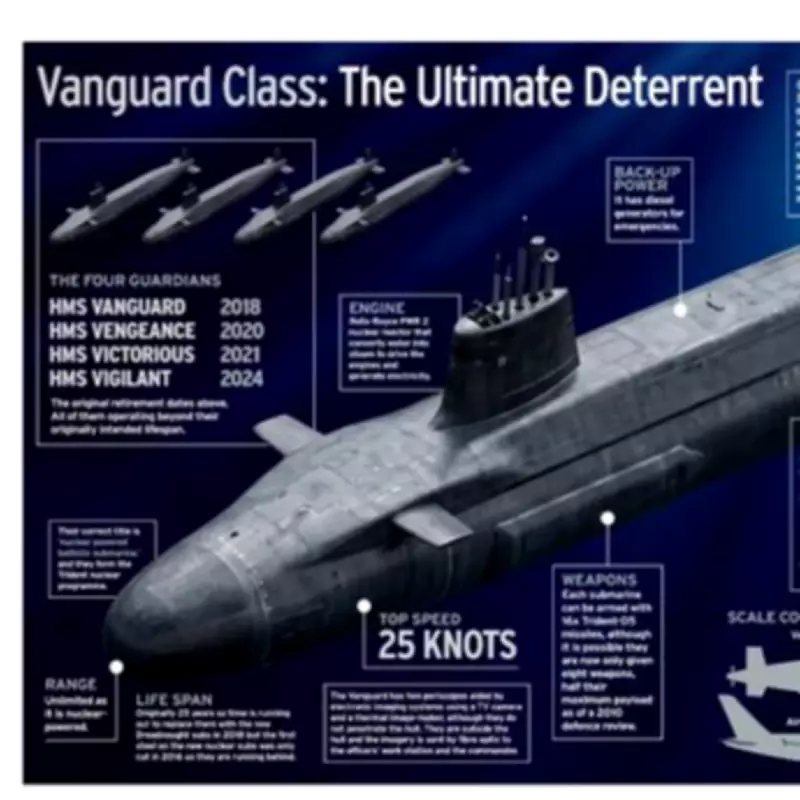
The Silent Guardians: Britain's £6 Billion Nuclear Submarine Fleet
Beneath the world's oceans, a silent and formidable presence glides through the depths, carrying the United Kingdom's ultimate nuclear deterrent. The Vanguard-Class ballistic missile submarines represent one of the British military's most closely-guarded secrets, with their exact locations known to only a handful of individuals beyond the Prime Minister.
The £6 Billion Underwater Leviathan
At today's prices, each Vanguard-Class submarine carries a staggering value of approximately £6 billion, making it the deadliest maritime weapon ever deployed by the Royal Navy. These sleek 25-mph leviathans lurk in oceanic depths, providing Britain with what military strategists describe as the ultimate protection against foreign adversaries.
For decades, Britain's four Vanguard submarines have rotated through continuous patrols, slipping beneath the waves from their Scottish base on secret missions that can last up to six months. Last year, HMS Vanguard returned to base after completing a record-breaking 204-day patrol, marking the longest-ever nuclear deterrent deployment in UK history.

The Continuous At-Sea Deterrence Strategy
This operation shattered previous records for the UK's Continuous At-Sea Deterrence (CASD) patrols, which have been increasingly exceeding five to six months in duration. Defence analysts suggest missions may be lengthening due to rising global threat levels or extended maintenance requirements for the aging submarine fleet.
The permanent patrols, conducted somewhere in the world's oceans at any given moment, cost the UK approximately £3 billion annually. This substantial expenditure has sparked ongoing debate about the necessity and cost-effectiveness of maintaining such a continuous nuclear presence.
Secret Operations and Command Structure
Few individuals beyond the Prime Minister possess precise knowledge of a Vanguard submarine's location at any particular time. The ultimate decision to launch a Trident nuclear missile in response to hostile state aggression rests solely with the Prime Minister, who would authorize such action through the Ministry of Defence's Submarine Command in Northwood, near London.
All four Vanguard-class submarines - Vanguard, Victorious, Vigilant, and Vengeance - are based at HMNB Clyde (Faslane) in Scotland, located approximately 40 miles west of Glasgow. This facility serves as the permanent home for Britain's nuclear deterrent fleet.
The Evolution of Britain's Nuclear Deterrent
Since 1969, the Royal Navy has maintained a continuous at-sea deterrent, ensuring at least one nuclear submarine remains on patrol at all times. This strategy ensures potential adversaries can never pinpoint the location of Britain's nuclear capability. Interestingly, many crew members themselves remain unaware of their submarine's exact position during missions.
The nuclear deterrent concept traces back to 1945 and the post-Second World War era, when UK military chiefs expressed concerns about vulnerability to overwhelming Russian attack. Initially, Britain's nuclear weapons would have been launched by air, with the Royal Air Force serving as the primary nuclear deterrent holder from 1954 until 1968.
Trident System and International Considerations
The Trident missile system remains closely linked to the United States' nuclear programme, raising questions about operational independence. According to the UK think tank Chatham House, while the missiles are US-built and the system relies on American maintenance, day-to-day operations remain completely independent. The British Prime Minister retains sole authority to launch missiles without external input.
Trident absorbs approximately six percent of the UK's defence budget, though changes in classification methods make precise annual costing difficult. Alternative nuclear deterrent strategies, including partnerships with France or broader European schemes, present their own unique challenges according to defence analysts.

The Future: Dreadnought-Class Successors
The Vanguard submarine system will be phased out within the next decade as the UK's new Dreadnought-class submarines, currently under manufacture, become operational. These super-stealthy vessels measure 169 yards in length and displace 17,200 tonnes, designed with advanced covert capabilities to carry Trident II D5 missiles.
The Dreadnought-class submarines will serve the UK for at least 30 years in an evolving global security landscape that increasingly includes military space capabilities. With shifting geopolitics and constantly changing threat environments, Britain's military establishment continues preparing for potential conflicts in the coming years while maintaining the nuclear deterrent that has protected the nation for over six decades.
The fundamental argument supporting this continuous deterrent remains unchanged: the threat of mutually assured destruction should theoretically dissuade any adversary from launching a nuclear attack against the UK mainland. This strategy has maintained its effectiveness since its implementation more than 60 years ago, through numerous geopolitical shifts and evolving global security challenges.





