US Strategic Bombers Touch Down at British Base as Iran Conflict Intensifies
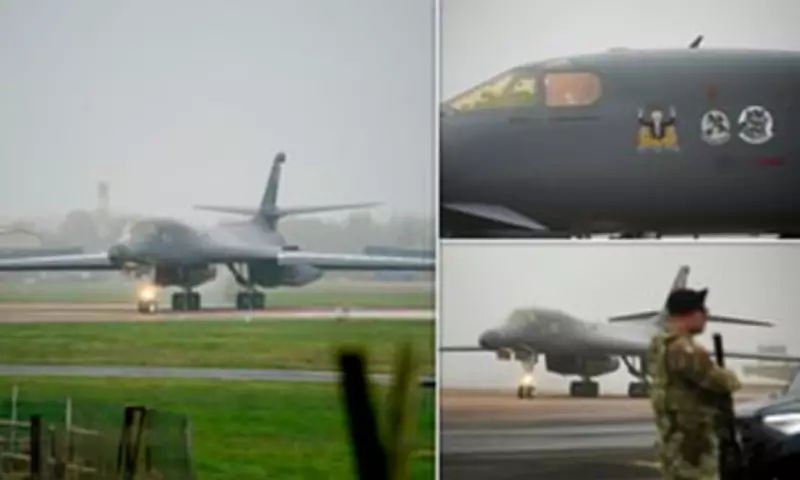
Three formidable US Air Force B-1 Lancer bombers have been photographed arriving at RAF Fairford in Gloucestershire today, marking a significant military buildup as Washington prepares for what President Donald Trump has ominously described as 'the big one' against Iran. These long-range strategic aircraft, each capable of carrying twenty-four cruise missiles, represent some of the most powerful conventional bombers in the American arsenal.
Military Surge at British Airbase
The arrival of these bombers follows the Pentagon's promise of a substantial 'surge' in strikes against Iranian targets, with RAF Fairford expected to host an increasing fleet of American bombers in the coming days. This development comes amid growing concerns that the conflict could escalate dramatically. The B-1 aircraft that landed on Friday evening is anticipated to be joined by additional stealth bombers, including B-2s and B-52 models, creating a formidable concentration of air power at the British facility.
Western officials confirmed earlier this week that these aircraft were expected at the base and that Britain had agreed to accept them. Each B-1 bomber, costing up to $2 billion, can execute long-range missions while remaining undetected, armed with some of the world's most devastating missiles. The strategic importance of these deployments cannot be overstated as tensions reach new heights.

Logistical Support and Cargo Capabilities
Accompanying the bomber deployment, a massive C-5 Super Galaxy cargo plane was also photographed at RAF Fairford on Friday night. As the largest aircraft in the US military inventory, its cavernous cargo bay can transport two M1 Abrams main battle tanks, six Apache helicopter gunships, or up to thirty-six military vehicles. This aircraft flew directly from Dyess Air Force Base in Abilene, Texas, arriving ahead of the first B-1 bomber from the 7 Bomb Wing based there.
Military sources have indicated that Saturday could mark D-day for a new massive bombardment campaign, exactly one week after America and Israel initiated 'Operation Epic Fury' against Iranian targets. The timing suggests a coordinated escalation of military pressure against Tehran.
Political Context and Strategic Statements
President Trump issued a stark warning to Iran this week, declaring that 'the big one' was imminent and emphasizing that 'we haven't even started hitting them hard. The big wave has not even happened.' This rhetoric has been matched by action, with US Defense Secretary Pete Hegseth announcing overnight that America would now utilize British RAF bases to 'dramatically' increase strikes against Iran.
Hegseth elaborated on the strategy, stating: 'When we say more to come, it's more fighter squadrons, it's more capabilities, it's more defensive capabilities, and it's more bomber pulses more frequently.' This statement followed Prime Minister Keir Starmer's authorization for American forces to launch defensive strikes from UK-US bases, despite earlier tensions between the two leaders.
Technical Specifications and Combat Capabilities
The B-1 Lancer measures 146 feet in length with a 137-foot wingspan, weighing 86 tonnes and achieving speeds exceeding 900 miles per hour, making it the fastest bomber in the US Air Force. Piloted by a crew of four and nicknamed 'the Bone,' this aircraft features advanced radar and GPS systems for precision targeting, along with electronic jammers, radar warning systems, and decoy mechanisms for protection against enemy defenses.
With a combat history spanning Syria, Libya, Afghanistan, and Iraq, the B-1 can carry up to 34 tonnes of weapons and equipment. According to the US Air Force, this aircraft 'carries the largest conventional payload of both guided and unguided weapons in the Air Force inventory' and serves as 'the backbone of America's long-range bomber force,' capable of delivering massive quantities of precision weapons against any adversary worldwide.

Escalating Military Activity and Security Measures
In a clear indication of increased military operations around Fairford, authorities have implemented a temporary Transponder Mandatory Zone (TMZ) effective today. This measure requires all aircraft in the area to activate their transponders for enhanced safety and air traffic control visibility, remaining in force for the next month. The Ministry of Defence has declined to comment on specific US aircraft movements when approached by media outlets.
Meanwhile, President Trump has declared that there would be 'no deal with Iran except UNCONDITIONAL SURRENDER!' in a social media post following Iran's announcement of unspecified mediation efforts. This uncompromising stance suggests diplomatic resolution remains distant as military preparations accelerate.
Potential Weapon Deployments and Expert Analysis
Military experts speculate that America might deploy the GBU-43/B Massive Ordnance Air Blast (MOAB), known as the 'Mother of All Bombs,' against Iranian targets. This 10-tonne explosive can create a 1,000-foot crater upon detonation, vaporizing anything at the blast site. While used previously in Afghanistan in 2017, it has not yet been deployed in the current conflict with Iran.
Sascha Bruchmann, a research fellow for defense at the International Institute for Strategic Studies, explained that 'the big one' likely refers to 'a sustained bombing campaign via the strategic bomber fleet, so the B-1s, the B-2s and the B-52s.' This assessment aligns with the observed buildup of bomber assets at British bases.
Iain Ballantyne, editor of Warships International Fleet Review magazine, added that these air attacks would likely be 'co-ordinated with the US navy unleashing not only the USS Gerald R Ford but also the USS Abraham Lincoln carrier strike groups,' suggesting a comprehensive multi-domain military operation.
Political Fallout and International Relations
The military escalation has created political tensions between the US and UK, with President Trump criticizing Prime Minister Starmer as 'unhelpful' and 'no Winston Churchill.' Despite these disagreements, Britain has ultimately permitted US use of its bases for defensive strikes against Iranian missile facilities.
As the conflict intensifies, central Tehran experienced one of the largest explosions of the war on Friday, with multiple plumes of smoke and fireballs visible across the city. Witnesses reported debris scattered throughout the city center and even claimed to have seen bodies thrown over 100 feet into the air, though these reports remain unverified.
The situation continues to develop rapidly, with all indicators pointing toward a significant escalation of military operations against Iran in the coming days and weeks.