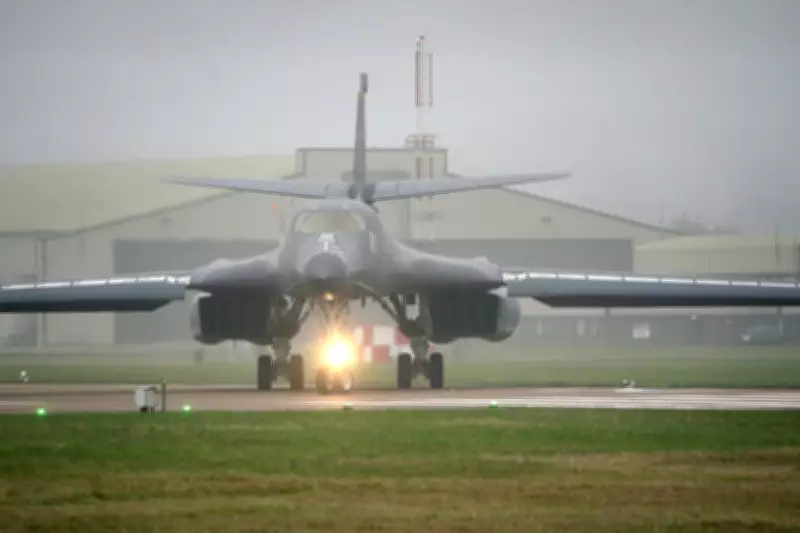
US Bombers Arrive at RAF Fairford for Defensive Missions
The United States has initiated the use of British military bases for what officials describe as "specific defensive operations" following the arrival of American B-1 Lancer bombers at RAF Fairford in Gloucestershire. The first of these formidable 146-foot aircraft touched down on Friday evening, with three additional bombers arriving on Saturday morning. This deployment comes amid heightened tensions in the Middle East, with former US President Donald Trump issuing a stark warning that Iran would be "hit very hard."
Defensive Posture Against Iranian Missile Threats
The Ministry of Defence has clarified that the US military is utilising these UK facilities to conduct defensive operations aimed at preventing Iran from launching missiles into the region, actions that could potentially endanger British lives. In a coordinated effort, a Merlin helicopter is being dispatched to assist with aerial surveillance, while RAF Typhoon and F-35 jets continue their air operations over Jordan, Qatar, and Cyprus.
Prime Minister Sir Keir Starmer has authorised this defensive US action against Iranian missile sites from British bases, emphasising a measured approach to the conflict. Sir Keir has defended his initial reluctance to permit US use of UK bases for offensive strikes against Tehran, suggesting such actions might have been unlawful and advocating for maintaining a "cool head" in government decision-making.

Evacuation Efforts for British Nationals Intensify
Meanwhile, evacuation efforts for British citizens caught in the conflict zone are accelerating. A second government charter flight carrying British nationals from Oman landed at Gatwick Airport in the early hours of Saturday, with a third flight scheduled to depart from Muscat on Sunday. The Foreign Office has announced plans for an additional commercial flight from the United Arab Emirates, scheduled to leave Dubai early next week pending security assessments.
These latest arrivals join more than 9,000 Britons who have returned from the UAE since widespread conflict erupted in the region. Eligibility for evacuation extends to British nationals along with their spouses, partners, and children under 18 years of age.
Regional Developments and Diplomatic Tensions
The conflict has prompted significant regional responses. Emirates Airlines briefly suspended all flights to and from Dubai following reports of explosions in the city, though services resumed approximately 30 minutes later. Qatar, Bahrain, and the United Arab Emirates all reported intercepting missiles and drones from Iran, despite Iranian President Masoud Pezeshkian's televised apology for attacks on neighbouring countries.
Diplomatic tensions continue to simmer, with the Iranian ambassador to the UK warning that Britain should exercise extreme caution regarding further involvement in the conflict. Within Iran itself, prominent cleric Ayatollah Nasser Makarem Shirazi has urged the Assembly of Experts to expedite the selection of a new supreme leader.
UK Military Considerations and Political Criticism
Questions persist regarding the United Kingdom's future role in the ongoing conflict. Deputy Prime Minister David Lammy has suggested that RAF jets could legally strike Iranian missile sites being used to attack British interests in the Middle East. Air Chief Marshal Sir Richard Knighton, Chief of the Defence Staff, indicated that the UK might participate in more proactive strikes as conflicts naturally evolve over time.
The UK's military response has faced criticism from allies, particularly concerning the defence of Cyprus where a British base was recently struck by a drone. While France and Greece have already deployed military assets to protect the island, the Royal Navy's Type 45 destroyer HMS Dragon is not expected to sail to the eastern Mediterranean until next week. Defence officials explain this delay results from equipping the vessel for potential extended deployment rather than rushing it into the region for a brief period.

Political divisions have emerged domestically, with Tory leader Kemi Badenoch launching renewed criticism of the government's response to the war. In a Saturday speech, Badenoch accused the Prime Minister of being "too scared to make foreign interventions" and asserted that Britain is "in this war whether Keir Starmer likes it or not."
Prime Minister Starmer has since agreed to allow the US to conduct defensive strikes against Iran from both RAF Fairford and Diego Garcia, a British territory in the Indian Ocean. US Defence Secretary Pete Hegseth has warned that military strikes are "about to surge dramatically," referencing increased fighter squadrons, enhanced defensive capabilities, and more frequent bomber deployments.