

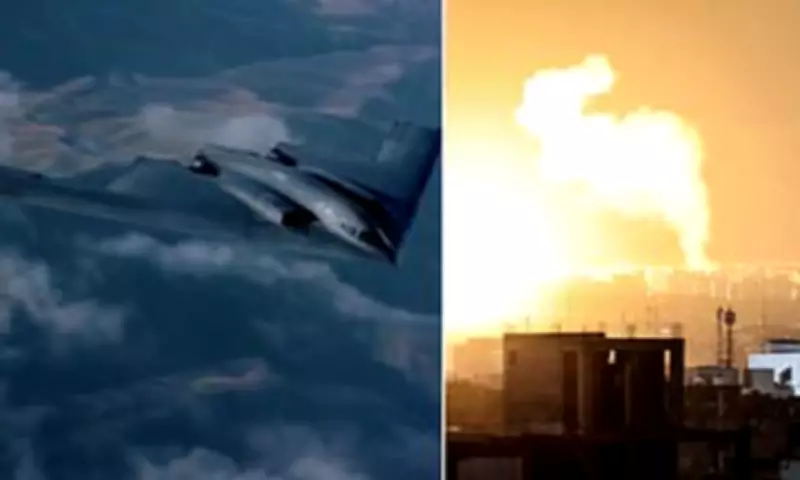
US Strategic Bombers Deploy to British Bases as Major Iran Strike Imminent
The United States Air Force's heaviest strategic bombers are expected to arrive at British military bases within hours, indicating that President Donald Trump's promised mega-attack on Iran—which he has ominously dubbed 'the big one'—is now imminent. America's formidable stealth air fleet, comprising B-1 Lancers, B-2 Spirits, and B-52 Stratofortresses, is reportedly en route to key locations: Diego Garcia in the Chagos Islands and RAF Fairford in Gloucestershire.
Unprecedented Firepower and Capabilities
These advanced strategic bombers, each costing up to $2 billion, possess the capability to execute long-range missions while evading detection, carrying some of the world's most devastating missiles. Military sources have suggested that Saturday could mark D-day for a new, gigantic bombardment campaign, precisely one week after the initial US-Israeli strikes on Iran as part of 'Operation Epic Fury'.
President Trump issued a stark warning to Iran earlier this week, declaring: 'We haven't even started hitting them hard. The big wave has not even happened.' Overnight, he escalated his rhetoric further, urging Iranian soldiers to 'surrender or die' following US raids that eliminated Ayatollah Ali Khamenei and much of Iran's senior military leadership.

Escalation and British Base Involvement
Military analysts widely concur that Trump's reference to 'the big one' signifies a dramatic escalation in US bombing sorties over Iran, potentially involving the deployment of America's largest conventional bombs. US Defense Secretary Pete Hegseth confirmed overnight that the United States will now utilize British RAF bases to 'dramatically' intensify its strikes on Iran, following Prime Minister Keir Starmer's authorization for the Americans to launch what are being termed 'defensive strikes' from UK-US facilities.
'When we say more to come, it's more fighter squadrons, it's more capabilities, it's more defensive capabilities, and it's more bomber pulses more frequently,' Mr. Hegseth stated emphatically.
Armament and Tactical Deployments
Among the aircraft preparing for action are U.S. B-2 stealth bombers, armed with 2,000-pound bombs. Experts suggest that some American bombers may carry the GBU-43/B Massive Ordnance Air Blast (MOAB), infamously known as the 'Mother of All Bombs'. This 10-tonne explosive creates craters approximately 1,000 feet wide, capable of destroying tunnels, bunkers, and infrastructure by pulling structures into the giant cavity.
Additionally, America's fleet of Reaper drones, equipped with thousands of pounds of laser-guided bombs for precision strikes, is expected to increase sorties over Iranian urban centers. Coordinated attacks from US aircraft carriers and submarine-launched missiles are also anticipated.
'The amount of firepower over Iran and over Tehran is about to surge dramatically,' Mr. Hegseth warned, underscoring the scale of the impending operations.
Expert Analysis and Strategic Implications
Sascha Bruchmann, a defence research fellow at the International Institute for Strategic Studies in Bahrain, explained to the Daily Telegraph: 'The big one is a sustained bombing campaign via the strategic bomber fleet, so the B-1s, the B-2s, and the B-52s.' He noted recent deployments, including four B-2s dropping heavy payloads with bunker-busting capabilities against missile sites.
Iain Ballantyne, editor of Warships International Fleet Review magazine, added: 'The most obvious thing that President Trump may mean by "the big one" is some kind of MOAB – the "Mother of All Bombs".' He predicted these air attacks would be coordinated with US naval forces, including carrier strike groups and submarine bombardments.
Political Fallout and British Response
The deployment claims follow Prime Minister Keir Starmer's decision to relax access for the US Air Force to use British bases, though he maintains that the UK is right not to have joined the offensive against Iran directly. At an emergency press conference, Sir Keir asserted he was providing 'calm, level-headed leadership' and urged President Trump to de-escalate the crisis.

However, his stance has drawn sharp criticism. President Trump labeled him a 'loser', while Shadow Foreign Secretary Priti Patel accused the government of feebleness. Reform UK leader Nigel Farage argued that Britain should have supported the US-Israeli attack from the outset, stating: 'If this war stops Iran from getting a nuclear bomb, it will have been worth it.'
Sir Keir defended his refusal to allow the initial US bombing raids to launch from Diego Garcia and RAF Fairford, which killed Iran's Supreme Leader and disrupted its nuclear program. He questioned the legality of the strikes and suggested a lack of post-bombing planning, emphasizing: 'While the region has been plunged into chaos, my focus is providing calm, level-headed leadership in the national interest.'
Regional Reactions and Military Deployments
Allies in the Middle East, including Bahrain and the United Arab Emirates, have reportedly criticized Sir Keir for insufficiently defending British interests. Cyprus has expressed disappointment after an RAF base on the island was hit by an Iranian drone, leading the country to seek military support from France, Italy, and Spain instead of Britain.
In response, Britain is deploying an additional four Typhoon jets to Qatar. Defence Secretary John Healey visited Cyprus to address concerns, though the warship HMS Dragon, tasked with defending the Cyprus base, may not arrive for up to two weeks, leaving Greek, Spanish, French, and Italian vessels to provide interim defence—a situation critics have called a national humiliation.
As tensions mount, the imminent arrival of US heavy bombers at British bases marks a critical juncture, with the potential for sustained, large-scale military action that could reshape the geopolitical landscape of the Middle East and test international alliances.





