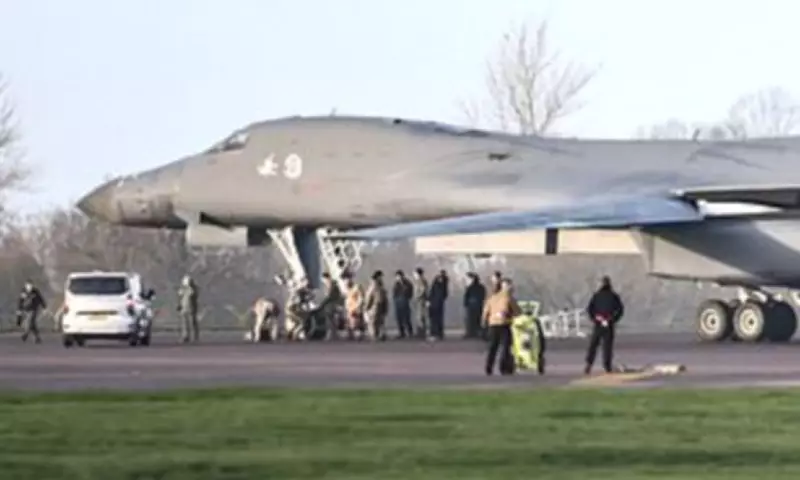
Three American B-1 Lancer bombers have returned to British soil after executing the first UK-sanctioned assaults on Iran since Prime Minister Sir Keir Starmer altered his government's military policy. The supersonic aircraft landed at RAF Fairford in Gloucestershire on a clear morning, concluding missions that contributed to what US War Secretary Pete Hegseth described as the conflict's 'most intense night of bombing'.
Policy Shift Following Iranian Attack
Previously, the Prime Minister had refused former President Donald Trump permission to utilize RAF Fairford and Diego Garcia for military campaigns, citing concerns that US intentions to instigate regime change in Iran violated international law. Downing Street's position changed dramatically after an Iranian drone targeted a British airbase in Cyprus on March 1st. Following this provocation, the UK authorized the deployment of B-1 and B-52 bombers at Fairford.
RAF Fairford serves as a crucial strategic asset for the United States Air Force due to its extended runway capacity and its ability to shorten flight distances for long-range bombers originating from American territory. The specific combat roles undertaken by the B-1s during their overnight missions remain classified information. Neither the Ministry of Defence nor Downing Street officials were willing to discuss operational details this morning.

Technical Capabilities and Mission Details
The B-1 Lancers, capable of exceeding speeds of 900mph, touched down around 08:30am after completing approximately 15-hour sorties. These aircraft were loaded with missiles prior to the raids and possess the capacity to carry up to 75,000 pounds of ordnance. Details regarding their contribution to Operation Epic Fury may eventually be disclosed by the White House or the US Department of War.
While the UK has permitted American forces to use British bases for offensive actions targeting Iranian munitions sites and missile launch facilities, British fighter jets deployed to the region remain restricted to defensive interceptions of airborne munitions. Conservative Leader Kemi Badenoch has characterized this approach as 'catching arrows rather than targeting the archer'.
Government Defense of Dual Strategy
Defence Minister Luke Pollard addressed this apparent contradiction during an appearance on BBC's World At One program. He stated: 'We have permitted and accepted a request from the United States to use a small number of our bases for very limited actions. The UK is not involved in offensive action. That is the right decision for us.'
Pollard elaborated: 'The defensive action that we are taking is to intercept missiles and drones that threaten British bases and our allies in the region. That's why we maintain continuous aerial patrols and are deploying additional resources to the theater. Defensive actions enjoy public support and represent the appropriate course of action.'
The minister emphasized the gravity of such decisions, noting: 'Committing our forces to military action represents the most significant determination a Prime Minister or Minister can undertake.'
Historical Context and Aircraft Design
The B-1 bomber was originally conceived during the 1970s, entered active service in the 1980s, lost its nuclear mission following the Cold War, and subsequently established its reputation through operations over Iraq and Kosovo. One of the aircraft's defining characteristics is its variable-sweep wing design, mounted high on either side of the fuselage.
These wings can adjust position depending on flight phase: positioned forward, they provide necessary lift and control for takeoff, landing, and refueling operations; swept backward, they reduce aerodynamic drag and enable high-speed flight. This configuration creates a bomber whose form reflects its function: transporting substantial weapons payloads across extensive distances while maintaining rapid flight capabilities.
Operational Impact and Iranian Response
The British-based bombers participated in what Secretary Hegseth termed the 'most intense' operations involving 'the most fighters, the most bombers and the most strikes'. Official statistics from last night's missions have not yet been released, but sorties are understood to have lasted approximately 15 hours.

US aircraft currently operate over Iranian airspace with what General Dan Caine, Chairman of the US Joint Chiefs of Staff, described as 'relative impunity'. This follows the substantial degradation of Iranian radar and surface-to-air missile systems. Footage released by US Central Command (CENTCOM) shows American bombers striking Iranian missile launchers, causing warheads to 'cook-off' within underground facilities.
CENTCOM Commander Admiral Brad Cooper confirmed that 'Iranian combat power is declining', noting the destruction of the last four remaining Soleimani-class warships. Additionally, CENTCOM verified the elimination of 16 mine-laying vessels capable of deploying mines in the strategically vital Strait of Hormuz.
Admiral Cooper explained: 'We are methodically dismantling Iranian capabilities by targeting their missiles and drones. Just last night, our bomber force struck a major ballistic missile manufacturing facility. Our strategy addresses not only immediate threats but also works to eliminate future dangers.'
Intelligence Challenges and Iranian Strategy
American forces reportedly face difficulties in locating all of Iran's missile launch sites. US defense officials have expressed concern that the Pentagon lacks comprehensive intelligence regarding the Islamic Republic's complete missile launcher inventory, according to The New York Times.
Sources suggest Iran has deliberately withheld numerous missiles, maintaining them in reserve for potential future attacks against critical American infrastructure such as radar installations. This strategic conservation indicates Tehran's preparation for prolonged conflict despite current military setbacks.