

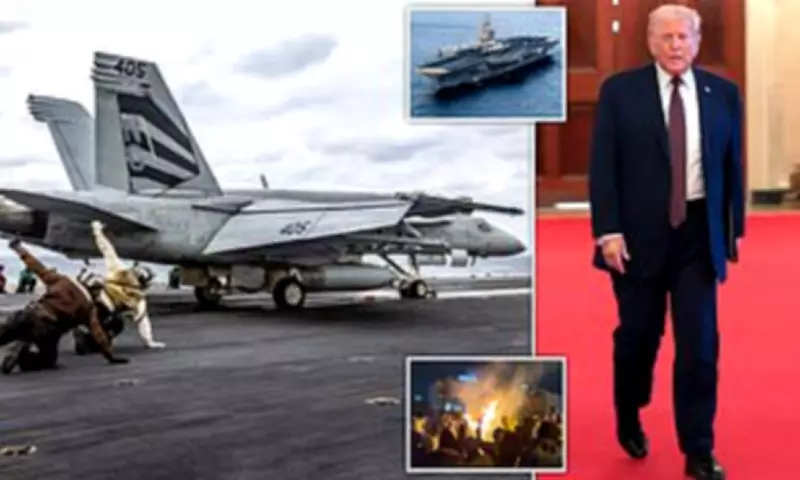
The United States military has initiated its most substantial deployment of jet fighter aircraft to the Middle East since the 2003 invasion of Iraq, as President Donald Trump deliberates on whether to authorise military action against Iran. According to reports, Trump has been deeply engaged in evaluating potential strike scenarios and may reach a decision regarding a large-scale operation by the upcoming weekend.
Military Buildup and Strategic Options
Sources indicate that President Trump is contemplating multiple offensive strategies, with the significant military mobilisation suggesting that any chosen course of action could require weeks to fully implement. The Wall Street Journal reports that US officials are presenting options ranging from a decapitation strike aimed at Iran's political and military leadership to spur regime change, to a more sustained assault on Iranian nuclear facilities, reminiscent of last year's operations.
Advanced Aircraft and Naval Assets
In recent days, the US has commenced deploying advanced fighter jets to the region, including F-35 and F-22 Raptor stealth aircraft, alongside F-15 and F-16 warplanes. Critical support assets such as KC-135 aerial refueling tankers and E-3 Sentry airborne warning and control aircraft have also been tracked heading towards the Middle East, essential for coordinating extensive air operations.

Naval reinforcements are equally substantial, with Washington currently maintaining 13 warships in the area, featuring the aircraft carrier USS Abraham Lincoln, nine destroyers, and three littoral combat ships. The USS Gerald R Ford, the world's largest aircraft carrier, is en route from the Atlantic Ocean, accompanied by three destroyers, following orders from Trump earlier this month. The presence of two US aircraft carriers in the region is a rare occurrence, highlighting the scale of the buildup.
Political and Diplomatic Context
Amid escalating tensions, the US is simultaneously preparing to withdraw its remaining troops from Syria, with a senior White House official stating that the Syrian government will assume responsibility for counter-terrorism efforts. This move occurs as diplomatic efforts with Iran have seen renewed indirect talks, mediated by Oman, though previous negotiations collapsed following Israeli strikes last June.
White House Press Secretary Karoline Leavitt emphasised that Iran would be wise to negotiate a deal with the Trump administration, while Trump himself has hinted at military action via social media. However, Tehran has shown reluctance, with Iran's top diplomat, Abbas Araghchi, mentioning that Iran is drafting a framework for future discussions, though key US demands regarding nuclear development remain unmet.
Domestic and International Reactions
Domestically, Trump faces divided counsel, with aides both advocating for and against military intervention. Republican Senator Ted Cruz assured that any action would not involve a ground invasion, stating that Trump is focused on defending national security interests without large-scale troop deployments. Conversely, Democrat House Minority Leader Hakeem Jeffries stressed that congressional approval should precede any acts of war, reflecting public wariness.
Internationally, Iran's exiled Crown Prince Reza Pahlavi has called for regime change, describing it as a humanitarian intervention, while Israeli Prime Minister Benjamin Netanyahu has urged the US to address Iran's ballistic missile program and support for proxy groups. Secretary of State Marco Rubio is scheduled to travel to Israel to update Netanyahu on negotiations.
Regional Tensions and Economic Implications
Iran has responded by conducting military drills, including a temporary closure of parts of the Strait of Hormuz, a critical waterway for global oil transit. This action serves as a warning of potential economic disruption if conflict escalates, though Iran has not fully closed the strait since the 1980s. Regional allies like Turkey and Saudi Arabia have cautioned against strikes, fearing a broader regional war.

The potential for conflict represents the most significant military engagement since the 2003 Iraq War, with profound implications for Trump's presidency and the upcoming midterm elections. As Republicans aim to maintain congressional control, a war could influence political dynamics, with Trump's preparations unfolding amid threats from Iranian leaders and ongoing strategic calculations.





