US Quietly Introduces Reverse-Engineered Lucas Drones in Iran Conflict
Amid the largest concentration of American military power in the Middle East in decades, a significant and ironic development has largely gone unnoticed. In the opening stages of the conflict with Iran, the United States has discreetly deployed its Low-Cost Uncrewed Combat Attack System, known as Lucas. This one-way attack drone is modelled directly on the inexpensive technology that Iran itself has been refining since the 1980s.
The Iranian Inspiration and Global Proliferation
Iran's Shahed drones, said to have been inspired by technology originally developed by Israel, emerged as a military workaround necessitated by international sanctions. Alongside ballistic missiles, they have become Iran's primary domestically produced air weapon. The Shahed-131 made its operational debut in September 2019 during an attack on a Saudi oil refinery.
What began as a regional tool has evolved into a global weapon. Iran's proxies, such as the Houthis in Yemen, initially utilized these drones. Subsequently, Russia employed them extensively in its war against Ukraine, leading Ukrainian President Volodymyr Zelensky to label Iran as "Putin's accomplice" for supplying both drones and the technology to manufacture them locally.

American Reverse Engineering and Swift Deployment
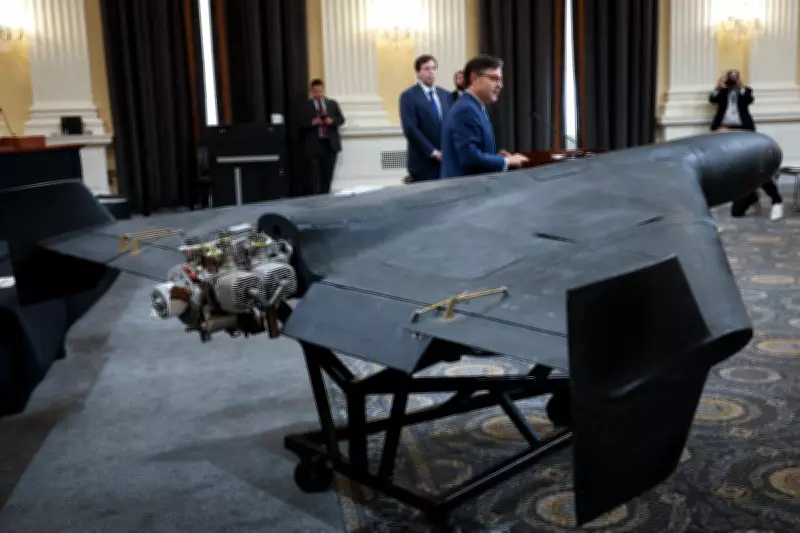
Impressed by the battlefield efficacy of large-scale, low-cost drone assaults, the United States initiated covert operations to capture Shahed-136 drones for technical analysis. Through reverse engineering, the US created replicas for counter-drone training. These replicas were further adapted into the current fleet of Lucas drones.
The rollout has been remarkably rapid. Within just five months of the program's inception, the Pentagon equipped US forces in the Middle East with Lucas drones. Capabilities were tested, including sea-launching from a warship in the Arabian Gulf.
On February 28, 2026, US Central Command confirmed the first combat use of Lucas drones. They were launched from ground positions by Scorpion Strike, a specialized US task force established in December 2025 with the explicit aim to "flip the script on Iran" using advanced drone technology.
Lucas drones are also believed to have been deployed in Caracas, Venezuela, on January 3, 2026, as part of a mission targeting President Nicolás Maduro. However, their official operational debut in Iran signifies a profound shift in the economics and potentially the philosophy of American air power.
The Arithmetic of Modern Warfare: Embracing Affordable Mass
For decades, Western airpower has focused on developing aircraft that are faster, higher-flying, and longer-ranging. However, a 1979 study by Pentagon official Norm Augustine highlighted the spiraling costs of such advanced fighter jets, humorously predicting that by 2054, the entire defense budget might afford only one tactical aircraft.
This underscored a critical truth: while highly advanced war machines are formidable, they are also scarce, slow to replace, and politically sensitive to lose. The solution, as demonstrated by military experiences in Israel and Ukraine—where approximately 75% of battlefield casualties have been attributed to small drones—is the concept of "affordable mass."
Priced at roughly $35,000 each, the Lucas drone embodies this strategic logic. The Trump administration's "drone dominance" program aims to amass a stockpile of 340,000 comparable drones by early 2028, building upon the earlier Replicator Initiative started under President Joe Biden.
Technical Comparison: Iranian Shahed vs. US Lucas Drones
Iran's Shahed drones, particularly the widely used Shahed-136 variant, are designed for long-range, one-way attacks. Constructed from foam and plywood, this 3.5-meter drone carries a 40-50kg explosive warhead. As loitering munitions, they can travel over a thousand miles at around 115 mph, circle for up to six hours, and then dive at their target with high accuracy using satellite navigation.
Costing upwards of $20,000 each, they occupy a strategic niche between cheaper quadcopter drones and expensive cruise missiles. The Russian-assembled version, Geran-2, has extended this threat to critical infrastructure and urban centers across Ukraine.

In contrast, the initial US imitation model, codenamed FLM-136, was lighter, reducing its range to 400 miles and halving its weapon payload to 18kg—though this is still double the payload of a US Hellfire missile. The operational Lucas drones have been observed with enhanced features:
- A nose-mounted gimballed camera system
- Modules for satellite connectivity
This connectivity allows Lucas operators to re-task drones in flight, update target data dynamically, and coordinate salvos more effectively than pre-programmed Shahed systems. Satellite links could also facilitate AI-powered "swarm" tactics, enabling drones to act as a coordinated attack team.
Strategic Implications and Future Potential
If deployed in large numbers, Lucas drones could saturate Iran's radar systems by presenting more targets than operators can effectively track. This could create openings for more advanced, expensive US and Israeli weapon systems to penetrate defenses and strike heavily protected targets like strategic bunkers and nuclear facilities.
Low-cost, expendable drones are particularly effective in compact theaters such as the Middle East, where distances and logistics are manageable. However, the full potential of Lucas in contested, electronically jammed environments will depend on its ability to leverage AI-driven swarming techniques.
Currently, the United States lacks the necessary technology, public support, and legal framework to deploy a fully AI-powered air force. Nevertheless, this development marks a significant step toward that future, reshaping the dynamics of modern aerial warfare.