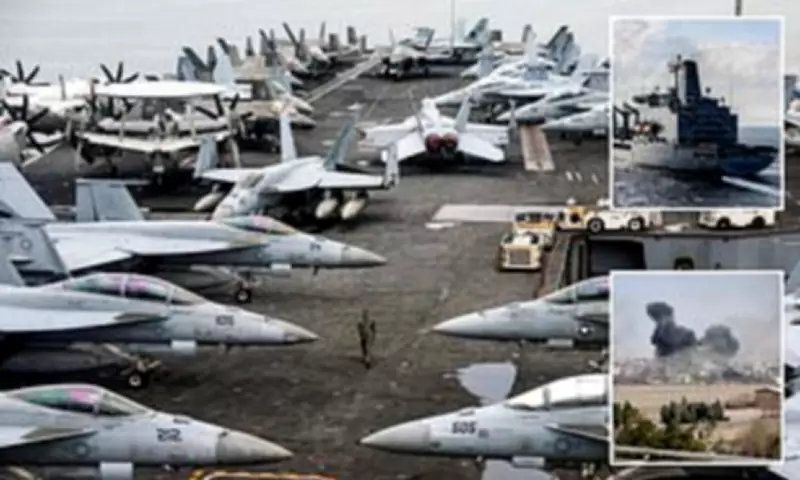
US Military Operation in Iran Costs Billions in First Week, Study Reveals
A full-scale military operation by the United States in Iran has potentially cost American taxpayers billions of dollars within just the first week of conflict. The joint strikes launched by the US and Israel on February 28 triggered retaliatory actions from Iran, targeting US military bases across the Middle East and resulting in a death toll that has climbed into the thousands.
Casualties and Initial Impact
According to Iran's UN ambassador, the death toll has surpassed 1,300 individuals. Additionally, more than 200 people have been killed in Lebanon, and at least 11 in Israel. In a significant incident, six US military members lost their lives in an Iranian airstrike at a base in Kuwait on Sunday. Former President Donald Trump attended their dignified transfer in Delaware on Saturday. The ongoing hostilities have severely disrupted travel, with airspace over the Middle East temporarily closed, leaving thousands of Americans stranded abroad.
Cost Breakdown and Estimates
The Trump administration has faced frequent questions regarding the financial burden of these operations. While the Department of War provided details on assets and targets from the initial 72 hours of Operation Epic Fury, government officials have not disclosed exact costs. However, the Center for Strategic and International Studies, a bipartisan research institution in Washington, analyzed Department of War fact sheets, Congressional Budget Office estimates, and official statements to offer an estimate. Their study concluded that the US spent approximately $3.7 billion, or $891.4 million per day, during the first 100 hours of the operation.

Key expenses include:
- Munitions: $3.1 billion, entirely unbudgeted.
- Combat losses and infrastructure damage: $359 million, also unbudgeted.
- Operations and support costs: $196.3 million, with $18.3 million already in the budget.
This indicates that the Department of War utilized around $3.54 billion in unbudgeted funds in the early stages of the conflict. Congress had previously passed a $900 billion defense budget last year.
Detailed Operational Costs
Below is a breakdown of military expenses across different domains:
Air Operations
CSIS estimates that air operations cost $125 million in the first 100 hours, increasing by $30 million daily. The US Central Command reported over 200 fighter aircraft involved, with daily costs for key assets including:
- Tanker and cargo: $9 million
- Carrier air wing: $5 million
- Non-stealth fighter: $5 million
- Stealth fighter: $5 million
Naval Operations
Naval operations amounted to $64 million initially, with $5.9 million unbudgeted, and costs rising by about $15 million per day. The US has deployed significant naval forces, including two aircraft carriers, 14 destroyers, and three littoral combat ships across the Arabian Sea, Persian Gulf, and eastern Mediterranean. Daily costs for major assets are:
- Aircraft carrier: $6 million
- Destroyer: $5 million
Ground Operations
While no ground invasion has been initiated, nearly 600 US soldiers are stationed in the Middle East, with artillery units and a National Guard battalion activated. Ground operations cost an estimated $7 million, with daily expenses for assets like an artillery brigade at $1 million and a National Guard battalion under $1 million.
Munition Expenditures and Future Projections
Based on past US air campaigns, CSIS projects that replenishing munitions used in the first 100 hours will cost $3.1 billion, with daily increases of $758.1 million. The US Central Command confirmed over 2,000 munitions sent to Iran in the initial days. Long-range missiles, though expensive and scarce, were crucial for destroying Iranian air defenses. Equipment losses and infrastructure damage add approximately $359 million to the total.

The extent of damage to US bases in Gulf countries remains unclear, but videos show explosions in Kuwait and Qatar. As the conflict enters its second week, Department of War Secretary Pete Hegseth stated that US forces are accelerating efforts, hinting at prolonged engagement. Researchers, such as Kent Smetters from the University of Pennsylvania's Penn Wharton Budget Model, warn that even a two-month war could cost up to $95 billion, echoing the Iraq War's $3 trillion price tag, far exceeding initial estimates. The Pentagon has not provided exact cost figures to the media.