

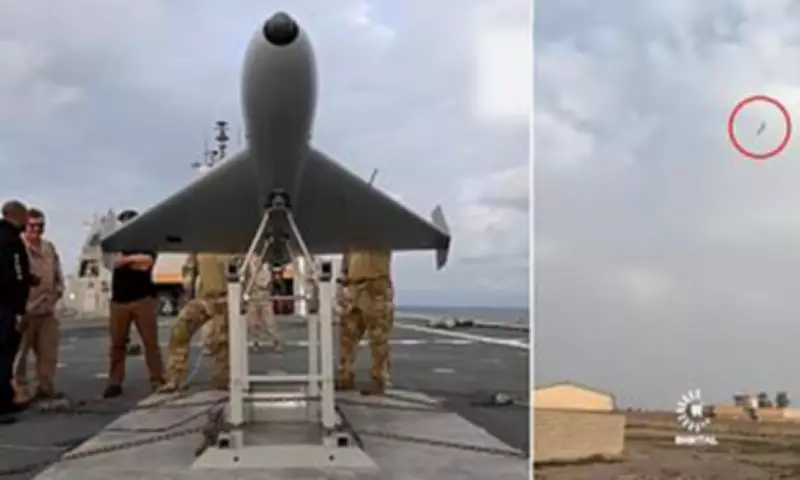
US Military Deploys LUCAS 'Suicide Drone' in Combat, Inspired by Iranian Shahed Design
The United States military has introduced its own version of Iran's notorious Shahed drones onto the battlefield for the first time, as revealed by the Daily Mail's War On Tape series. The LUCAS (Low-cost, Uncrewed Combat Attack System) was captured on camera during an operation in Iraq, where it was used by an Iranian militia to attack an enemy shelter, resulting in a massive explosion.
Design and Development of the LUCAS Drone
Developed by SpektreWorks for the US military, the LUCAS drone costs approximately $35,000, making it significantly cheaper than traditional missiles. It has been utilized since the initial phases of Operation Epic Fury, a joint US-Israel strike against Iran. Foreign correspondent Chris Pleasance notes that this marks a rare instance in decades where the US has openly imitated an adversary's military technology.
Key Differences Between LUCAS and Shahed Drones
While both drones serve as one-way attack vehicles, often termed 'suicide' or 'kamikaze' drones, the LUCAS model features critical advancements. Unlike Iran's Shahed, which requires pre-programmed flight paths before launch and cannot alter course, the LUCAS can be operated via satellite. This allows pilots to communicate over vast distances, view real-time footage from the drone's front camera, and adjust targets mid-flight.

Enhanced Capabilities: The satellite relay enables the LUCAS to scan for new targets, engage moving objects like tanks, and coordinate with other drones in a swarm, significantly boosting its effectiveness. Measuring 10 feet in length with an eight-foot wingspan, it is slightly smaller than the Shahed 136. It has a top speed of 115mph and a range of 500 miles, compared to the Shahed's 125mph and 1,500-mile range.
Versatility and Military Impact
Weighing 180lbs when fully loaded, the LUCAS is lighter and quieter than its Iranian counterpart. Its 40lb warhead can be swapped for surveillance or electronic jamming equipment, adding to its versatility. Pleasance explains that this adaptability allows it to be used against various targets, such as field barracks, ammunition dumps, or vehicle workshops, introducing friction into enemy operations without requiring expensive missile systems.
Admiral Brad Cooper of US Central Command (CENTCOM) praised the drone's impact, stating that Task Force Scorpion has achieved 'massive effects' with these one-way attack drones. He highlighted that the LUCAS design was originally based on captured Iranian drones, which were reverse-engineered and produced domestically.
Strategic Implications in Modern Warfare
The deployment of LUCAS drones represents a strategic shift, offering a cost-effective complement to traditional missiles. By targeting lower-value assets, they can disrupt adversary plans efficiently. As conflicts evolve, such innovations underscore the growing importance of unmanned systems in military campaigns, potentially reshaping tactics in regions like the Middle East.






