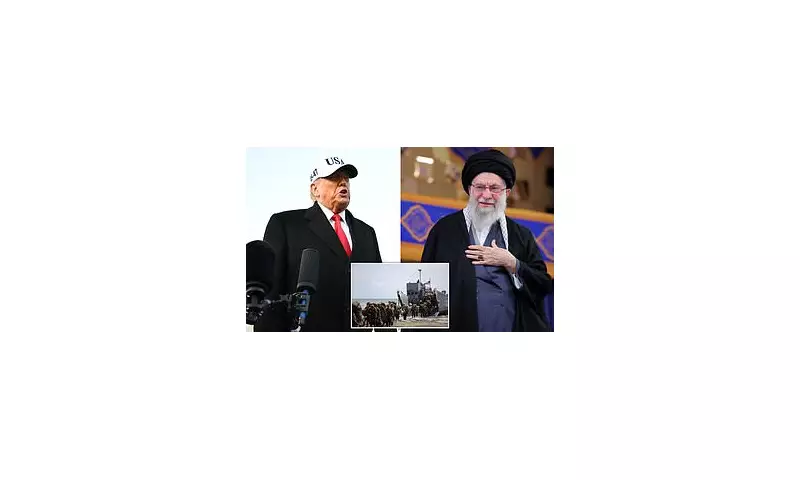
The Trump administration has insisted it retains multiple options to respond to Iran's violent crackdown on demonstrators, but a quiet reduction of American military assets in the region has significantly constrained its potential firepower.
Shifting Sands: US Military Assets Redeployed
While officials publicly maintain a posture of strength, key warships and thousands of troops have been redeployed from the Middle East to the Caribbean for operations concerning Venezuela. In a further drawdown, a major missile defence system was returned to South Korea.
Critically, the United States currently has no aircraft carrier stationed in the Middle East, as the last one was dispatched to the Caribbean late last year. Administration officials have privately acknowledged to Politico that there are no present plans to send heavy weaponry back to the region, marking a notable shift from the posture of just a few months ago.

Limited Strikes and Political Divisions
President Donald Trump could still authorise airstrikes targeting Iranian leadership or military installations. However, his options are considered far less robust than during Operation Midnight Hammer in June, a joint US-Israeli operation that struck Iran's major nuclear facilities at Fordow and Natanz.
This military limitation emerges as US lawmakers remain deeply divided on whether America should intervene at all. Critics warn that fresh strikes could entangle the US in another protracted Middle Eastern conflict.
"What's the objective? How does military force get you to that objective?" demanded Senator Jack Reed, the top Democrat on the Armed Services Committee. He added that the president has "yet to make the case" that military action would aid protesters or force political change.
In contrast, hawkish Senator Lindsey Graham framed potential US intervention as essential for both liberating the Iranian people and ensuring regional security.
On-the-Ground Horror and a Potential Hit List
The debate unfolds against a backdrop of escalating brutality in Iran. Protests, triggered in December by soaring inflation and the collapse of the rial, have expanded into broader demands for political change. According to human rights groups, the death toll has now surpassed 3,000, with thousands more reportedly facing execution.
Iranians have told the Daily Mail that the Islamic Revolutionary Guard Corps (IRGC) has orders to "shoot to kill" unarmed protesters. Harrowing accounts describe kidnappings, home raids, and hospitals receiving protesters with gunshot wounds. One doctor described a "mass casualty" situation, with images emerging of rows of body bags. Disturbingly, two sources claim the Iranian government is charging families for the return of their loved ones' bodies.
As the bloodshed reaches a fever pitch, President Trump is actively weighing his options, even reviewing geographic intelligence. He stated on Tuesday that he had cancelled meetings with Iranian officials and told protesters, "help is on the way."
The administration has reportedly been provided with a sophisticated list of high-value military targets. The Washington-based group United Against Nuclear Iran compiled a dossier of 50 targets, including the exact coordinates of the IRGC's Tharallah Headquarters—the nerve centre of the protest crackdown—and delivered it to White House officials.
With roughly 10,000 US service members at Qatar's Al-Udeid Air Base and smaller contingents across Iraq, Jordan, and Syria, a former defence official warned that any conflict could quickly become a "sticky situation," especially if Iranian counter-attacks overwhelmed US defensive interceptor supplies.
A White House official stated, "All options are at President Trump's disposal to address the situation in Iran," emphasising that he will "ultimately make the decision that he feels is best." However, the gap between rhetorical options and tangible military capability has never been wider.