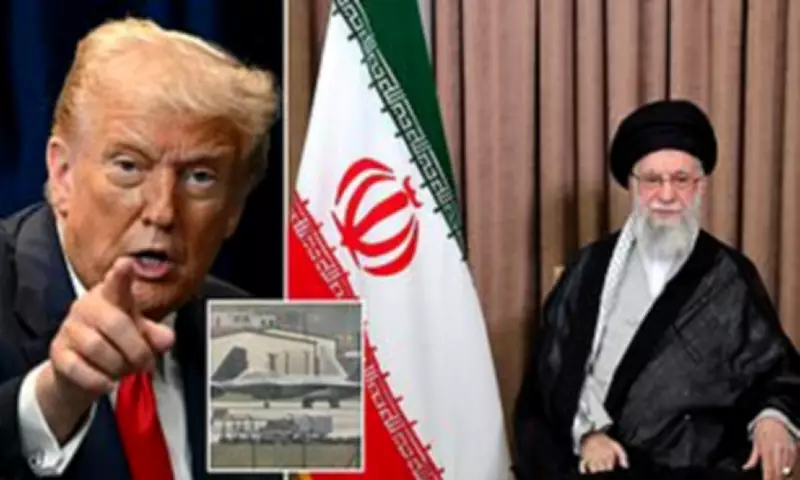
The United States military has formulated advanced and high-stakes contingency plans for a potential military strike against Iran, encompassing extreme options that target specific individuals and actively pursue total regime change in Tehran. This development comes as President Donald Trump stated today during a breakfast with governors at the White House that he is 'considering' a limited military strike on Iran, aiming to increase pressure on the country's leadership.
Decision Hinges on Presidential Approval
All potential actions against Iran depend entirely on the green light from President Trump. According to a State Department insider speaking to the Daily Mail, at this critical juncture, Trump has not yet reached a final decision. He is carefully weighing Iran's responses and the counsel of his cabinet members and advisers.
Aggressive Military Options Signal Readiness for Conflict
Two U.S. officials have revealed that these aggressive military plans represent the most stark indication to date that America is preparing for a serious, all-out conflict should ongoing diplomatic efforts completely collapse. These chilling new details build upon reports from last week indicating that the Pentagon is actively gearing up for a sustained, weeks-long military blitz designed to obliterate Iranian security facilities and deeply embedded nuclear infrastructure.

Unprecedented Military Buildup in the Region
The U.S. military presence in the Middle East has expanded dramatically, with more resources positioned across the region than at any point in recent history. Military experts assert this constitutes the greatest concentration of naval armada and firepower assembled since the invasion of Iraq.
Currently, two aircraft carriers are deployed alongside approximately a dozen warships, supported by hundreds of fighter jets and advanced air defense systems, with additional reinforcements en route. The world's largest aircraft carrier, USS Gerald R. Ford, is among the military assets moving into the Middle East theater.
Massive Logistics and Airpower Deployment
Over 150 U.S. cargo flights have already transported substantial quantities of weapons and ammunition into the Middle East. In just the past 24 hours, an additional 50 fighter jets, including advanced F-35s, F-22s, and F-16s, have been dispatched to the region. U.S. Air Force F-22s stationed in the United Kingdom are also en route to the Middle East to support B-2 bomber operations.
Coordinated Operations and Regional Implications
The anticipated military operation is expected to be coordinated with Israel and would be broader in scope than last year's 12-day conflict, which escalated when the United States joined Israeli efforts to destroy Iran's underground nuclear facilities. Such a campaign is described by sources as potentially 'existential for the regime' in Tehran, possessing the capacity to fundamentally reshape the balance of power across the entire Middle East.
Insiders have warned that any military action would exert a 'dramatic influence on the entire region' and could define the remaining years of President Trump's administration. Despite these enormous stakes, there has been remarkably little public debate in Washington, with congressional attention and public focus directed toward other matters.
Escalating Tensions and Diplomatic Efforts
Tensions have been building for several weeks, with Trump having previously considered military action in early January following reports of the Iranian regime killing thousands of protesters. This week, talks were held in Geneva between Trump advisers Jared Kushner and Steve Witkoff and Iran's Foreign Minister Abbas Araghchi. The discussions lasted three hours, with both sides claiming they 'made progress,' though U.S. officials acknowledge that significant gaps remain unresolved.
Iran has simultaneously been conducting joint military exercises with the Russian Navy, framing these drills as efforts to ensure 'maritime security.' In a notable development, Iran's foreign minister Abbas Araghchi stated this morning on the Morning Joe program that Trump's designated negotiators, Steve Witkoff and Jared Kushner, reportedly did not request Iran to commit to zero uranium enrichment during their discussions in Geneva.