

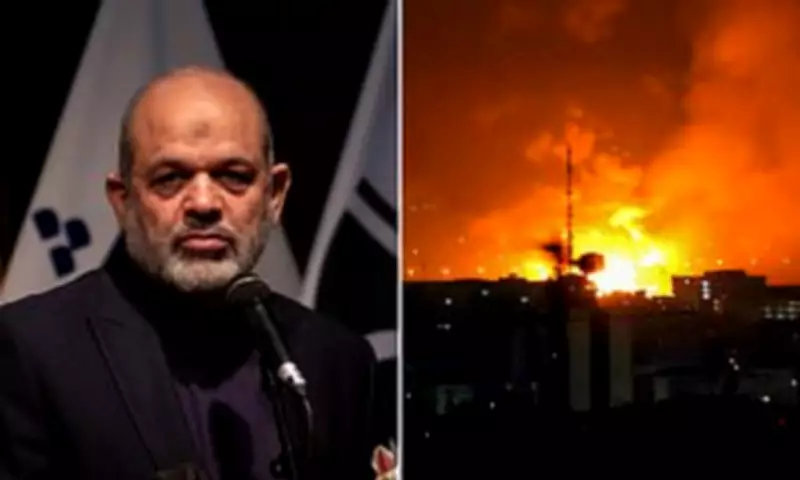
The United States is developing a range of military contingencies that could involve targeting senior Iranian officials, including the commander of the Islamic Revolutionary Guard Corps, should the current ceasefire in the Strait of Hormuz break down. According to sources familiar with internal discussions, American defence officials are drafting plans focused on Iran's military presence in and around the strategic waterway, as reported by CNN.
Strategic Waterway at Risk
The Strait of Hormuz, a vital maritime chokepoint, handles approximately one-fifth of the world's oil and gas exports alongside other critical commodities. Officials are reportedly considering 'dynamic targeting' strategies aimed at Iran's fleet of fast attack boats, minelaying vessels, and other asymmetric maritime assets operating across the strait, as well as in the southern Arabian Gulf and the Gulf of Oman. These capabilities are considered central to Tehran's ability to disrupt global shipping and exert pressure on international energy supplies.
Potential Targets and Key Figures
Military planners are also developing options that could include strikes on infrastructure and energy facilities, as well as targeting top regime figures and 'obstructionists'. One source indicated that IRGC commander Ahmad Vahidi has been mentioned in these discussions. Vahidi serves on Iran's Supreme National Security Council, the high-level body currently managing the country's affairs. This council has effectively assumed control while Supreme Leader Mojtaba Khamenei remains out of the public eye and in hiding due to injuries sustained in US-Israeli airstrikes.

Other council members include parliamentary speaker Mohammad Bagher Qalibaf, who has emerged as a key figure and is acting as chief negotiator with Washington, alongside Saeed Jalili, a hardline representative of the supreme leader, President Masoud Pezeshkian, who formally heads the council, and the council's new secretary, Mohammad Bagher Zolghadr.
Challenges and Risks
Despite the planning, officials have cautioned that renewed strikes in the Strait of Hormuz may not quickly restore safe passage for shipping. A source familiar with the proposals told CNN: 'Unless you can unequivocally prove that 100 per cent of Iran's military capability is destroyed or near certainty that the US can mitigate the risk with our capability, it will come down to how badly is [Trump] willing to accept the risk and start pushing ships through the strait.' There are also concerns within US circles about the risks of widening the conflict, with officials warning that targeting infrastructure would mark a significant and controversial escalation.
Trump's Stance and Ceasefire Dynamics
President Donald Trump has repeatedly argued that Iran's leadership is divided following joint US-Israeli operations that killed several senior figures, including former Supreme Leader Ayatollah Ali Khamenei. Writing on Truth Social on Thursday, he claimed internal divisions are complicating diplomatic efforts, stating: 'Iran is having a very hard time figuring out who their leader is! They just don't know! The infighting between the "Hardliners," who have been losing BADLY on the battlefield, and the "Moderates," who are not very moderate at all (but gaining respect!), is CRAZY!' Speaking on MS Now, Trump added: 'They're all messed up. They have no idea who their leader is. You know, we took out, really, three levels of leaders. And everybody that was even close behind him. So they have a hard time figuring out who the hell can speak for the country. They just don't know.'
While Trump has extended the ceasefire for two weeks, officials stress that the pause is temporary. Sources say it is not intended to be indefinite, and the US military remains ready to resume operations if required. The president has expressed frustration at Iran's refusal to reopen the Strait of Hormuz, which was effectively shut to international shipping after the initial wave of US-Israeli strikes.

Blockade and Economic Pressure
The US on April 13 began enforcing a blockade of Iranian ports and has redirected at least 33 ships as of Thursday. The Pentagon announced that US forces have intercepted at least three ships, including two in the Indian Ocean 2,000 miles from the Persian Gulf. The most recent action saw a 'sanctioned stateless vessel' transporting Iranian oil boarded overnight on Wednesday. Speaking to the media, White House Press Secretary Karoline Leavitt boasted about the success of President Trump's blockade and its effect on Iran's economy, stating: 'We are completely strangling their [Iran's] economy through this blockade. They are losing $500 million a day. Kharg Island is completely full, they can't move oil in or out, they can't even pay their own people as a result of the economic leverage that President Trump has inflicted on them.' She added: 'Not only have they been significantly weakened and obliterated militarily, but they are losing economically and financially every single moment that passes with this blockade.'





