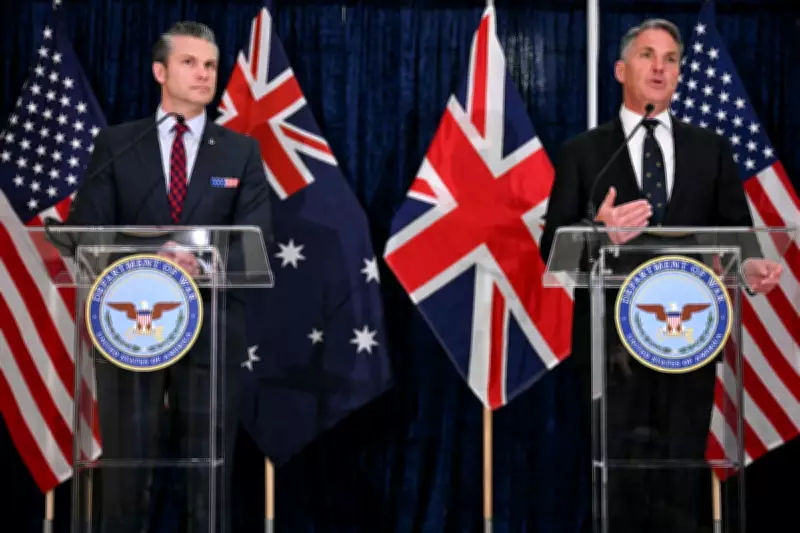
A new report from the United States Congress has raised significant questions about the future of the Aukus submarine agreement, openly contemplating the possibility that the US may not deliver any nuclear submarines to Australia as promised. The report, authored by the Congressional Research Service, suggests that retaining submarines under US command could be strategically preferable in a potential conflict with China over Taiwan.
Strategic Concerns Over Submarine Deployment
The congressional analysis presents an alternative "military division of labour" scenario where Virginia-class submarines, originally earmarked for sale to Australia, would instead remain under US control while operating from Australian bases. This approach, the report argues, would ensure immediate deployment capability in a crisis, as US-commanded vessels could be ordered into action without requiring Australian approval.
"This could weaken rather than strengthen deterrence and warfighting capability in connection with a US-China crisis or conflict," the report states, highlighting concerns that Australian-commanded submarines might not be available for operations during such tensions.

Australian Government's Response
Australian Defence Minister Richard Marles has dismissed the congressional report as mere "commentary," insisting that the Aukus agreement remains "full steam ahead." When questioned about the report's findings, Marles emphasised that the US president has clearly stated America's commitment to the partnership, including the transfer of Virginia-class submarines.
A spokesperson for the Australian Submarine Agency reinforced this position, stating that "Australia's commitment to the Aukus partnership is unwavering" and that all three partner nations are investing significantly in their industrial bases to ensure the agreement's success.
Political Criticism and Industry Challenges
Former Australian Prime Minister Malcolm Turnbull has been particularly vocal in his criticism of the Aukus arrangement, describing it as "always been a bad deal for Australia." Turnbull argues that the agreement is fundamentally lopsided in America's favour, with the US gaining access to Australian facilities without any firm obligation to deliver submarines.
The Greens senator David Shoebridge has echoed these concerns, characterising the deal as a "pantomime" that dangerously compromises Australian sovereignty to US interests. Shoebridge suggests that the congressional report confirms long-standing suspicions that the US would only transfer submarines if Australia guaranteed their use in a potential conflict with China.
US Shipbuilding Capacity Concerns
Central to the debate is America's struggling submarine production capacity. For the past fifteen years, US shipyards have consistently failed to meet their target of building two Virginia-class submarines annually, currently achieving only about 1.1 to 1.2 boats per year. This has created a growing backlog of ordered but unbuilt submarines.
The US fleet currently operates with only 49 submarines against a target of 66, representing just three-quarters of its required capability. To meet both American needs and supply submarines to Australia, production would need to increase dramatically to 2.33 boats per year - a target many experts consider unrealistic given current industrial constraints.
Legislative Hurdles and Certification Requirements
US legislation presents additional barriers to submarine transfers. American law prohibits the sale of any submarine to Australia if the US navy requires it for its own fleet. Furthermore, the sitting US president must personally certify that relinquishing a submarine "will not degrade the United States undersea capabilities" before any transfer can proceed.
Turnbull has highlighted these legislative requirements as evidence of the deal's fundamental flaws, noting that "if the US say 'there are no subs for you Australia', it is not reneging on the deal: that is the deal, that is what Australia signed up to."
The Aukus Timeline and Costs
The Aukus agreement involves a complex, multi-decade timeline with substantial financial commitments:

- Australia plans to purchase between three and five Virginia-class submarines from the US, with the first expected in 2032
- The UK will launch the first specifically designed Aukus submarine for the Royal Navy in the late 2030s
- Australia will build its first Aukus submarine in the early 2040s, with construction continuing through the 2060s
- The total cost to Australia is forecast to reach A$368 billion by the mid-2050s
Each nuclear submarine is expected to have an operational life of approximately thirty years, with Australia responsible for managing nuclear waste storage for thousands of years - including high-level nuclear waste and spent fuel that presents weapons proliferation risks.
Broader Strategic Implications
The congressional report's publication comes amid growing geopolitical tensions in the Indo-Pacific region and increasing scrutiny of defence partnerships. The document highlights fundamental questions about burden-sharing within alliances and the practical realities of technology transfer in an era of strategic competition.
While the Australian government maintains its commitment to the Aukus pathway, the congressional analysis suggests that political and industrial realities in Washington may ultimately determine the agreement's fate, regardless of Canberra's intentions or investments.