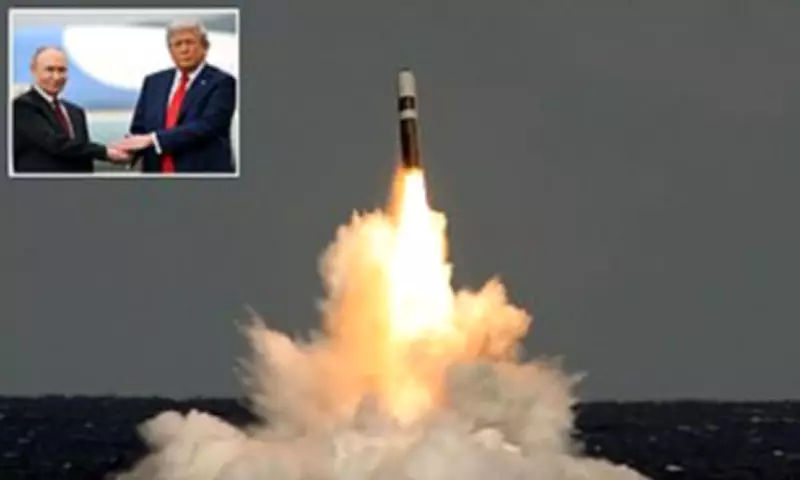
Nuclear Arms Control Era Ends as New START Treaty Expires
The final remaining nuclear weapons agreement between the United States and Russia has officially lapsed, creating what experts describe as a perilous new chapter in global security. At midnight on Thursday, the New Strategic Arms Reduction Treaty (New START), originally signed by both superpowers in 2010, reached its conclusion without any extension agreement in place.
Unrestricted Nuclear Buildup Now Possible
This expiration fundamentally alters the strategic landscape, permitting both nations to expand their nuclear stockpiles without any binding limitations or mandatory verification procedures. The treaty had previously established crucial caps, restricting each side to no more than 1,550 deployed strategic nuclear warheads. Furthermore, it limited long-range delivery systems—including missiles, submarines, and bombers—to 700 active platforms per country.
Mutual inspections and data sharing mechanisms, which provided essential transparency between the two nuclear giants, have also ceased with the treaty's end. Russian politician Alexei Zhuravlev, who serves as First Deputy Chairman of the State Duma Defense Committee, issued a stark warning regarding his nation's capabilities in this new environment. 'Russia currently possesses weapons capable of wiping out any country, or even completely destroying the entire planet,' he declared.

Blame and Diplomatic Stalemate
Moscow has squarely placed responsibility for the treaty's collapse on Washington. Zhuravlev asserted that Russia was prepared to agree to a one-year extension, but claimed the Trump Administration insisted on including China—the nation with the world's third-largest nuclear arsenal—in any new agreement. 'Moscow is playing the role of peacemaker,' Zhuravlev told Russian news outlet news.ru. 'Washington, however, has often linked this issue to the inclusion of Beijing, which is rapidly nipping at everyone's heels, in the agreement.'
China, a close ally of Russia, has reportedly refused to participate in any multilateral nuclear treaty, complicating diplomatic efforts further. This stance occurs against a backdrop of heightened tensions between China, the United States, and American allies across the Asian region.
Historical Context and Current Violations
New START represented the last in a series of strategic arms agreements dating back to the original START treaty in 1991. It succeeded START II, which aimed to ban multiple warheads on intercontinental ballistic missiles but never fully entered force due to political disputes. Researchers from the Federation of American Scientists (FAS) have revealed that both the US and Russia had already exceeded the New START limits prior to its expiration on February 5, 2026. Their report alleges Russia deployed 1,718 warheads and the US 1,670, surpassing the 1,550 ceiling.
The think tank's analysis indicates these two nations collectively control approximately 86 percent of the global nuclear inventory. Worldwide, nine countries are estimated to possess around 12,321 nuclear warheads, with Russia maintaining the largest military stockpile exceeding 4,300 weapons. The United States follows with roughly 3,700 warheads in its current military stockpile.
Experts Sound Alarm on Global Security
Daniel Holz of the Bulletin of Atomic Scientists expressed grave concern, stating the world has never been closer to Doomsday and warning the treaty's end could trigger 'a runaway nuclear arms race' involving multiple nations. Dr Jim Walsh, Senior Research Associate at MIT's Security Studies Program, cautioned that while nuclear restraint might not immediately unravel, the expiration could set in motion a dangerous chain reaction with far-reaching consequences for international stability.
Compounding the uncertainty, both the Biden Administration and Russian government ceased publicly sharing data about their deployed strategic warheads and launchers in 2023, despite this being a treaty requirement. With formal talks on a successor agreement stalled—partly due to both nations' focus on the conflict in Ukraine—the international community now faces an unprecedented period of nuclear ambiguity and potential proliferation.