US Deploys Second Aircraft Carrier to Middle East Amid Escalating Iran Tensions
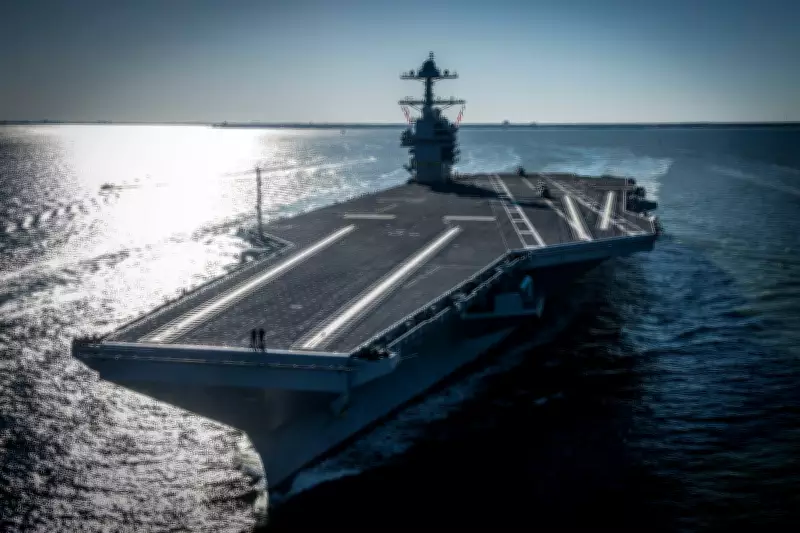
According to a report from the New York Times, the United States is sending the world's largest aircraft carrier, the USS Gerald R. Ford, to the Middle East in a significant escalation of tensions with Iran. The massive warship, accompanied by escort vessels, is scheduled to depart the Caribbean for the region in the coming days, as confirmed by US officials.
Trump's Warning and Diplomatic Stance
Earlier this week, President Donald Trump explicitly warned that he was considering deploying a second aircraft carrier to the Middle East if a nuclear agreement with Iran could not be secured. "We have to make a deal, otherwise it's going to be very traumatic, very traumatic," he told reporters on Thursday, underscoring the high stakes involved.
Following a meeting with Israeli Prime Minister Benjamin Netanyahu at the White House to discuss Iran, President Trump stated, "There was nothing definitive reached other than I insisted that negotiations with Iran continue to see whether or not a Deal can be consummated. If it can, I let the Prime Minister know that will be a preference. If it cannot, we will just have to see what the outcome will be."

Recent Military Movements and Regional Context
This deployment follows the recent dispatch of the USS Abraham Lincoln and several guided-missile destroyers to the Middle East from the South China Sea last month, which occurred after a severe crackdown on protesters in Iran. Although difficult to verify precisely, human rights organisations estimate that at least 6,000 people were killed, with some reports suggesting the numbers could be substantially higher.
In response, Iranian President Masoud Pezeshkian issued an apology this week, saying, "We are ashamed before the people, and we are obligated to assist all those who were harmed in these incidents. We are not seeking confrontation with the people."
Iran's Position and Nuclear Capabilities
Despite these statements, speculation persists that the US is preparing for a potential confrontation with Iran. The US and Israel previously collaborated in a series of coordinated military strikes against Iran's nuclear facilities in June last year, which Iran condemned as an attempt to sabotage talks and destabilise the region.
President Pezeshkian has insisted that Iran is not seeking to expand its nuclear capabilities, attributing stalled negotiations to mistrust. "The high wall of mistrust that the United States and Europe have created through their past statements and actions does not allow these talks to reach a conclusion," he said. "At the same time, we are engaging with full determination in dialogue aimed at peace and stability in the region alongside our neighbouring countries."
However, Ali Shamkhani, an adviser to Iran's supreme leader, emphasised on Wednesday that "The Islamic Republic's missile capabilities are non-negotiable," highlighting a key point of contention.
Historical Deployment and Strategic Implications
The USS Gerald R. Ford, the largest warship ever constructed, was previously engaged in Venezuela as part of the Trump administration's efforts to bolster its military presence in the region and later in operations targeting President Nicolas Maduro. Prime Minister Netanyahu expressed hope that conditions could be established to avert military action, while President Trump outlined that a satisfactory deal with Iran would entail "no nuclear weapons, no missiles."
As diplomatic efforts continue, the deployment of this formidable aircraft carrier signals a robust military posture by the US, raising concerns about further instability in an already volatile Middle East.