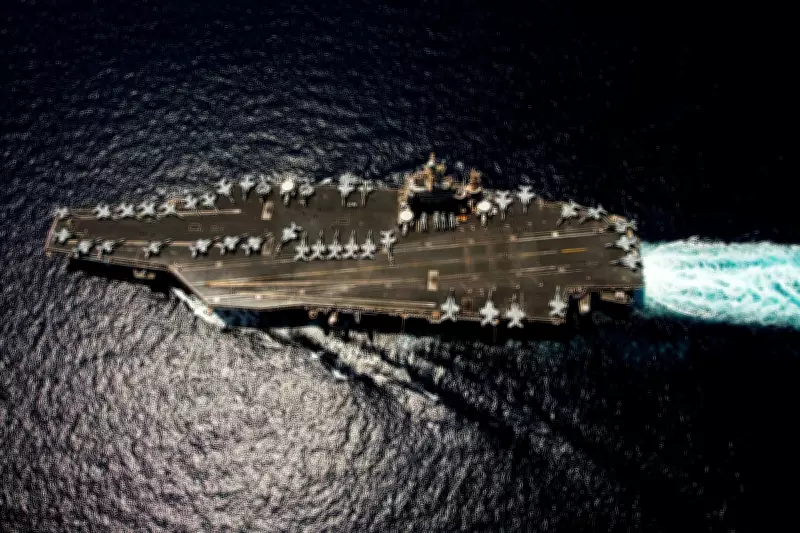
The United States military has confirmed the shooting down of an Iranian drone in the Arabian Sea, marking a significant escalation in regional tensions just days before crucial nuclear negotiations are set to commence. The incident occurred on Tuesday when an Iranian-139 drone aggressively approached the USS Abraham Lincoln aircraft carrier, prompting defensive action from American forces.
Military Confrontation in International Waters
According to US military spokesperson Navy Captain Tim Hawkins, the unmanned Iranian aircraft flew towards the Nimitz-class carrier "with unclear intent" despite de-escalatory measures being taken by American forces operating in international waters. The drone was ultimately intercepted and destroyed by an F-35 fighter jet approximately 500 miles from Iran's southern coastline.
No American personnel were injured during the confrontation, and no US military equipment sustained damage. The USS Abraham Lincoln is part of what Captain Hawkins described as a "large armada" currently deployed in the region, reflecting the heightened military presence as diplomatic efforts continue.

Iran's Response and Additional Incidents
Iran's Tasnim news agency reported that connection had been lost with a drone in international waters, though they stated the reason remained unknown. On the same day, separate incidents further complicated the already tense situation.
The US Central Command reported that Islamic Revolutionary Guard Corps forces harassed a US-flagged tanker in the strategically vital Strait of Hormuz. "Two IRGC boats and an Iranian Mohajer drone approached M/V Stena Imperative at high speeds and threatened to board and seize the tanker," Captain Hawkins stated.
The destroyer USS McFaul responded to this incident, escorting the commercial vessel with defensive air support from the US Air Force. These simultaneous events highlight the increasing volatility in key maritime corridors as diplomatic preparations continue.
White House Confirmation and Diplomatic Context
White House press secretary Karoline Leavitt confirmed the drone incident, stating she had been informed by the Pentagon that CENTCOM had "acted both appropriately and necessarily to protect our US personnel and equipment in the region."
Leavitt emphasized that President Donald Trump "remains committed to always pursuing diplomacy first" but noted that successful negotiations require willing partners on both sides. She confirmed that Special Envoy Steve Witkoff is scheduled to have discussions with Iranian representatives later this week, though she cautioned that "the president always has a range of options on the table, and that includes the use of military force."
Nuclear Talks and Regional Dynamics
The confrontation comes amid preparations for nuclear talks between the United States and Iran scheduled for Friday in Oman. According to reports, the Trump administration agreed to Tehran's request to shift the venue from Turkey, though discussions continue about whether regional Arab and Muslim countries will participate in the negotiations.
President Trump told reporters on Tuesday that "We are negotiating with them right now" but had previously warned that with US warships heading toward Iran, "bad things" would probably happen if a deal could not be reached.
The timing of these military incidents is particularly sensitive given the domestic context in Iran, where unrest has erupted over an economic crisis. Reports indicate that over 6,000 protesters have been killed in a brutal crackdown by Ayatollah Ali Khamenei's regime, adding another layer of complexity to the already delicate diplomatic landscape.
As both nations prepare for what could be pivotal negotiations, the downing of the Iranian drone serves as a stark reminder of the military capabilities deployed in the region and the fine line between diplomatic engagement and armed confrontation.