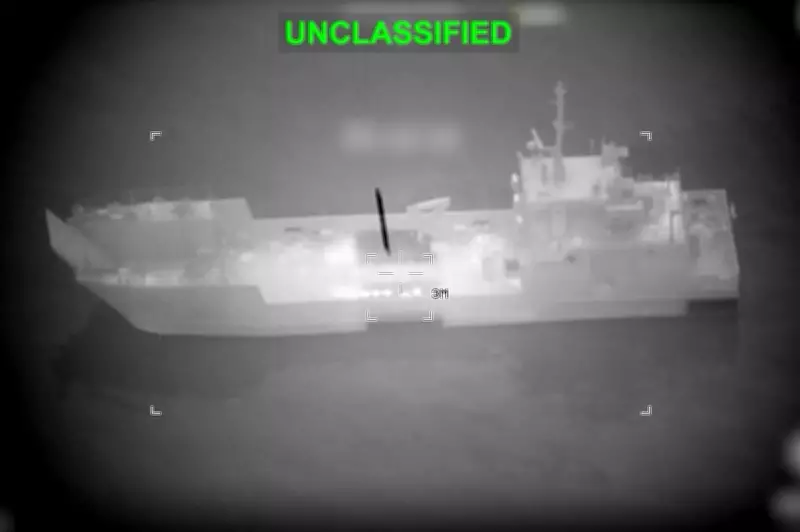
In a significant escalation of military tensions, United States forces have eliminated 16 Iranian mine-laying ships near the strategically vital Strait of Hormuz. The Pentagon confirmed the strikes, which came directly after President Donald Trump issued stark warnings to Iran regarding reported mining activities in the waterway that transports approximately one-fifth of the world's oil supply.
Trump's Threats Precede Military Action
President Trump took to his Truth Social platform on Tuesday to deliver an ultimatum to the Iranian regime. "If for any reason mines were placed, and they are not removed forthwith, the Military consequences to Iran will be at a level never seen before," he declared. Mere minutes later, he announced the initial destruction of 10 vessels, promising more to follow.
The president's social media post stated: "I am pleased to report that within the last few hours, we have hit, and completely destroyed, 10 inactive mine laying boats and/or ships, with more to follow!" U.S. Central Command subsequently updated the total to 16 destroyed vessels via an official statement on X.

Intelligence Reports of Iranian Mining
The military action followed intelligence reports suggesting Iran was preparing to deploy mines in the critical shipping lane. CBS News cited U.S. officials who indicated Iran might be getting ready to lay mines, while CNN reported, based on sources familiar with U.S. intelligence, that Iran had already placed several dozen mines in the waterway in recent days.
Trump emphasized that the U.S. was utilizing "the same Technology and Missile capabilities deployed against Drug Traffickers to permanently eliminate any boat or ship attempting to mine the Hormuz Strait." This reference points to controversial boat strikes previously conducted by U.S. forces in the Caribbean and Pacific regions.
Strategic Importance of the Strait
The Strait of Hormuz, bordered to the north by Iran, serves as a crucial maritime chokepoint for global energy markets. Tankers transporting oil and gas from major producers including Iran, Saudi Arabia, Kuwait, Iraq, Qatar, Bahrain, and the United Arab Emirates must navigate this narrow passage. The majority of this oil is destined for Asian markets.
The recent tensions have already impacted oil prices, which surged to nearly $120 per barrel on Monday—the highest level since 2022—before retreating below $90 after Trump suggested the conflict with Iran was largely concluded.
Iranian Threats and Regional Tensions
Iran has previously threatened to attack any vessel attempting to transit the Strait of Hormuz. Ebrahim Jabari, a senior official with Iran's Islamic Revolutionary Guard Corps, stated last week: "The strait is closed. If anyone tries to pass, the heroes of the Revolutionary Guards and the regular navy will set those ships ablaze."
Defense Secretary Pete Hegseth reinforced the U.S. position, declaring on X: "At the direction of President Trump, @CENTCOM has been eliminating inactive mine-laying vessels in the Strait of Hormuz—wiping them out with ruthless precision. To the weakened Iranian regime: you have officially been put on notice!" He added that the United States "will not allow terrorists to hold the Strait of Hormuz hostage."
Broader Conflict Context
The military strikes occur within the broader context of what the U.S. has designated Operation Epic Fury. According to the Associated Press, the conflict has resulted in at least 1,230 fatalities in Iran, including the late Ayatollah Ali Khamenei, whose son, Ayatollah Mojtaba Khamenei, has assumed the role of Iran's supreme leader. At least seven American service members have also lost their lives.
Iranian Foreign Minister Abbas Araghchi has vehemently denied U.S. justifications for the conflict, posting on X: "The claim that Iran was planning on attacking the U.S. or U.S. Forces, whether preventively or preemptively, is a sheer and utter lie. The sole purpose of that lie is to justify Operation Epic Mistake, a misadventure engineered by Israel and paid for by ordinary Americans."

President Trump has countered allegations that Israel pressured the U.S. into military action, quipping to reporters: "I might of forced their hand." He further downplayed Iran's military capabilities, stating: "Iran has 'no navy, no communications, they've got no air force. Their missiles are down to a scatter. Their drones are being blown up all over the place, including their manufacturing of drones.'"
Uncertainty and Public Perception
Despite Trump's assertions about the conflict's progress, uncertainty persists regarding the duration of U.S. military engagement. A recent Quinnipiac University poll reveals divided American opinions: 18% of voters believe the war will conclude within weeks, 32% anticipate months of conflict, and 26% expect it to last longer than a year.
The ongoing hostilities have introduced significant volatility into global oil markets and raised concerns about the stability of one of the world's most critical maritime trade routes. The destruction of 16 mine-laying vessels represents a direct response to perceived threats against this vital economic artery, underscoring the high stakes involved in the strategic waters of the Strait of Hormuz.