US Spy Drones Intensify Surveillance Over Persian Gulf as Iran Strike Speculation Mounts
Amid escalating tensions and widespread speculation that a major US military strike against Iran could be imminent, America's most advanced and trusted spy drones have initiated a significant intelligence-gathering operation high above the Persian Gulf. This development follows the collapse of negotiations with Tehran over President Trump's nuclear red line, heightening fears of an impending conflict.
Drone Deployment and Flight Patterns
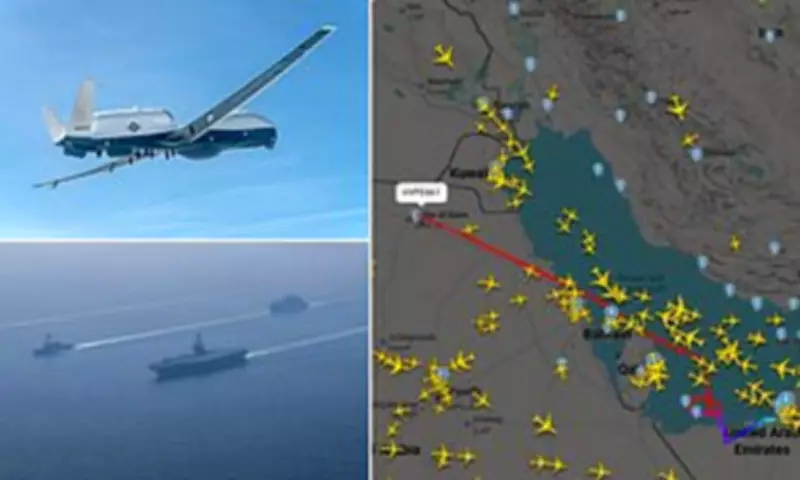
On Wednesday, a remote-controlled MQ-4 Triton drone launched from Al Dhafra Air Base in the United Arab Emirates, spending several minutes conducting surveillance over the Persian Gulf before altering its course towards Saudi Arabia and Iraq. Both nations are close neighbors of Iran, positioned on the opposite side of the Gulf, where two US Navy carrier strike groups are expected to be stationed shortly. This strategic positioning underscores the military buildup in the region.
The MQ-4 Triton is an unmanned aerial vehicle specifically designed for the US Navy, serving as a high-altitude, long-range aircraft optimized for surveillance missions, particularly over maritime environments. Capable of operating at altitudes exceeding 50,000 feet for more than 24 hours, it boasts an impressive range of approximately 8,500 miles. Equipped with advanced 360-degree radar systems, these drones are instrumental in detecting, tracking, and classifying targets across vast areas, providing critical intelligence in advance of potential military operations.

Recent Reconnaissance Activities
Wednesday's flight represents the latest in a series of reconnaissance missions conducted by MQ-4 drones over the Middle East. According to the flight-tracking website Flight Aware 24, another Triton was observed on February 14, with its patrol route taking it to the southeast of Iran's coastline. In contrast, the most recent drone was directed towards the west of Iran, indicating a comprehensive surveillance effort encircling the nation.
The deployment of these drones coincides with the breakdown of diplomatic talks between the US and Iran, which has prompted the US military to reinforce its presence in the region with two carrier strike groups. This move signals a potential shift towards military action, as intelligence gathering intensifies.
Strategic Implications and Ongoing Developments
The use of Triton drones highlights the US military's reliance on cutting-edge technology for real-time intelligence in volatile regions. As tensions simmer, the continuous surveillance over the Persian Gulf serves as a precursor to possible escalation, with experts closely monitoring flight patterns and military movements. This is a breaking story, and further details are anticipated as the situation evolves.