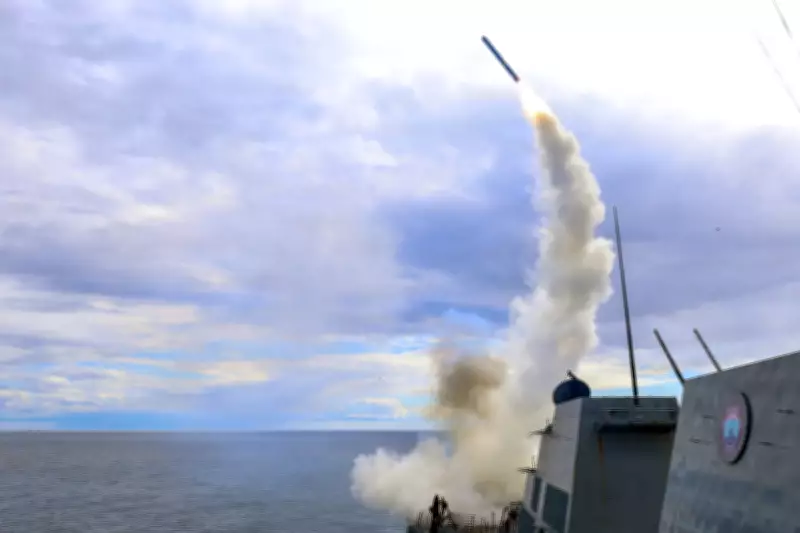
US Military Faces Tomahawk Missile Shortage After Intensive Iran Campaign
The United States military has reportedly fired approximately 850 Tomahawk missiles into Iran during the ongoing conflict, sparking significant internal concerns about dwindling supplies within the Pentagon. According to a report from The Washington Post, the rapid rate of deployment in President Donald Trump's war, now entering its fourth week, has prompted urgent discussions about increasing production and replenishing stockpiles.
'Alarmingly Low' Stockpiles Raise Strategic Concerns
Multiple U.S. officials have described the number of Tomahawk missiles remaining in the Middle East as 'alarmingly low', with one using the military slang term 'Winchester' to indicate supplies are nearly exhausted. These precision-guided weapons, capable of being launched from submarines and Navy warships, have been extensively utilized since the conflict began on February 28, with many deployed in the initial days of hostilities.
Each Tomahawk missile carries an estimated price tag exceeding $2 million, making their depletion not only a tactical issue but a substantial financial consideration. Preliminary findings from an investigation suggest that a Tomahawk missile was likely responsible for a strike on an elementary school in Minab, southern Iran, during the first weekend of the conflict, resulting in 175 casualties including children.

Classified Inventory and Replenishment Challenges
While exact inventory numbers for Tomahawk missiles remain classified, analysts cited by The Washington Post estimate that the 850 launches represent approximately a quarter of the U.S. military's total stockpile. The Center for Strategic and International Studies estimates the Navy may have had around 3,000 Tomahawk missiles available at the war's onset last month.
Mark Cancian, a senior adviser at the think tank, warned that if over 800 Tomahawks have been used in Iran, it 'would leave a large gap for a conflict in the Western Pacific' and could take several years to replenish given production constraints. This potential shortfall raises questions about the military's readiness for simultaneous engagements in multiple theaters.
Official Responses and Production Acceleration
Pentagon spokesperson Sean Parnell issued a statement asserting that the U.S. military 'has everything it needs to execute any mission at the time and place of the President's choosing' and criticized media coverage for attempting to portray 'the world's strongest military as weak.' He accused the media of trying to 'frighten and sow doubt in the minds of the American people' through scrutiny of weapon supplies.
Defense Secretary Pete Hegseth previously stated the military has 'no shortage of munitions' and supplies would sustain the campaign as long as necessary. White House press secretary Karoline Leavitt echoed this sentiment, claiming there are 'more than enough munitions, ammo and weapons stockpiles to achieve the goals of Operation Epic Fury.'
In response to the supply concerns, President Trump announced on March 6 that his administration held a 'very good meeting' with defense manufacturing companies, including Raytheon, the contractor responsible for Tomahawk missile production. The president stated these companies agreed to 'quadruple production of exquisite class weaponry as rapidly as possible' to address potential shortages.
The situation highlights the complex logistics of modern warfare, where even well-stocked militaries must balance immediate operational needs against long-term strategic preparedness. As the conflict in Iran continues, monitoring ammunition and missile supplies will remain a critical aspect of military planning and public discourse.