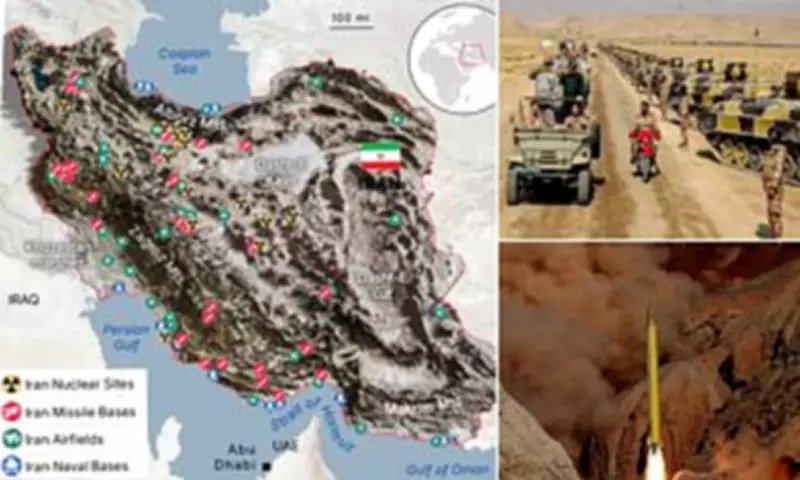
US Military Deployment to Middle East Raises Invasion Concerns Over Iran
The United States has deployed 5,000 Marines to the Middle East, marking the first major troop movement since the current regional conflict began. This deployment has sparked intense speculation about potential military action against Iran, with analysts drawing comparisons to historical invasions.
Historical Precedents and Current Tensions
Iran has not been conquered since 1941, when British and Soviet forces combined their military might during the Second World War to overcome the under-developed forces of Reza Shah. Now, with President Donald Trump declaring the war will end "when I feel it," and Defense Secretary Pete Hegseth stating the US is "willing to go as far as we need to," concerns are mounting about potential American ambitions in the region.
This military deployment comes despite White House press secretary Karoline Leavitt stating just last week that ground operations were "not part of the plan right now." The troops are being dispatched from Japan, indicating a significant escalation in military posture.

Iran's Formidable Natural Defenses
Iran presents one of the most challenging invasion prospects in modern warfare due to its extraordinary geography. The country spans over 630,000 square miles, making it larger than France, Germany, the Netherlands, Belgium, Spain and Portugal combined. With a population exceeding 93 million, it dwarfs neighboring nations, being four times larger than Iraq and nearly three times larger than Afghanistan.
The nation's elevation presents immediate challenges. Tehran sits at 3,900 feet, compared to London's peak of just 139 feet. Military personnel operating above 4,000 feet risk acute mountain sickness and decreased performance, requiring significant acclimatization that would be difficult during a rapid invasion.
Mountainous Fortresses and Hidden Assets
Iran is dominated by three major mountain ranges that create natural fortifications throughout the country:
- The Zagros Range: Stretching 990 miles from northwest Iran to the Strait of Hormuz, with Mount Dena reaching 14,465 feet
- The Alborz Range: Protecting Tehran's northern side, home to Mount Damavand at 18,405 feet
- The Makran Range: Extending across Iran's Gulf of Oman coastline
These mountains conceal countless military and nuclear facilities, creating what analyst Çağatay Balcı describes in The Daily Sabah as a scenario where "a comprehensive ground intervention could prove even more strategically costly than Vietnam, Afghanistan and Iraq combined."
Strategic Challenges and Military Considerations
According to NATO's Mountain Warfare Centre of Excellence, mountainous terrain presents extreme challenges including difficult access, rugged landscapes, severe weather conditions and high altitude. Military vehicles face steep inclines and narrow paths, while soldiers risk lethal falls. NATO recommends splitting armies into smaller units for flexibility, but this increases vulnerability to Iran's Islamic Revolutionary Guard Corps, whose fighters are trained in guerrilla warfare and know the terrain intimately.
Kris Osborn, military affairs editor of 19FortyFive, warns that even if conventional forces were defeated, irregular Iranian forces "could continue fighting for years."
Coastal and Wetland Barriers
Iran's control of the Strait of Hormuz creates additional complications. This critical waterway, through which 20% of the world's oil normally passes, is now largely blocked due to the conflict. Iran has threatened to prevent "one litre of oil" from being shipped if from the US or Israel.
The only non-elevated border region, Khuzestan province, presents different challenges with its 400,000 hectares of wetlands. These marshes are notoriously difficult for heavy vehicles and create predictable routes that would make invading troops vulnerable to Iranian forces familiar with the terrain.
Desert Warfare Complications
Iran's central and eastern regions feature two major salt flats covering 50,000 square miles. Desert warfare brings its own challenges:

- Poor infrastructure complicating troop and supply movement
- Extreme temperatures reaching 50°C (122°F)
- Rapid temperature drops at night
- Corrosive salt dust damaging equipment and electronics
- Severe water scarcity
Limited Operations as Alternative Strategy
Given these formidable challenges, experts suggest limited operations might represent a more feasible approach. Thomas Bonnie James of Qatar's AFG College with The University of Aberdeen told Al Jazeera that specialized operations targeting specific nuclear facilities would present smaller risks than full-scale invasion.
Such operations would likely focus on critical nuclear sites including the Natanz Nuclear Facility, Fordow Fuel Enrichment Plant and Isfahan Nuclear Technology Center. James describes this approach as involving "penetrating hardened facilities, collecting intelligence, and locating or securing sensitive nuclear materials with the overall emphasis on speed, precision and limited exposure."
However, Neil Quilliam of Chatham House warns that even limited operations would be "high-risk, complex and lengthy operations taking place in very hostile environments and against facilities heavily protected by the country's security forces."
The deployment of US Marines represents a significant escalation in the Middle East conflict, but Iran's combination of size, population, elevation, mountainous terrain, coastal control and desert landscapes creates what may be one of the most challenging invasion scenarios in modern military history.