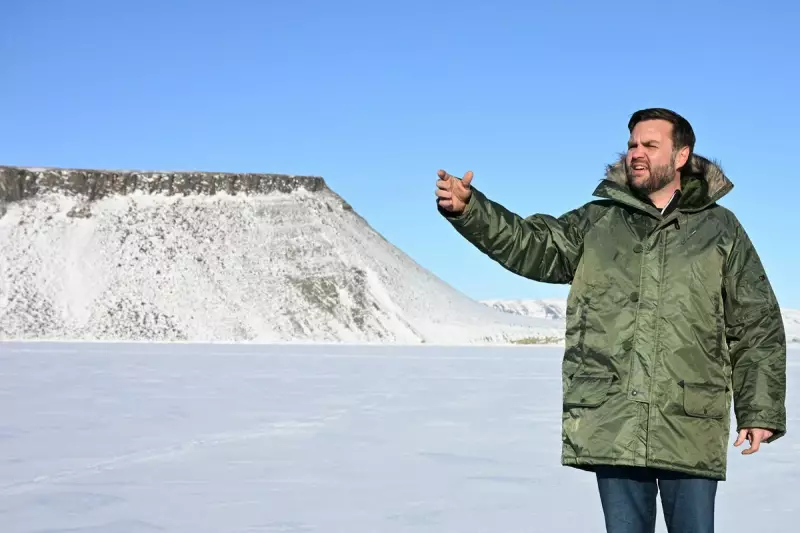
The White House is set to host a pivotal summit on the future of Greenland, as the Trump administration's persistent interest in acquiring the vast Arctic territory moves to the forefront of international diplomacy. Vice President JD Vance and Secretary of State Marco Rubio will meet with foreign ministers from Denmark and Greenland's government, against a backdrop of stark warnings from President Donald Trump about taking the island "the easy way or the hard way."
Geopolitical Stakes in a Warming Arctic
Greenland's immense strategic value stems primarily from its location. More than two-thirds of the self-governing Danish territory lies within the Arctic Circle, positioning it as a sentinel for the North Atlantic approaches to North America. This role was cemented during World War II when the United States occupied it to prevent a Nazi takeover.
Today, climate change is thinning the Arctic ice, potentially opening new shipping routes like the Northwest Passage and intensifying a scramble for resources. The Trump administration has criticised Denmark for inadequate regional security, a concern shared by European allies who fear the US may resort to force. This comes as Russia strengthens its polar military capabilities and China, declaring itself a "near-Arctic state," promotes a "Polar Silk Road."

Mineral Wealth and Military Might
Beneath Greenland's ice lie vast deposits of rare earth minerals, critical components for smartphones, computers, electric vehicle batteries, and defence technologies. The US and its Western allies are keen to break China's dominance over these supply chains, making Greenland's resources a matter of economic and national security.
However, exploiting these reserves is fraught with difficulty due to the harsh climate and Greenland's strict environmental controls, which have deterred some investors. Militarily, the US already maintains a key presence at the Pituffik Space Base in northwestern Greenland, established under a 1951 treaty. This base supports missile warning and space surveillance for the US and NATO, monitoring the crucial GIUK Gap for Russian naval movements.
Denmark's Response and Sovereign Resolve
In response to growing tensions, Denmark is bolstering its Arctic defences. A 14.6 billion-kroner ($2.3 billion) agreement was announced last year with Greenland and the Faroe Islands to enhance surveillance and sovereignty. This investment will fund new Arctic naval vessels, long-range drones, and satellite capacity.
Denmark's Joint Arctic Command, headquartered in Greenland's capital Nuuk, oversees sovereignty operations, supported by the elite Sirius Dog Sled Patrol. Despite this, Greenland's Prime Minister has firmly rejected the prospect of US ownership or governance, asserting that the island's people will determine their own future. As the high-stakes summit begins, the clash between great-power ambition and local sovereignty is set to define a new chapter in Arctic geopolitics.