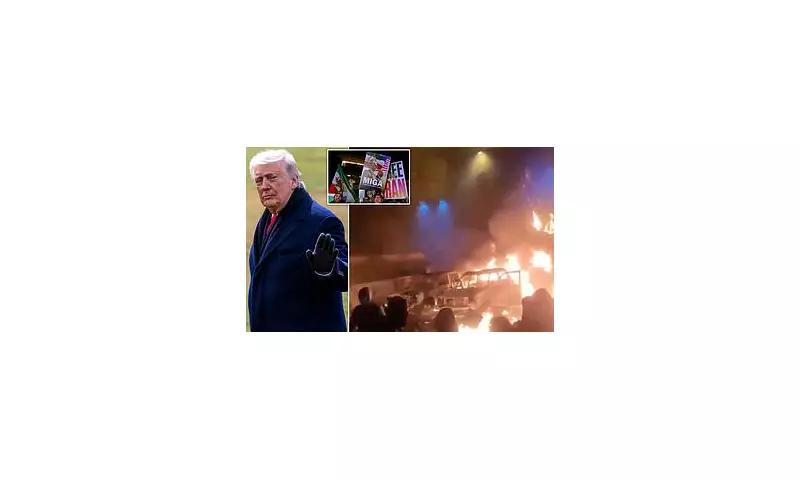
Faced with the spectre of another drawn-out and unpredictable conflict in the volatile Middle East, Donald Trump moved from being 'locked and loaded' for military strikes on Iran to placing the plans firmly on hold. This dramatic shift followed intense internal deliberations and stark warnings from regional allies.
From 'Locked and Loaded' to a Calculated Pause
A brief closure of Iranian airspace on Wednesday had sparked widespread anticipation that the United States was poised to strike a second nation gripped by unrest this month. This came as protests, initially over economic woes, raged in Tehran for weeks, morphing into a direct challenge to the country's theocratic rule.
While White House press secretary Karoline Leavitt stated on Thursday that 'all options remain on the table' for the President, the decision not to proceed left many questioning his reasoning. Trump told reporters on Friday that 'I convinced myself' after learning that planned executions of detained protesters had been halted. However, reports from The Wall Street Journal reveal a far more complex advisory process behind the scenes.

As Trump leaned toward authorising an attack on Tehran earlier in the week, officials reportedly cautioned that strikes alone were unlikely to successfully topple the Iranian regime. There were also significant doubts within the administration about whether targeting Iran's military sites would materially aid the protest movement, coupled with concerns over having the necessary arsenal for a sustained campaign.
Regional Allies Urge Caution Amidst Internal Crackdown
Critical advice also flowed from America's partners in the region. Officials from Israel and several Arab nations consulted with the Trump administration, arguing that the situation in Tehran was too intense for military intervention. They noted that the regime had already largely suppressed the protests through a harsh crackdown.
A major point of contention was the lack of a clear successor government if the US succeeded in removing Supreme Leader Ali Khamenei's regime. This persisted despite claims from Iran's exiled Crown Prince, Reza Pahlavi, that he could assume power. Allies feared creating a dangerous power vacuum.
Further presentations to the President highlighted the risk of retaliatory backlash against US military bases hosted by regional allies like Qatar, the United Arab Emirates, and Saudi Arabia. Concurrently, a group of Iranian leaders, including national security adviser Ali Larijani, reportedly worked through counterparts in Iraq and Turkey to persuade Trump against the plan. Israeli Prime Minister Benjamin Netanyahu also advised that an attack might be too late to assist the uprising.
A Fragile Calm and Unresolved Threats
By Friday, an uneasy calm had returned to Tehran's streets after a wave of protests met with a bloody response. However, a senior hard-line cleric called for the death penalty for detained demonstrators and directly threatened President Trump, underscoring the enduring rage within the Islamic Republic's authorities.
The scale of the repression has been significant. The U.S.-based Human Rights Activists News Agency reported a death toll of at least 3,090—a figure that surpasses any other round of protest in Iran for decades and continues to rise. Executions and the killing of peaceful protesters were two red lines Trump had set for potential action.
Despite the pause, Trump reiterated his right to act in the future. 'Nobody convinced me. I convinced myself,' he stated, crediting the halt in executions. The US had moved military assets toward Iran, keeping options open. In a conciliatory gesture, Trump even thanked Iran's leaders for not carrying out the planned executions, signalling a potential de-escalation.
The unrest, sparked by dire economic conditions, represented the most serious internal challenge to Iran's rulers in years, coinciding with heightened international pressure. While Crown Prince Pahlavi urged Trump to make good on pledges of support and called for renewed protests, he has struggled to gain wide appeal within Iran. European powers, including Britain, France, Germany, and Italy, summoned Iranian ambassadors to protest the violent crackdown, maintaining diplomatic pressure on the regime.