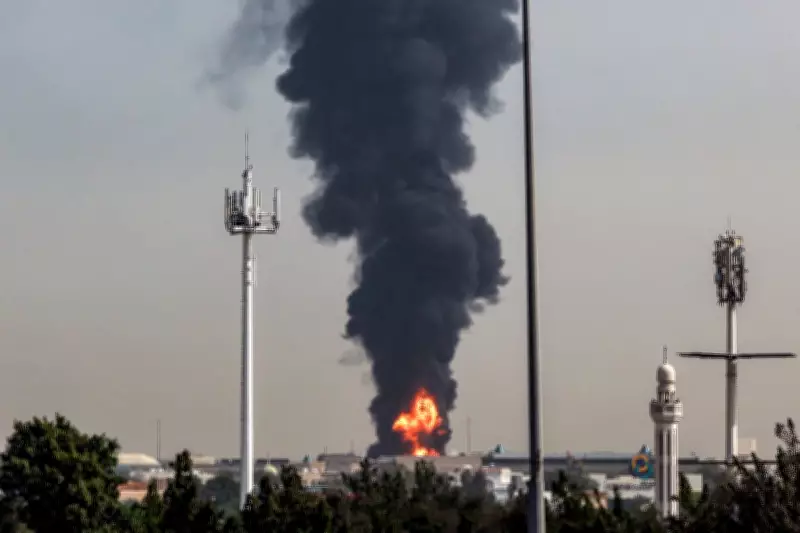
The Ominous Rise of Drone Warfare
Far-flung frontlines across the globe are being ominously knitted together by a form of warfare the world has never witnessed before. What was once merely an irritant—comparable to the buzzing of an insect—has rapidly transformed into a matter of life and death. Today, people worldwide find themselves living beneath the persistent whine of man-made drones, a shift accelerated dramatically since Russia's invasion of Ukraine in 2022.
A New Era of Connected Battlefields
Linked by state-of-the-art and bootleg drone kits, often piloted from hundreds of miles away, these unmanned systems have fundamentally altered modern combat. Ukrainian President Volodymyr Zelensky has dispatched teams of experts to share Ukraine's cutting-edge drone technology with nations like Qatar, the United Arab Emirates, and Saudi Arabia. This outreach occurs even as drone strikes forced the closure of Dubai's airport, highlighting the immediate and widespread impact of this technology.
The United Kingdom is reportedly considering deploying mine-hunting drones to help secure the Strait of Hormuz, underscoring the strategic value now placed on these systems. A key component in Ukraine's successful resistance has been its robust development of domestic drone manufacturing. This capability has frustrated Russian ground advances by subjecting Kremlin troops to relentless, pinpoint attacks that can target individual tanks or even soldiers.

The Democratisation of Air Power
Now, leaders like Donald Trump and Benjamin Netanyahu confront the same stark reality. While the United States and Israel have utilised advanced ballistic and cruise missiles with remarkable accuracy against Iranian targets, Iran's Revolutionary Guards have retaliated effectively using swarms of drones. These low-cost systems overwhelm expensive anti-missile defences by targeting the billion-dollar radar systems that guide counter-measures, making the kamikaze drone a poor man's ballistic missile.
Drones are effectively democratising warfare. Smaller states and non-state actors, including insurgents and criminal groups, can now easily acquire drone technology. They assemble these systems from universally available raw materials and components, elevating cheap drone technologies over traditional, costly military assets like aircraft carriers.
Historical Parallels and Modern Perils
By equalising access to air power, drones are making lethal strikes from the sky available globally. A century ago, imperial powers like Italy possessed aircraft while their colonial subjects did not. Benito Mussolini, a pilot himself, viewed planes as invulnerable instruments of coercion. His son Bruno notoriously described the "fun" of watching humans burst "like petals" during bombings in Ethiopia in 1936.
Philosopher Bertrand Russell warned that air power fostered the dehumanisation of civilians, reducing them to mere dots. He viewed air war as inherently anti-democratic. Yet, today's drone technology perversely equalises the prerogatives of great powers. While ballistic missiles target static infrastructure, drones offer a cheap, reactive means for less affluent actors to strike back at high-tech enemies.
The Unseen Threat and Cultural Ironies
These systems are not merely inexpensive; they offer capabilities that far more costly weapons lack. Vast areas are now at risk of coordinated strikes, operated with the detachment of a teenager playing a computer game. For those living near military bases like RAF Brize Norton or the US Air Force's Fairford base, the roar of traditional aircraft may go unnoticed. However, the constant whirr of drones—as experienced by people from Gaza to Iran—promises a far more restless existence.
A world of drone wars is unequivocally more dangerous than previous conflicts. During NATO's 1999 bombing of Belgrade, civilians adapted to "smart" bombs, knowing they were not targets of carpet bombing. Life continued largely uninterrupted unless near key infrastructure. Drones obliterate that sense of security, making nowhere truly safe.

A Dystopian Tribute to Technophobia
Ironically, much of this emerging dystopia pays perverse tribute to English literature's great technophobe, J.R.R. Tolkien, who abhorred the subordination of man to machine. Modern militarised AI elites mask their agendas under names borrowed from his works. Palantir transforms Tolkien's all-seeing crystals into a global surveillance technology, while the mythical sword Anduril becomes an AI-powered state weapon. Ukrainians even label Russians as "Orcs," inverting Tolkien's values.
This reflects a neo-Nietzschean ethos among tech elites, particularly on the US West Coast. Their enthusiasm for AI's potential to bolster US power should not obscure a global reality: people worldwide, many unfamiliar with Tolkien, understand that cheap drone technology—coupled with equally affordable AI for targeting—has ushered in a dark new era. World War Drone is dawning upon us, reshaping conflict in ways more perilous and pervasive than ever before.