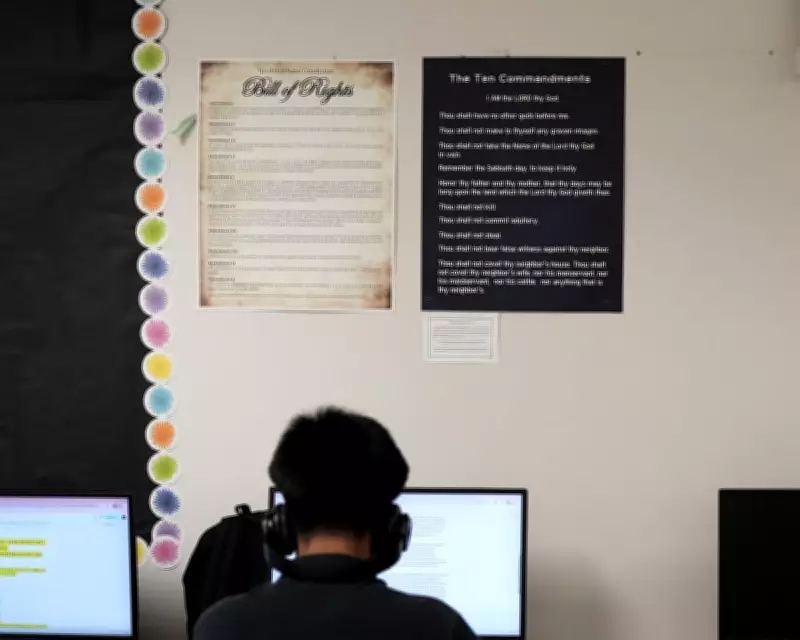
In a classroom in Kyle, Texas, students work under posters of the Ten Commandments and the Bill of Rights, a scene captured on 16 October 2025. This visual underscores the ongoing integration of religious elements into public education in the state. Now, a Bible-infused curriculum that Texas approved for public schools over pushback in 2024 is set to undergo corrections to fix hundreds of errors identified by teachers and education officials after its introduction to classrooms.
Curriculum Errors Spark Debate
The curriculum, known as the "Bluebonnet" textbook, is part of Republican-led efforts in the US to incorporate more religious teaching into classrooms. Designed by the state's public education agency, it is optional for schools to adopt, though they receive additional funding if they do so. Bluebonnet was approved despite concerns from religious scholars that the reading lessons favored Christianity over other faith traditions and pushback from advocacy groups that the materials inappropriately prioritized preaching over teaching.
Board Approves Corrections Amid Concerns
The state board of education voted 8-6 on Wednesday to approve changes to the curriculum. These changes include correcting factual errors, fixing punctuation, and replacing images due to licensing or copyright issues. Some board members questioned the high number of errors, with Democrat Tiffany Clark expressing concern that students have been failed this school year by using the flawed material.

Republican board chair Aaron Kinsey challenged Clark, asking if correcting issues like copyright problems implied that students would not pass the state's annual standardized test. Clark retorted that even simple typos, especially in math equations, can have significant consequences. "If we have been teaching incorrectly, this is going to have an impact," she said.
Republican board member Pam Little added, "I understand that some of these errors are minimal, some of them are for clarity and some of them are for accuracy. But still, an error is an error."
Discrepancy in Error Counts
Colin Dempsey, a Texas education agency official, acknowledged the "high number of updates" needed but insisted factual errors were "minimal," though he did not provide an exact figure. Board members stated that more than 4,000 corrections were required. However, Jake Kobersky, spokesperson for the Texas education agency, told the Associated Press that approximately 1,900 changes were made, including duplicate corrections in the teacher guide, student workbook, and other documents.
Kobersky emphasized that most changes were "proactive in response to teacher feedback or grammatical fixes, not a result of factual errors."
Adoption and Implementation Challenges
It remains unclear how many districts adopted the curriculum for the current school year, the first it became available. As of August, more than 300 school districts and charter schools indicated they would use it, representing about a quarter of Texas's 1,207 districts and charters.
After Wednesday's approval of changes, the education agency said online curriculum materials would be updated within 30 days. However, it did not specify how long it would take to print and replace physical learning materials or the associated costs.
Future Improvements and Precedent
Little, who voted for the proposed changes, expressed worry that the board has "set a precedent for sloppy publishing." In response, Dempsey noted that the agency has increased the number of reviewers from five to eight to assess the material going forward. "I'm hopeful that will improve our process, where these are caught in the summer and not later on," he said.
This situation highlights the ongoing tensions between religious integration and educational standards in Texas, as the state moves forward with corrections to ensure accuracy and compliance in its curriculum.